Best Bread Maker 2026: 10 Ranked on the Loaf Size They Hide
By Felipe Iglesias · Updated
A bread machine has one specification that decides whether you bought the right one: how big a loaf it makes. Four of the ten machines in this comparison do not publish that number anywhere on their listing — and they are the four most expensive, the three Panasonics and the £249 Sage. Of the six that do, no two use the same unit. Tower puts 2lb in the title and no grams anywhere; Morphy Richards offers three loaf sizes and never says what any of them weigh; Russell Hobbs claims 750g and 1kg in a bullet while its own specification table says the capacity is 0.9 kilograms. Only Lakeland does the conversion for you, listing 1lb in the title and 454g in the capacity field, which is exactly right. Meanwhile 2lb is 907 grams, not a kilo, so two machines sold as the same tier are 10% apart. Below we rank the best bread maker options on Amazon in August 2026 on loaf size, machine weight and published wattage — the three numbers this category treats as optional.
At a glance
| # | Product | Price | Rating | Link |
|---|---|---|---|---|
| 1 | Morphy Richards Fastbake Breadmaker, 12 Programmes, 3 Loaf Sizes | £79.00 | 4.4 | View |
| 2 | Panasonic SD-YR2550 Bread Maker, Yeast and Nut Dispenser, 31 Programmes | £199.00 | 4.5 | View |
| 3 | Tower T11003 2lb Digital Bread Maker, 12 Programs, 550W | £69.69 | 4.3 | View |
| 4 | KitchenArm 29-in-1 Smart Bread Maker, 500g 700g 900g, Stainless Steel | £97.34 | 4.6 | View |
| 5 | Panasonic SD-B2510 Bread Maker, 21 Programmes, Dual Temperature Sensors | £119.00 | 4.5 | View |
| 6 | Russell Hobbs Electric Bread Maker 27260, 12 Programs, 450W | £69.99 | 4.3 | View |
| 7 | Tefal Pain and Delices Bread Maker, 20 Programs, 15-Hour Delay | £89.00 | 4.2 | View |
| 8 | Panasonic SD-R2530 Bread Maker, Nut Dispenser, 30 Programmes | £159.00 | 4.5 | View |
| 9 | Lakeland Compact 1lb Daily Loaf Bread Maker, 11 Settings | £69.99 | 4.2 | View |
| 10 | Sage Custom Loaf Bread Maker, Collapsible Blade, Brushed Stainless Steel | £249.00 | 4.2 | View |
Morphy Richards Fastbake Breadmaker, 12 Programmes, 3 Loaf Sizes

The best bread maker here on weight of evidence: 8,144 ratings, six times the next deepest sample, and 7.4kg of machine holding the dough still while it kneads.
Pros
- 8,144 ratings at 4.4, six times the next deepest sample here
- 7.4kg of mass keeps it still through the kneading cycle
- Fastbake produces a loaf in 50 minutes, the quickest quoted here
- 12 programmes including sourdough, gluten free, pizza dough and jam
- 13-hour delay timer with keep warm, at £79.00
Cons
- Three loaf sizes advertised and not one of them given a weight
- Material field reads Cool Touch, which is a finish rather than a material
- No wattage published anywhere on the listing
Eight thousand one hundred and forty-four ratings at 4.4 stars is not a close call — it is six times the sample behind the Panasonic at number two and more than every other machine in this comparison combined. When a bread machine survives that many British kitchens at that average, the basic engineering is sound, and this one has been on sale long enough for the failures to have shown up.
The number that matters and nobody advertises is 7.4 kilograms. Kneading bread dough is the heaviest mechanical job any countertop appliance does, twenty to thirty minutes of a motor dragging a paddle through something with the consistency of putty, and the machine either has the mass to sit still or it walks. At 7.4kg this is the fourth heaviest here and only 100 grams lighter than the £199 Panasonic. The Fastbake programme turns out a loaf in fifty minutes, the quickest in this comparison, and there is a 13-hour delay timer, three crust settings and a keep warm.
Two things stop it being a clean win. It offers three loaf sizes and never states what any of them weigh — not in pounds, not in grams, not in the title, bullets or specification table. And the material field reads "Cool Touch", which is a surface treatment, not a material; it is the one field where you would find out whether the body is steel or plastic, and it has been used for something else.
Panasonic SD-YR2550 Bread Maker, Yeast and Nut Dispenser, 31 Programmes
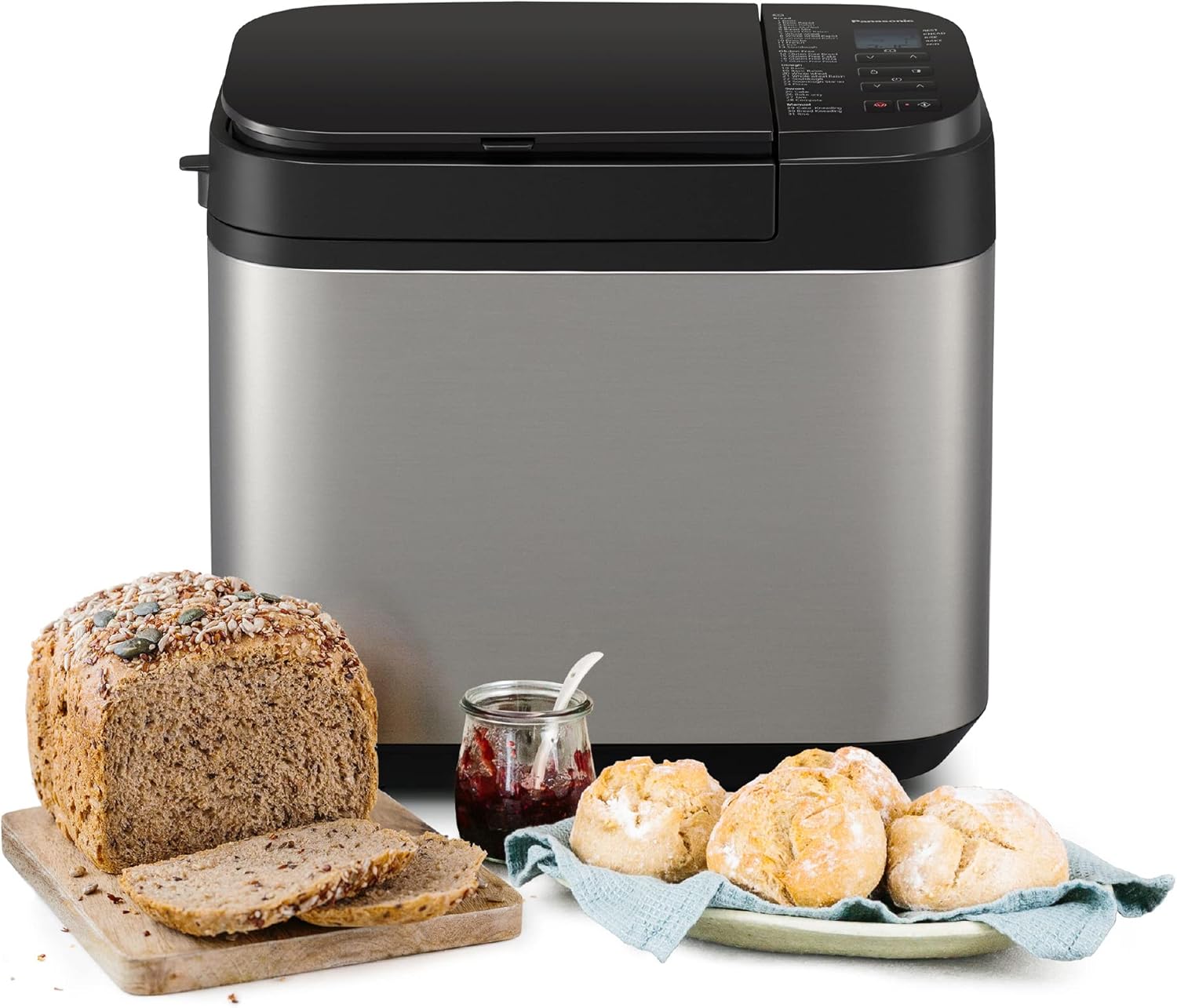
The only brand here that itemises what its programme count contains — and its own breakdown shows just 13 of the 31 programmes actually bake a loaf.
Pros
- The only listing here that itemises its programme count, and it adds up
- Automatic yeast dispenser keeps yeast out of the water until mixing
- Dual temperature sensors adjust fermentation to room temperature
- 7.5kg, second heaviest here, with a 36.2cm flush-lid height
- Separate raisin and nut dispenser and a sourdough cup included
Cons
- No loaf size published in grams or pounds anywhere on the listing
- £199.00 for 1,009 ratings, against £79.00 for 8,144 at number one
- Only 13 of the 31 programmes actually bake a loaf
- Near-identical SD-YR2540 sells alongside it at £199.99
Every manufacturer in this category sells a programme count and leaves you to imagine what is inside it. Panasonic is the only one that opens the box: 31 programmes, being 13 bread, 4 gluten free, 7 dough, 4 sweet and 3 manual. Those figures add to 31, which is more than can be said for the same brand at number five. It also means fewer than half the programmes bake bread, and knowing that is worth more than the headline number.
The hardware is the reason this is the machine to buy if the budget stretches. The automatic yeast dispenser drops the yeast into the pan at the right moment in the mixing cycle so it never sits in the water, which is the single most common reason a home loaf fails to rise; there is a separate raisin and nut dispenser; and dual temperature sensors read both the room and the interior so the fermentation time adjusts to a cold January kitchen rather than assuming one temperature all year. At 7.5kg it is heavy enough to sit still, and the flush-lid horizontal design keeps the height to 36.2cm.
Against it: £199.00 is the second highest price here for a machine with 1,009 ratings, and Panasonic does not publish a loaf size anywhere — not in grams, not in pounds. It is also worth knowing that the nearly identical SD-YR2540 sells for £199.99 with 32 programmes and 817 ratings, and that Panasonic gives three different dimension sets across its three models on this page, one of which has the width and height transposed.
Tower T11003 2lb Digital Bread Maker, 12 Programs, 550W

The cheapest machine here and one of only two that publishes its wattage — 550W, the highest figure anyone in this comparison is willing to print.
Pros
- 550W published, the highest wattage figure anyone here prints
- Cheapest machine in this comparison at £69.69
- Complete specification table: dimensions, weight, voltage and power
- 1,350 ratings at 4.3 with a three-year guarantee on registration
- Honest enough to record the body material as plastic
Cons
- 4.1kg is the second lightest here and will move during a stiff knead
- Plastic body at a time when rivals at the same price use steel
- 2lb in the title is never converted, and 2lb is 907g rather than 1kg
- 60-minute fast bake is slower than the 50 minutes at number one
At £69.69 this is the least expensive bread maker in the comparison, and it is also one of only two out of ten that tells you how much power the element draws. Five hundred and fifty watts is the highest published figure here, a hundred more than the Russell Hobbs, and wattage is what browns a crust — a machine that cannot get the outside of the loaf hot enough produces pale bread whatever the crust setting says. That Tower prints the number at all puts it ahead of eight rivals including every Panasonic.
It is a straightforward 2lb machine with 12 programmes, three crust settings, a 13-hour delay timer, a 60-minute fast bake and a 60-minute keep warm, backed by 1,350 ratings at 4.3 stars and a three-year guarantee with registration. The specification table is complete: 24.9 x 36.2 x 29.4cm, 4.1kg, 240 volts.
The 4.1kg is the catch, and it is the second lightest machine on this page. A bread maker doing a wholemeal knead is fighting a stiff dough, and four kilos is not much to anchor it — expect it to shuffle on a smooth worktop and give it room from the edge. Tower is also honest enough to record the material as Plastic, which no other brand here admits to, and while that is to its credit it does tell you what the body is. The 2lb in the title is never converted, so for the record that is 907 grams, not a kilogram.
KitchenArm 29-in-1 Smart Bread Maker, 500g 700g 900g, Stainless Steel

The highest rated machine here at 4.6, and the only one that puts all three loaf sizes in grams in the title where you cannot miss them.
Pros
- 4.6 stars, the highest rating in this comparison
- All three loaf sizes published in grams: 500g, 700g and 900g
- Programme count itemised and correct: 21 bread, 7 non-bread, 1 custom
- Menu 29 lets you set knead, rest, rise and bake times individually
- 77 recipes included and a proper UK 230V three-pin build
Cons
- 238 ratings, the second thinnest sample on this page
- 4.35kg is light for a machine making a 900g loaf
- Bullet text contains VVarranty with the W typed as two Vs
- Pan coating named as Teflon rather than described generically
Four point six stars is the best average in this comparison, and the listing behind it does something no premium brand here manages: it states the loaf sizes in grams, in the title, in the bullets, and in the same unit throughout — 500g, 700g and 900g. It also itemises the programme count the way Panasonic does, as 21 bread menus, 7 non-bread menus and one fully programmable cycle, which adds up correctly to 29.
The programmable menu is the genuine feature. Menu 29 lets you set the duration of each individual stage — knead, rest, rise, bake — rather than picking a preset, which is the difference between a machine that makes the bread it was designed for and one that makes the bread in your recipe book. For sourdough in particular, where the rise depends on your starter rather than a factory assumption, that control is the whole game. There are 77 recipes included and a UK 230V build with a three-pin plug.
Two reservations, and one of them is about the listing rather than the machine. At 238 ratings this is the second thinnest sample here, so 4.6 stars is encouraging rather than settled. And at 4.35kg it is the third lightest machine on the page, which for something advertising a 900g loaf is not much ballast. The copy also contains "2-YEAR Product VVarranty", with the W typed as two Vs — a small thing, but the kind of substitution that usually means text was pasted to get past a filter, and it sits alongside a direct naming of Teflon as the pan coating that most brands are careful to describe generically.
Panasonic SD-B2510 Bread Maker, 21 Programmes, Dual Temperature Sensors

The cheapest way into Panasonic dual temperature sensors, but its own programme breakdown adds up to 20 and the box says 21.
Pros
- Dual temperature sensors adjust the rise to your kitchen, not a fixed timing
- Eighty pounds cheaper than the SD-YR2550 with the same sensor system
- 6.5kg, heavier than six of the ten machines here
- 4 dedicated gluten-free modes
- 900 ratings at 4.5 stars
Cons
- Programme breakdown given as 9+4+3+4, which is 20 and not the 21 claimed
- Dimensions appear to have width and height transposed against the sister model
- No loaf size published in grams or pounds
- No yeast dispenser and no sourdough programme at this price
This is the entry point to the Panasonic range and it keeps the feature that actually separates the brand: two temperature sensors, one reading the room and one reading the interior, so the machine lengthens the rise on a cold morning and shortens it on a warm one. Bread dough is far more sensitive to ambient temperature than most people expect, and a fixed-timing machine is guessing. At £119.00 with 900 ratings at 4.5 stars it undercuts the SD-YR2550 by eighty pounds.
What you give up is the yeast dispenser, the sourdough programmes and ten of the presets, and what you gain is the same 4 gluten-free modes and the same flush-lid design. At 6.5kg it is the lightest of the three Panasonics but still comfortably heavier than everything below it here except the Tefal.
Now the arithmetic. The bullet reads "21 Automatic Programmes- 9 Bread, 4 Gluten Free, 3 Dough, 4 Sweet". Nine plus four plus three plus four is twenty. The same brand gets the sum right on the SD-YR2550 further up this page, so this is a missing line rather than a system, but it is the second time in one comparison that Panasonic has published a number nobody checked. The dimensions are the third: this listing gives 25.2D x 36.2W x 40.8H, while the SD-YR2550 gives 25.2D x 40.8W x 36.2H — the same three figures with width and height swapped, on two machines whose selling point is a flush lid that reduces the overall height. Forty point eight centimetres tall would not clear the gap under many British wall cabinets, so it matters which way round it is.
Russell Hobbs Electric Bread Maker 27260, 12 Programs, 450W

The most complete specification table in this comparison, which is exactly why you can catch it contradicting itself: 1kg in the bullets, 0.9kg in the table.
Pros
- The most complete specification table of the ten, including wattage
- 450W published, one of only two brands here to state power draw
- 10-minute power cut-off memory protects the loaf through a brief outage
- Two-year guarantee extended to three on registration, at £69.99
- Programme list published in full rather than as a headline count
Cons
- Bullets claim a 1kg loaf, the capacity field says 0.9kg
- 4.0kg is the lightest machine in this comparison
- Two different lists of the same twelve programmes on one page
- 450W is the lowest published wattage here, which limits crust browning
Russell Hobbs publishes more of its own numbers than anyone else on this page — model number, dimensions, weight, capacity, wattage, voltage, material and a full programme list are all there in the specification table, at a time when three Panasonics and a Sage between them manage none of it. That transparency is genuinely worth something, and it is also what makes the error visible. The bullets advertise "Two Bread Sizes (750g/1kg)". The capacity field says 0.9 kilograms. Those cannot both be true, and the difference between a 900g and a 1kg loaf is a slice and a half.
There is a second, smaller version of the same problem. The twelve programmes are listed twice on the page and the two lists do not match: the bullet gives Fastbake I and Fastbake II, while the special features field replaces them with Quick and Bake. Same count, different contents.
As a machine at £69.99 it is a sensible buy. Four hundred and fifty watts is published, which only one other brand here does, and a 10-minute power cut-off memory means a brief outage does not ruin the loaf. There is a 13-hour delay timer, three crust settings, an hour of keep warm, and a two-year guarantee extended to three on registration. The reservation is physical: at 4.0kg this is the lightest machine in the comparison, lighter even than the plastic-bodied Tower, and a wholemeal knead will move it.
Tefal Pain and Delices Bread Maker, 20 Programs, 15-Hour Delay

The only listing here that quotes a baking time for each loaf size separately — 1hr 27 for 500g, 1hr 38 for 1000g — though it buries it in a footnote.
Pros
- The only listing here that publishes a bake time for each loaf size
- 15-hour delay timer, the longest in this comparison
- 20 programmes including pasta and pizza dough plus a dairy function
- Genuine stainless steel body at 5.2kg
- Includes a 1L dairy pot, cottage cheese filter and recipe book
Cons
- 4.2 stars is the joint lowest rating in this comparison
- Loaf sizes appear only in a footnote, never in the specification table
- Under 90 minutes is contradicted by its own footnote of 87 to 98 minutes
- No wattage published
Read the fifth bullet to the end and Tefal does something no rival manages: it gives a rapid bake time per loaf size. Five hundred grams in one hour twenty-seven, 750g in one hour thirty-two, 1000g in one hour thirty-eight. That is the only place in the whole comparison where a manufacturer connects the size of the loaf to the time it takes, and it is also, incidentally, the only place Tefal states its loaf sizes at all — in an asterisked footnote under a claim about baking a loaf in under 90 minutes.
The rest of the package is unusually broad. Twenty programmes covering bread, pasta and pizza dough, dedicated gluten-free settings, jam, and a dairy function that comes with a 1L pot and a cottage cheese filter, which is an odd inclusion but a real one. A 15-hour delay timer is the longest here, there are three loaf sizes and three crust settings, and the body is genuine stainless steel at 5.2kg.
The rating is the problem. Four point two stars across 863 ratings is the joint lowest average in this comparison, shared with the Lakeland and the £249 Sage, and unlike those two it is not explained by an unusual design or a premium price. A machine trying to be a breadmaker, a pasta maker and a cheese press is spreading the engineering thin, and the reviews appear to reflect that. Meanwhile the crucial 90-minute claim in the bullet is contradicted by the footnote directly beneath it, where every one of the three quoted times is over an hour and a half.
Panasonic SD-R2530 Bread Maker, Nut Dispenser, 30 Programmes

At 7.99kg this is the heaviest and steadiest machine on the page, but £159 buys one fewer programme than the £199 model and one more than the £119 one.
Pros
- 7.99kg, the heaviest and steadiest machine in this comparison
- Panasonic dual temperature sensors adjust the rise to room temperature
- Automatic raisin and nut dispenser included
- 30 programmes with four dedicated gluten-free modes
- 4.5 stars across 585 ratings
Cons
- £40 more than the SD-B2510 for programmes rather than capability
- £40 less than the SD-YR2550 but without the yeast dispenser
- No loaf size published in grams or pounds
- A third different dimension set from the same brand on this page
Seven point nine nine kilograms makes this the heaviest bread maker in the comparison, and for the one job a breadmaker does badly when it is light — kneading a stiff wholemeal or rye dough without travelling — that is the specification to want. It sits on the worktop and stays there. It carries the Panasonic dual temperature sensors, an automatic raisin and nut dispenser, 30 programmes including four gluten-free modes, and a 13-hour timer, with 585 ratings at 4.5 stars.
The difficulty is where it lands in Panasonic's own range. It costs £159.00. The SD-B2510 below it costs £119.00 and has 21 programmes and the same sensors. The SD-YR2550 above it costs £199.00 and adds the yeast dispenser — the feature that genuinely changes how reliably a loaf rises — plus sourdough support and one extra programme. This machine is forty pounds more than the cheap one for nine programmes you may never use, and forty pounds less than the good one for the absence of the dispenser that matters.
It also inherits the family problems. No loaf size is published in any unit. And its dimensions are given as 25.2D x 39.5W x 36.2H, a third distinct set from the same brand on this page, differing from the SD-YR2550 by 1.3cm of width on what appears to be the same chassis. When three listings from one manufacturer give three different widths, the safe assumption is that none of them was measured for this listing.
Lakeland Compact 1lb Daily Loaf Bread Maker, 11 Settings

The only listing of ten that converts its own loaf size: 1lb in the title, 454g in the capacity field, which is exactly right. Also the smallest machine here.
Pros
- The only listing here that converts its loaf size: 1lb stated as 454g
- Smallest footprint in this comparison at 25 x 21.5cm
- 1lb daily loaf is the right size for one or two people
- 4.75kg, heavier than three larger machines on this page
- One-year returns window from Lakeland on proof of purchase
Cons
- 4.2 stars is the joint lowest rating in this comparison
- Eleven programmes, the fewest of the ten
- No wattage published
- Costs the same as 2lb machines despite making half the loaf
This machine is on the list for one line in its specification table. Capacity: 454 g. One pound is 453.6 grams, so Lakeland has rounded correctly and, alone among ten manufacturers, has told a British buyer what its imperial headline actually means. Tower puts 2lb in a title and stops. Morphy Richards says three sizes and stops. Panasonic and Sage say nothing at all. Lakeland does the conversion, in the field where you would look for it.
The machine it describes is deliberately small: a 1lb daily loaf, eleven pre-installed settings including crusty, gluten free, wholemeal and French, a knead-only function for pizza dough and rolls, and a 25 x 21.5 x 31cm footprint that is the narrowest here by a clear margin. If you are one or two people, a 1lb loaf eaten the day it is baked is the honest use case for a bread machine, and a 1kg machine is a way of making stale bread in bulk. Lakeland also offers a one-year returns window on proof of purchase.
Two things put it at nine rather than higher. Four point two stars across 603 ratings is the joint lowest average in this comparison, and unusually for a compact appliance it weighs 4.75kg, which is respectable, but there is no wattage published and only eleven programmes, the fewest here. It is also £69.99 for a 1lb machine when £69.69 buys a 2lb one from Tower — you are paying a small premium for the smaller loaf, which is the right trade only if you genuinely want it.
Sage Custom Loaf Bread Maker, Collapsible Blade, Brushed Stainless Steel

The collapsible kneading blade is the one genuinely new idea in this category, but £249.00 buys the lowest rating and the second thinnest sample here.
Pros
- Collapsible kneading blade leaves no hole in the bottom of the loaf
- 7.8kg brushed stainless steel, the best built machine here
- Nine custom programmes you can create, name and store
- 60 minutes of backup power protects the bake through an outage
- Automatic fruit and nut dispenser
Cons
- £249.00, three and a half times the cheapest machine in this comparison
- No loaf size published in any unit anywhere on the listing
- 4.2 stars across 273 ratings, the joint lowest average here
- No wattage published either, at the highest price on the page
Every bread machine leaves a hole in the bottom of the loaf where the kneading paddle was, and every owner learns to dig it out with a fork. Sage is the only manufacturer here that has engineered a fix: the blade folds flat into the base of the pan when the kneading finishes and before the bake begins, so the dough rises over it and the loaf comes out whole. There are nine custom settings you can name and store, an automatic fruit and nut dispenser, and sixty minutes of backup power that carries the programme through a cut.
At 7.8kg with a brushed stainless steel body it is the second heaviest machine here and easily the best built. If you bake several times a week and the paddle hole genuinely annoys you, this is the machine that solves it.
Everything else argues against it. Two hundred and forty-nine pounds is three and a half times the cheapest machine on this page and £50 more than the Panasonic that has four times the ratings. Those ratings — 273 at 4.2 stars — are the second thinnest sample and the joint lowest average in the comparison, which is an uncomfortable combination at this price. And for £249.00 Sage publishes no loaf size, in any unit, anywhere on the listing: not in the title, not in the bullets, not in the specification table. The most expensive bread maker here will not tell you how much bread it makes.
Final Verdict
Picking the best bread maker is easier once you stop reading the programme count. Start with the loaf: 454g feeds one or two people for a day and goes stale before it is finished by anyone else, 750g is the standard household loaf, and 1kg is a batch you slice and freeze. If the listing will not tell you which of those you are buying, that is information in itself — and it is the premium end of this category that stays quietest, with three Panasonics and a Sage between them publishing not a single gram. Then weigh the machine. A breadmaker kneads stiff dough for twenty to thirty minutes and its own mass is the only thing stopping it travelling across the worktop; the range here runs from 4.0kg to 7.99kg, a two-fold spread that no manufacturer mentions because it appears only in the shipping field. By contrast, programmes are the number you can safely ignore. Panasonic is the only brand that itemises what its count contains, and its own breakdown shows just 13 of 31 programmes actually bake a loaf — the rest are dough, jam and cake. Crucially, one of those two breakdowns does not even add up: the 21 programmes on the SD-B2510 are listed as 9 bread, 4 gluten free, 3 dough and 4 sweet, which is 20.
Written by
Felipe Iglesias
Founder & Lead Reviewer
Felipe is the founder of ranked10 and the person behind every buying guide on the site. He spends his time digging through specs, customer reviews and real-world feedback so you do not have to, turning hours of research into clear, honest top 10 lists for UK shoppers. When he is not comparing air fryers or cordless mowers, he is tinkering with the technology that keeps ranked10 running.
Related buying guides
All Kitchen guidesBest Soup Maker 2026: 10 Ranked on Millilitres Per Portion
Every soup maker listing sells you a litre and a portion count, and almost none of them will divide one by the other. Do it yourself and the category falls apart. Morphy Richards calls 1.6 litres six people on one model and four people on another — the same brand, the same capacity, and a 50% swing in what the word portion means. Only one machine in this comparison prints the actual millilitres: Hamilton Beach states 450ml for four servings or 250ml for six, and once you have that figure you can hold every other listing to it. A 400g tin of Heinz is the British benchmark for one bowl, so a 1.6L soup maker sold as feeding six is offering two-thirds of a tin each. Meanwhile Ninja is the only brand that admits the jug holds less when it is hot — 1.7 litres cold, 1.4 litres hot — an 18% drop that nobody else acknowledges exists. Below we rank the best soup maker options on Amazon in August 2026 on the arithmetic the listings leave out, and flag the fiction where we found it.
KitchenBest Slow Cooker 2026: 10 Ranked on Watts Per Litre
Slow cooker listings give you two numbers — litres and watts — and never the one that connects them. Watts divided by litres is what decides how long low actually takes, because the job of a slow cooker is to bring a large mass of cold food up to somewhere between 80 and 95°C and hold it there for eight hours. Across the ten machines in this comparison that ratio runs from 25 to 57 watts per litre, a 2.3-fold spread, and the most striking case sits inside a single brand: Morphy Richards fits a 163 watt element to its 6.5 litre pot and a 153 watt element to its 3.5 litre one. Ten watts more, for nearly double the volume. Meanwhile the capacity on the box is the pot's total volume, not what you can put in it — every manufacturer's own manual says fill between half and three-quarters, so a 6.5 litre cooker holds around four litres of dinner. Below we rank the best slow cooker options on Amazon in August 2026 on the arithmetic the listings leave out.
KitchenBest Burr Coffee Grinder 2026: 10 Ranked, and Why 75 Settings Is Not Better Than 17
Grind settings are the headline number in this category and they are close to meaningless. The settings on a burr grinder are detents on a collar that moves one burr nearer or further from the other, and the total distance that collar travels is fixed by the geometry of the burrs. Going from 17 settings to 75 does not widen the range from espresso to French press — it chops the identical range into smaller pieces. Past a certain point each click changes the gap by less than the machine's own mechanical repeatability, which means the difference between click 62 and click 63 is smaller than the difference between two runs on the same setting. Tellingly, the grinder in this comparison with 17 settings has a stainless steel body and the one with 75 is plastic. Below we rank the best burr coffee grinder options on Amazon in August 2026 on the things that genuinely change what lands in the basket: burr type, burr size, burr material and build.
Highest rated in our other guides
Weighted by how many people rated each product, not just the score.

BoYata Aluminium Adjustable Laptop Stand, 0-90 Degree, Foldable
£32.99

Ninja Foodi Blender and Soup Maker HB150UK, 1.7L Glass Jug, 1000W
£180.00

Acer Predator GM7 2TB SSD, Gen4 NVMe 2.0, 7200MB/s, Graphene Thermal Pad
£228.99

SanDisk 128GB Extreme microSDXC + Adapter, 190MB/s, A2, V30, U3
£27.99