Best Burr Coffee Grinder 2026: 10 Ranked, and Why 75 Settings Is Not Better Than 17
By Felipe Iglesias · Updated
Grind settings are the headline number in this category and they are close to meaningless. The settings on a burr grinder are detents on a collar that moves one burr nearer or further from the other, and the total distance that collar travels is fixed by the geometry of the burrs. Going from 17 settings to 75 does not widen the range from espresso to French press — it chops the identical range into smaller pieces. Past a certain point each click changes the gap by less than the machine's own mechanical repeatability, which means the difference between click 62 and click 63 is smaller than the difference between two runs on the same setting. Tellingly, the grinder in this comparison with 17 settings has a stainless steel body and the one with 75 is plastic. Below we rank the best burr coffee grinder options on Amazon in August 2026 on the things that genuinely change what lands in the basket: burr type, burr size, burr material and build.
At a glance
| # | Product | Price | Rating | Link |
|---|---|---|---|---|
| 1 | Molino Electric Coffee Grinder, Flat Burr, 17 Grind Settings, Steel | £37.99 | 4.4 | View |
| 2 | De'Longhi KG79 Burr Coffee Grinder, 120g Hopper, Cup Selector | £51.99 | 4.4 | View |
| 3 | Krups Expert Electric Burr Coffee Grinder, 17 Settings, 225g Hopper | £54.00 | 4.2 | View |
| 4 | Wancle Electric Burr Coffee Grinder, 28 Grind Settings, 2-12 Cups | £36.99 | 4.4 | View |
| 5 | AMZCHEF Burr Coffee Grinder, 48 Settings, Stainless Steel, LCD Touch | £89.70 | 4.4 | View |
| 6 | SHARDOR Conical Burr Coffee Grinder, 40mm Stainless Burrs, 51 Settings | £67.99 | 4.3 | View |
| 7 | OutIn Fino Portable Electric Coffee Grinder, 420 Steel Burr, Battery | £179.99 | 4.5 | View |
| 8 | AMZCHEF Electric Coffee Grinder, 75 Grind Settings, Anti-Static | £79.99 | 4.3 | View |
| 9 | Dualit Burr Coffee Grinder, 35 Settings, Removable Stainless Burrs | £98.99 | 4.0 | View |
| 10 | Amazon Basics Electric Burr Coffee Grinder, Flat Burr, 30 Settings | £34.19 | 3.9 | View |
Molino Electric Coffee Grinder, Flat Burr, 17 Grind Settings, Steel

The best burr coffee grinder here on the specs that matter: a flat burr, a steel body and 17 settings, for £37.99 with 5,280 ratings behind it.
Pros
- Flat burr, which gives a tighter particle distribution than a cone
- Specification table gives the material as Steel, not plastic
- 5,280 ratings at 4.4 for £37.99
- Capacity dial for 2 to 12 cups
- One of only three listings here that states its burr type
Cons
- 17 settings is coarse stepping if you are dialling in espresso
- Does not publish burr diameter or motor wattage
- No burr material stated, only the body
This is the grinder that makes the argument for us. Molino states a professional flat grinding disc, 17 grind settings and a capacity dial for 2 to 12 cups, and the specification table gives the material as Steel. Thirty-seven pounds ninety-nine, 5,280 ratings, 4.4 stars.
Flat burrs are the specification worth understanding. They shear beans between two parallel rings rather than crushing them through a cone, which produces a tighter particle size distribution — more grounds at the size you asked for and fewer fines and boulders. That is the thing that actually changes how the coffee tastes, and only three of the ten listings in this comparison bother to say which type they fit.
Seventeen settings sounds meagre next to the seventy-five on the AMZCHEF further down this page, and that is the point of ranking it first. Both machines move one burr across a fixed range; this one divides that range into seventeen usefully distinct steps and puts the money into a metal body and a flat burr instead. For cafetière, drip and moka pot it is all the adjustment anyone needs. If you pull espresso and want finer control at the fine end, look at the SHARDOR at number six, which publishes its burr diameter.
De'Longhi KG79 Burr Coffee Grinder, 120g Hopper, Cup Selector
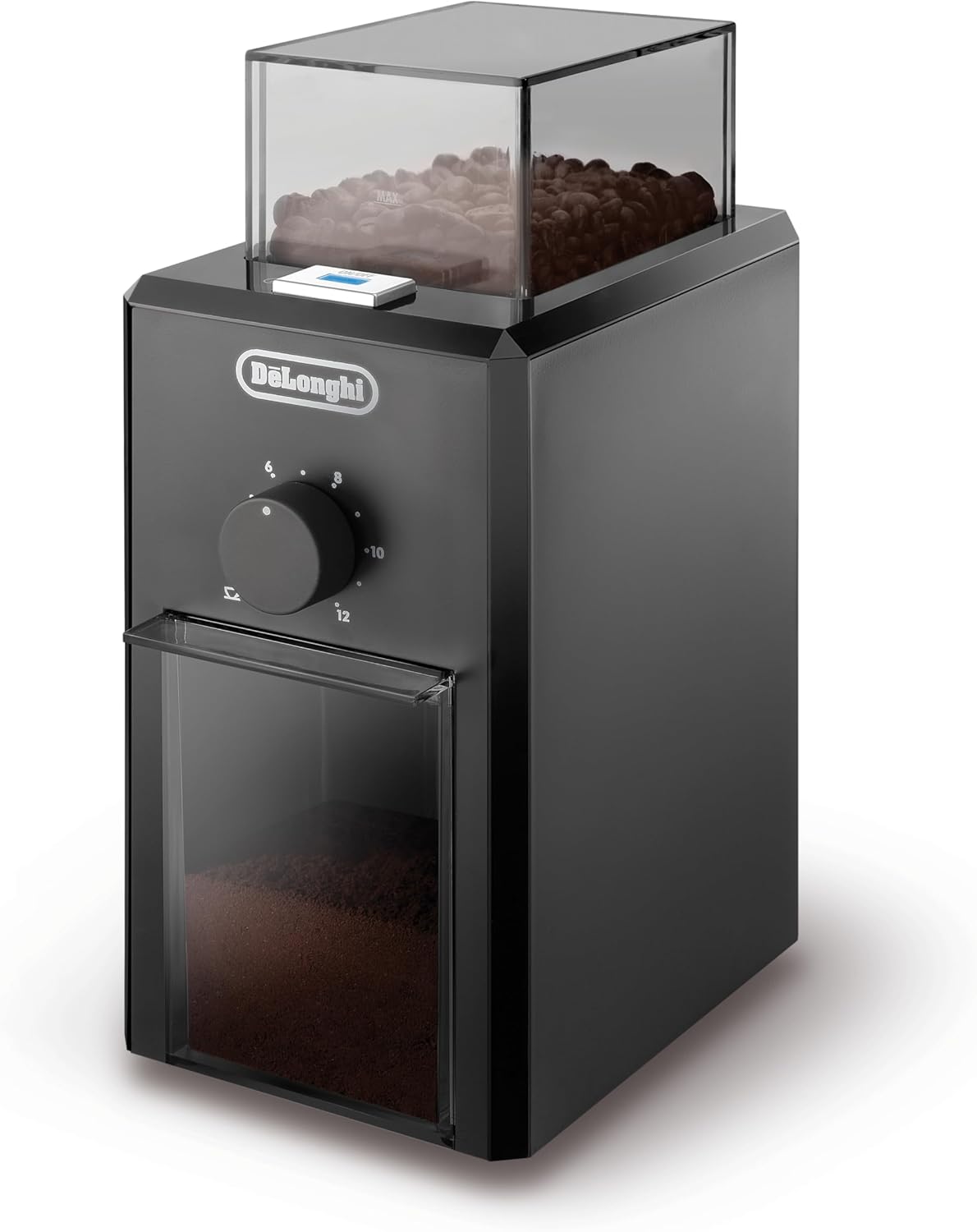
The most reviewed grinder in this comparison at 8,800 ratings, from a name people trust, on a listing that is literally displaying its own HTML.
Pros
- 8,800 ratings at 4.4, the deepest evidence in this comparison
- Separate dials for cup count and coarseness, so it runs unattended
- 120g bean hopper
- De'Longhi brand support and easy parts availability
Cons
- Bullet points display raw HTML markup as visible text
- Never states the grind settings count, burr type or burr material
- Specification table gives the material as Plastic
- Costs £14 more than the flat-burr Molino
Eight thousand eight hundred ratings at 4.4 stars makes this the safest purchase on the page by weight of evidence, and De'Longhi is a brand most British kitchens already contain. The design is sensible: a 120g bean hopper, separate dials for cup count and grind coarseness, and soft-touch controls, which means you set how many cups you want and walk away rather than holding a button and guessing.
It is a genuine burr grinder rather than a blade one, which at £51.99 is the main thing to establish. Blade grinders chop at random and produce dust and chunks in the same batch; burr grinders crush to a set gap. Everything else in this article is about degrees of burr quality, and this clears the bar.
The listing itself is a mess in a specific and funny way. Its bullet points display raw markup as text: the first bullet reads, literally, less-than li greater-than Professional burr grinder less-than slash li greater-than, and the second does the same around 120 g coffee beans capacity. Somebody pasted HTML into a field that already wraps each line in a list tag. It is cosmetic, but on the most reviewed grinder in the category it has apparently been there long enough for nobody to care. More substantively, the listing never states how many grind settings the machine has, nor the burr type, nor the material of anything except the plastic body.
Krups Expert Electric Burr Coffee Grinder, 17 Settings, 225g Hopper
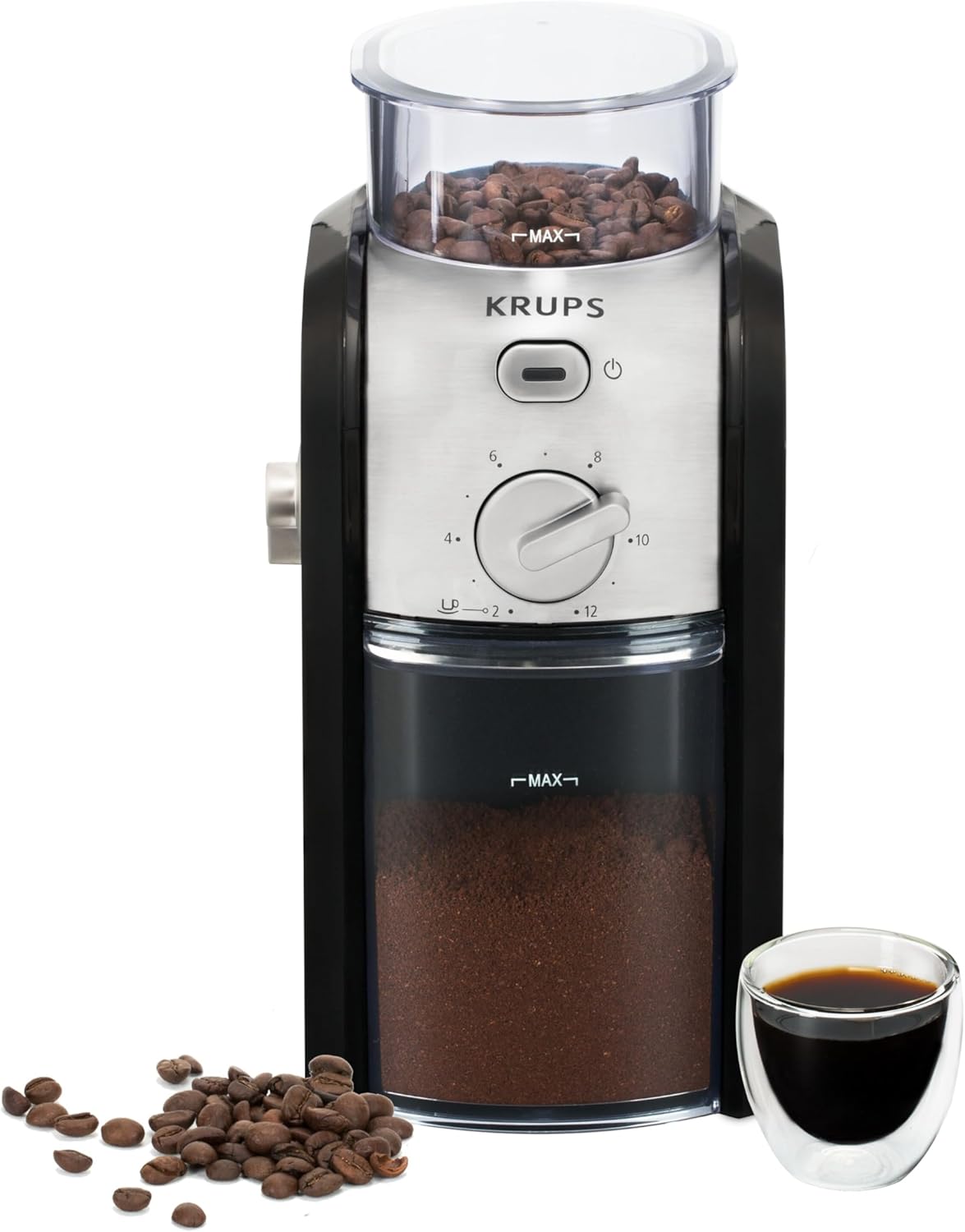
The only listing in the comparison that explains what a grind setting actually is — and, not coincidentally, the one with the fewest of them and a stainless steel body.
Pros
- The only listing that explains what a grind setting physically adjusts
- Stainless steel body where rivals at higher prices use plastic
- 225g bean hopper, the largest in this comparison
- Automatic shut-off on the selected cup count
- 3,047 ratings
Cons
- 4.2 average, the lowest of the top three here
- Known for being loud and for static cling in the grounds container
- Does not state burr type or diameter
- Costs £16 more than the Molino
Read the first bullet: 17 settings adjust the distance between the two burrs for a fine or coarse result. That single sentence is the most useful thing written on any of the ten listings we read, because it tells you what the number means. Every other manufacturer prints a settings count and lets you infer that more is better; Krups explains the mechanism, and once you understand it the arms race stops making sense.
The build matches the honesty. The specification table gives the material as Stainless Steel, where the 75-setting AMZCHEF and the £98.99 Dualit both say Plastic. The hopper holds 225g, the largest here, and the cup selector runs from 2 to 12 with automatic shut-off when the dose is done.
The 4.2 average across 3,047 ratings is the lowest of the three grinders above it, and worth weighing. Krups grinders of this generation have a reputation for being loud and for static making grounds cling to the container — both real, both common to the whole category, and neither fatal. At £54 you are paying a £16 premium over the Molino for a metal body, a bigger hopper and a manufacturer willing to tell you how its own product works.
Wancle Electric Burr Coffee Grinder, 28 Grind Settings, 2-12 Cups
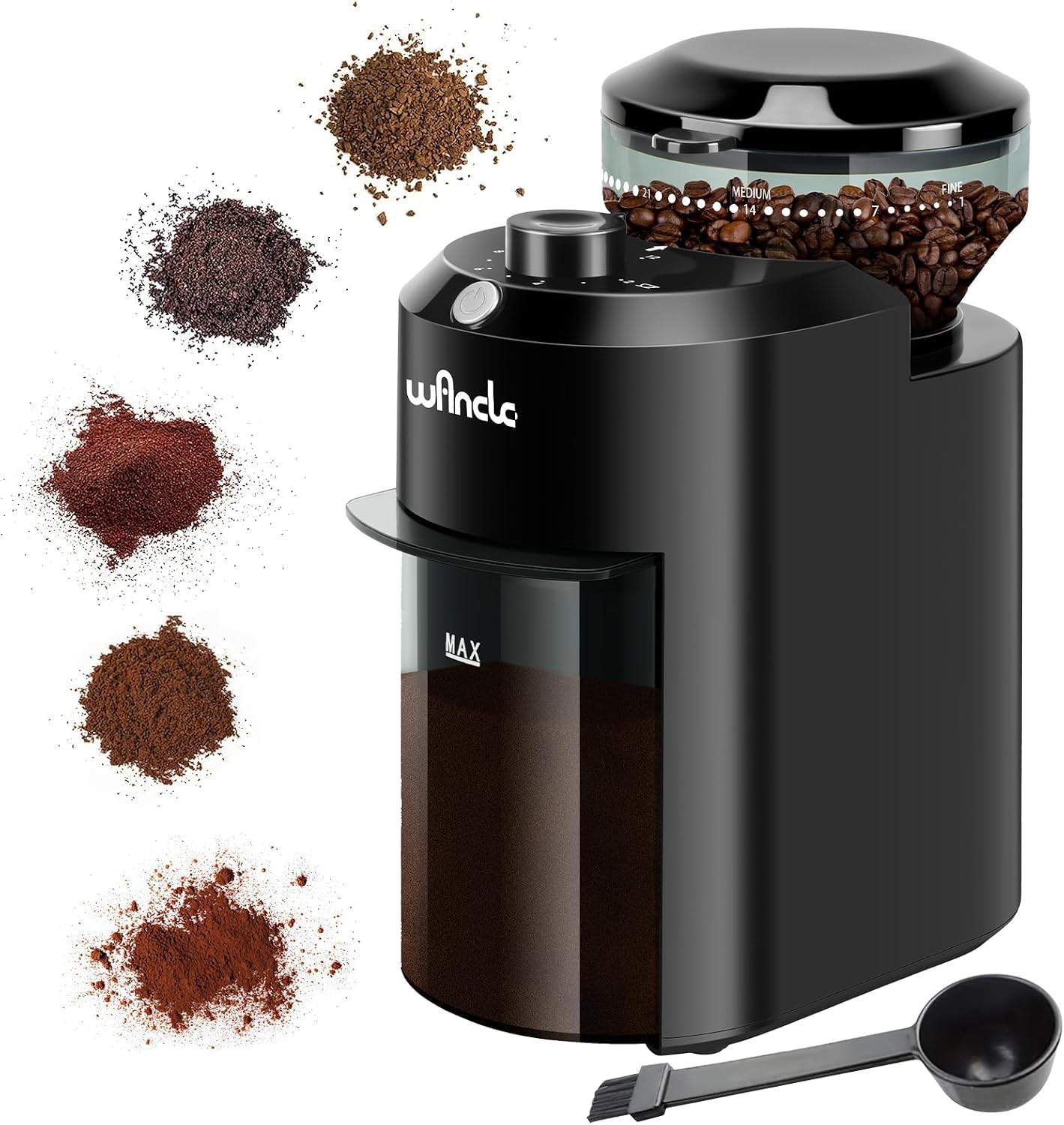
The cheapest electric burr grinder here with a real review history: £36.99, 3,139 ratings and on-demand control for 2 to 12 cups.
Pros
- Cheapest electric burr grinder here with a substantial review history
- 3,139 ratings at 4.4
- On-demand control for 2 to 12 cups
- Does not attach a fake decibel figure to its quiet claim
Cons
- Plastic body
- Does not state burr type, material or diameter
- 28 settings divide the same range as the Molino 17, no more
Thirty-six pounds ninety-nine is the entry price for a competent electric burr grinder, and Wancle has 3,139 ratings at 4.4 stars saying it clears that bar. Twenty-eight settings, on-demand grinding for 2 to 12 cups, and a low-noise claim that the company sensibly does not attach a decibel figure to.
For anyone moving off pre-ground coffee or off a blade grinder, this is the sensible first purchase and the difference in the cup will be larger than any upgrade from here. Consistent particle size is what changes extraction, and any burr grinder gives you that; the refinements above it are refinements.
The specification table gives the material as Plastic, and the listing does not say whether the burrs are flat or conical, what they are made of, or how large they are. That is the norm at this price rather than a specific failing, but it does mean you are buying on the review count. Twenty-eight settings sits mid-scale in this comparison, which by the argument of this article makes it neither better nor worse than the 17 on the Molino — the same range, more finely chopped, on a plastic body instead of a steel one.
AMZCHEF Burr Coffee Grinder, 48 Settings, Stainless Steel, LCD Touch

The espresso-focused pick: stainless steel, an LCD dosing panel and a portafilter holder in the box, so it grinds straight into the basket.
Pros
- Portafilter holder included, so it doses straight into the basket
- Stainless steel body at under £100
- LCD touch panel for timed dosing
- 961 ratings at 4.4
- Fine stepping is genuinely more useful for espresso than for filter
Cons
- Costs £89.70, more than double the Molino
- Does not publish burr type or diameter
- 48 settings still divide the same fixed range
This is the machine on the page aimed squarely at someone with an espresso machine. It ships with a portafilter holder and a pad, so the grinder doses directly into the basket rather than into a cup you then tip and lose half of, and an LCD touch panel sets the dose by time. The specification table gives the material as Stainless Steel.
Grinding into the portafilter matters more than it sounds. Every transfer loses grounds and adds mess, and a grinder that cannot hold a portafilter turns a two-minute routine into a five-minute one with a chore at the end. Among the sub-£100 grinders here, this is the only one that solves it.
Forty-eight settings is a lot, and by the argument of this article most of them are between other settings rather than beyond them. But the fine end is where espresso lives, and finer stepping genuinely is more useful there than it is for a cafetière — so of all the high-count grinders here, this is the one where the count is at least pointed at a real use. At £89.70 with 961 ratings at 4.4, it is well evidenced for the price without being the deepest sample here.
SHARDOR Conical Burr Coffee Grinder, 40mm Stainless Burrs, 51 Settings

The only grinder in this comparison that publishes its burr diameter: 40mm stainless steel conical burrs. That number tells you more than fifty-one settings do.
Pros
- The only listing here that publishes burr diameter, at 40mm
- States that the burrs are stainless steel and conical
- Conical burrs retain fewer grounds between doses
- Touch screen dose control
- Stainless steel body
Cons
- 161 ratings, the second thinnest sample in this comparison
- 51 settings is marketing rather than capability
- Conical burrs give a slightly wider particle spread than flat
Forty millimetres. That is the number to take away from this listing, and SHARDOR is the only manufacturer in this comparison that prints it. Burr diameter is the specification that decides how a grinder actually behaves: a larger burr passes beans through with fewer rotations, which means less heat into the grounds, less time in the chamber and a more consistent particle size. Forty millimetres is a proper mid-range burr rather than the small ones typically fitted at this price.
It also tells you the burrs are stainless steel and that they are conical, which is two more facts than seven of the ten listings here provide. Conical burrs retain fewer grounds between doses and run quieter than flat ones, at the cost of a slightly wider particle spread. There is a touch screen for dose control.
The reservation is evidence. One hundred and sixty-one ratings at 4.3 is the second thinnest sample in this comparison, so the specification is doing the persuading rather than the review history. At £67.99 it sits between the budget machines and the AMZCHEF espresso setup. If you want the most burr for your money and are comfortable buying on specification rather than crowd, this is the one. The 51 settings, as ever, divide the same span the 17-setting Krups divides — ignore them and buy it for the 40mm.
OutIn Fino Portable Electric Coffee Grinder, 420 Steel Burr, Battery

The most technically specific listing in the category: 420 stainless steel burrs at HRC 55-60 hardness, in a 690g battery-powered grinder for travel.
Pros
- Publishes both the steel grade (420) and the hardness (HRC 55-60)
- Battery powered and only 690g, genuinely portable
- Detachable dosing cup, auto-stop and clog protection
- 4.5 stars from 550 ratings
- Materials transparency unmatched in this comparison
Cons
- Costs £179.99, roughly five times the Molino
- A mains grinder at half the price will match it at home
- The heptagonal burr claim is not independently verifiable
- 28 settings, mid-scale, on the most expensive machine here
Nobody else in this comparison publishes a steel grade, and nobody else publishes a hardness figure. OutIn does both: the burrs are 420 stainless steel at HRC 55 to 60 on the Rockwell scale. That matters because burr hardness is what determines how long the cutting edges stay sharp, and a soft burr rounds off and starts crushing rather than cutting within a couple of years of daily use. HRC 55-60 is genuine knife-steel territory.
The format is the other reason it exists. At 690g with a fast-charge battery and a detachable dosing cup, this is a grinder for a campsite, a hotel room or an office drawer — the whole point being fresh grounds where there is no socket. The heptagonal burr geometry is unusual and OutIn says it is for grind consistency; we would treat that claim as unverified, unlike the steel grade, which is checkable.
It is also £179.99, by far the most expensive machine on this page and roughly five times the Molino. You are paying for portability and for materials transparency, not for a better grind at your kitchen counter — a mains grinder at half the price will match or beat it at home. At 4.5 from 550 ratings the evidence is decent. Buy it if you actually travel with coffee; if the grinder will live on a worktop, buy almost anything else here.
AMZCHEF Electric Coffee Grinder, 75 Grind Settings, Anti-Static

The settings champion at 75, on a plastic body, at £79.99 — and the clearest illustration on this page that the number and the build move in opposite directions.
Pros
- Publishes retention of just 0.1 to 0.2 grams per grind
- Honest 60-75dB noise figure rather than a fictional low number
- Anti-static technology to reduce grounds clinging
- 4.3 stars from its first 262 buyers
Cons
- Plastic body at £79.99, where the £54 Krups is stainless steel
- 75 settings divide the same fixed range as 17 settings do
- 262 ratings is a thin sample for the price
- Publishes no burr type, diameter or material
Seventy-five grind settings is the highest count in this comparison and it is the reason this grinder is here. The Krups at number three has seventeen. Both machines move one burr across a range fixed by the burr geometry; this one simply has more detents along the way. Somewhere past thirty or so, the change per click drops below what the machine can hold repeatably from one dose to the next, and the extra clicks become decoration.
The specification table settles the argument in one line: Material, Plastic. The 17-setting Krups is stainless steel and costs £25.99 less. That is the whole thesis of this article printed on two Amazon listings.
There is a competent grinder underneath and two of its claims are worth crediting. AMZCHEF quotes retention of 0.1 to 0.2 grams per grind, which is a genuinely good figure and the sort of specific, checkable number the rest of the category avoids. And it quotes noise at 60 to 75dB, which is honest — grinders are loud, and after a week of reading appliance listings claiming 20dB for machines with pumps, a manufacturer admitting to 75 is a small pleasure. At 262 ratings the sample is thin for £79.99.
Dualit Burr Coffee Grinder, 35 Settings, Removable Stainless Burrs
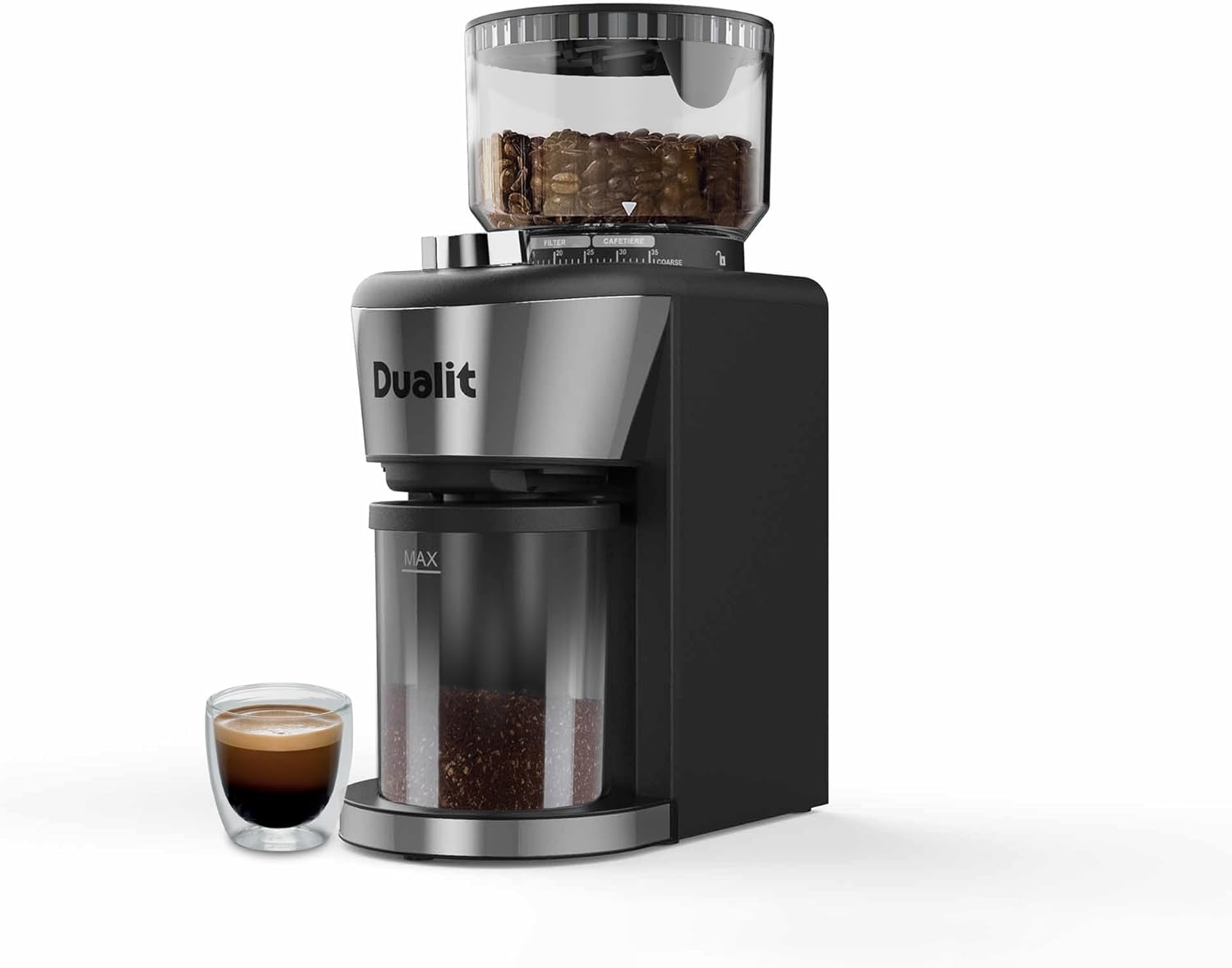
Removable burrs are a genuinely good idea nobody else here offers, but at £98.99 with a plastic body and 74 ratings it is asking a lot on brand alone.
Pros
- Removable stainless steel burrs, unique in this comparison
- Proper cleaning access prevents rancid oils tainting future grinds
- Adjustable portion control with 35 settings
- Established British brand
Cons
- Plastic body at £98.99, against a stainless steel Krups at £54
- 4.0 from just 74 ratings, joint lowest average here
- Second most expensive grinder in this ranking
- Does not state burr type or diameter
The feature worth having is the removable stainless steel burrs. Every burr grinder accumulates old grounds and oils in the chamber, and those oils go rancid and taint everything ground afterwards. Most grinders make you attack this with a brush through a gap; Dualit lets you take the burrs out and clean properly. On a machine you keep for years, that is a real advantage and no other listing here offers it.
Dualit is also a British brand with a genuine manufacturing history, and 35 settings with adjustable portion control is a sensible, unshowy specification that sits sanely in the middle of the range.
Two things make it hard to recommend at £98.99. The specification table gives the material as Plastic, which at this price and against a £54 stainless Krups is difficult to justify. And 4.0 from 74 ratings is both the joint lowest rating and one of the thinnest samples in the comparison — with a sample that small a 4.0 could move in either direction, but it is not the number you want to see on the second most expensive grinder on the page. Buy it for the removable burrs if long-term cleanliness is your priority; otherwise the Krups and the SHARDOR both offer more machine for less money.
Amazon Basics Electric Burr Coffee Grinder, Flat Burr, 30 Settings

The cheapest grinder here at £34.19 and one of only three that names its burr type, but a 3.9 average is the lowest in the comparison.
Pros
- Names its flat burr mechanism, which most of this category avoids
- Cheapest grinder in this comparison at £34.19
- 30 settings covering espresso through to cafetière
- Amazon own-brand returns handling
Cons
- 3.9 from 75 ratings, the lowest average in this ranking
- Thin sample for an own-brand product with prime placement
- Only £3.80 cheaper than a steel-bodied grinder with 5,280 ratings
- Mixed plastic and steel construction
Amazon Basics does one thing right that most of this category does not: it names the mechanism. The first bullet says flat burr grinding mechanism, which puts it alongside the Molino at number one and the SHARDOR at number six as the only listings here that tell you what is actually inside. Thirty settings, from fine for espresso to coarse for a cafetière, and a mixed plastic and stainless steel construction.
At £34.19 it is the cheapest machine on the page, undercutting the Wancle by £2.80 and the Molino by £3.80, and it comes with Amazon's own returns handling, which is worth something on a device with a motor.
The rating is why it is last. Three point nine from 75 ratings is the lowest average in this comparison, and while 75 is a thin sample, an own-brand product with Amazon's placement advantages should be gathering reviews faster and settling higher than this. Given that the Molino sits £3.80 away with a flat burr, a steel body and 5,280 ratings at 4.4, there is no scenario where this is the better buy unless it is heavily discounted. Included because it names its burr type, which most of the field will not do at any price.
Final Verdict
The best burr coffee grinder for you is chosen on three specifications, and the settings count is not among them. First, burr type: flat burrs produce a tighter particle distribution and suit filter and espresso, conical burrs run cooler and retain less, and only three of the ten listings here say which they fit. Second, burr diameter, because a larger burr grinds faster with less heat and more consistency — one listing in this entire comparison publishes it. Third, the body material, which is the honest proxy for everything you cannot see: a stainless steel grinder with 17 settings is a better machine than a plastic one with 75, and the pricing in this category quietly agrees. Meanwhile, if you are grinding for a cafetière or a drip machine, almost any burr grinder here will serve you and the cheapest sensible one is the right answer. If you are grinding for espresso, the step size near the fine end is what matters — but you will find that out from the burr size and build, not from a number on the front of the box.
Written by
Felipe Iglesias
Founder & Lead Reviewer
Felipe is the founder of ranked10 and the person behind every buying guide on the site. He spends his time digging through specs, customer reviews and real-world feedback so you do not have to, turning hours of research into clear, honest top 10 lists for UK shoppers. When he is not comparing air fryers or cordless mowers, he is tinkering with the technology that keeps ranked10 running.
Related buying guides
All Kitchen guidesBest Bread Maker 2026: 10 Ranked on the Loaf Size They Hide
A bread machine has one specification that decides whether you bought the right one: how big a loaf it makes. Four of the ten machines in this comparison do not publish that number anywhere on their listing — and they are the four most expensive, the three Panasonics and the £249 Sage. Of the six that do, no two use the same unit. Tower puts 2lb in the title and no grams anywhere; Morphy Richards offers three loaf sizes and never says what any of them weigh; Russell Hobbs claims 750g and 1kg in a bullet while its own specification table says the capacity is 0.9 kilograms. Only Lakeland does the conversion for you, listing 1lb in the title and 454g in the capacity field, which is exactly right. Meanwhile 2lb is 907 grams, not a kilo, so two machines sold as the same tier are 10% apart. Below we rank the best bread maker options on Amazon in August 2026 on loaf size, machine weight and published wattage — the three numbers this category treats as optional.
KitchenBest Soup Maker 2026: 10 Ranked on Millilitres Per Portion
Every soup maker listing sells you a litre and a portion count, and almost none of them will divide one by the other. Do it yourself and the category falls apart. Morphy Richards calls 1.6 litres six people on one model and four people on another — the same brand, the same capacity, and a 50% swing in what the word portion means. Only one machine in this comparison prints the actual millilitres: Hamilton Beach states 450ml for four servings or 250ml for six, and once you have that figure you can hold every other listing to it. A 400g tin of Heinz is the British benchmark for one bowl, so a 1.6L soup maker sold as feeding six is offering two-thirds of a tin each. Meanwhile Ninja is the only brand that admits the jug holds less when it is hot — 1.7 litres cold, 1.4 litres hot — an 18% drop that nobody else acknowledges exists. Below we rank the best soup maker options on Amazon in August 2026 on the arithmetic the listings leave out, and flag the fiction where we found it.
KitchenBest Slow Cooker 2026: 10 Ranked on Watts Per Litre
Slow cooker listings give you two numbers — litres and watts — and never the one that connects them. Watts divided by litres is what decides how long low actually takes, because the job of a slow cooker is to bring a large mass of cold food up to somewhere between 80 and 95°C and hold it there for eight hours. Across the ten machines in this comparison that ratio runs from 25 to 57 watts per litre, a 2.3-fold spread, and the most striking case sits inside a single brand: Morphy Richards fits a 163 watt element to its 6.5 litre pot and a 153 watt element to its 3.5 litre one. Ten watts more, for nearly double the volume. Meanwhile the capacity on the box is the pot's total volume, not what you can put in it — every manufacturer's own manual says fill between half and three-quarters, so a 6.5 litre cooker holds around four litres of dinner. Below we rank the best slow cooker options on Amazon in August 2026 on the arithmetic the listings leave out.
Highest rated in our other guides
Weighted by how many people rated each product, not just the score.

BoYata Aluminium Adjustable Laptop Stand, 0-90 Degree, Foldable
£32.99

Ninja Foodi Blender and Soup Maker HB150UK, 1.7L Glass Jug, 1000W
£180.00

Acer Predator GM7 2TB SSD, Gen4 NVMe 2.0, 7200MB/s, Graphene Thermal Pad
£228.99

SanDisk 128GB Extreme microSDXC + Adapter, 190MB/s, A2, V30, U3
£27.99