Best Knife Sharpener 2026: The Grit Field Holds a Word
By Felipe Iglesias · Updated
A sharpener is sold on one specification — the grit — and Amazon provides a field for it. In this ranking of ten, three listings fill that field properly and seven do not, and the failures are not random: they are all one word where the product has more than one grade. The Smart Sharp at number three is a three-stage tool with carbide and ceramic slots, and its grit type says coarse. The Diamond Edge at number four is a two-stage cutter and says fine. The two AnySharp listings, which between them hold 79,547 ratings and the number one badge in the category, say fine on a single-stage tool that uses tungsten carbide blades to cut a new edge — and one of their own reviewers describes the result: it takes a lot of metal off the blade, so take it easy when dragging through.
The device with the best information here puts it in the wrong place. The rolling sharpener at number seven names both of its grades in the bullets — 400 mesh coarse on the rotating side, 1000 mesh fine on the fixed side — and its grit field still says fine, because one word is what the field appears to accept. Its model number is 01, which is a dropdown value, and it is ranked first in Sharpening Steels, a category for the rods that come with knife blocks. Meanwhile only one listing in the whole ranking publishes an angle: the AnySharp, which says it is pre-set at the optimal 20 degrees. Twenty degrees is the European kitchen convention, and knowing that a pull-through tool imposes it is the difference between maintaining a knife and slowly changing it — a Japanese blade ground at twelve degrees will not stay at twelve if it goes through this every week.
The kind of sharpener matters more than the brand, and these ten divide into three. A pull-through tool, which is nine of them, draws the blade across tungsten carbide or ceramic at a fixed angle: it is fast, it asks nothing of the user, and it removes steel, which is why the Diamond Edge reviewer warns about it and why a knife sharpened this way weekly becomes visibly thinner within a year. A stone, which is one listing here, at number six, refines an edge rather than creating one from nothing: the Amazon Basics whetstone is dual-sided at 1000 and 6000 grit, uses water, comes with a bamboo base and an angle guide, and it is the only product in this ranking whose grit field contains numbers instead of an adjective. And a rolling tool, at number seven, sits between them: diamond discs, a fixed angle, and a motion that a beginner can repeat without producing a wobbly bevel.
The identification fields deserve a paragraph of their own, because they are the least reliable part of the category. The Smart Sharp's manufacturer part number says does not apply, which is a refusal rather than a code. The silver AnySharp holds two global trade item numbers in one field, separated by a comma, for a product whose barcode must be unique. The two AnySharp listings encode the colour in the model number — ANYSHARPBLACK and ANYSHARPSILVER — and cost £8.00 and £10.00 for the same tool, sharing the same reviews and both wearing the number one badge, which makes two pounds the price of silver paint. And the two Diamond Edge listings are the same sharpener at the same £12.99 with the same 10,515 ratings, differing in colour and in a weight field that reads 70 grams on one page and 60 on the other. None of it changes what arrives, and all of it tells you how much checking these pages receive. So buy by kind first: a stone if you are willing to learn, a rolling tool if you want a fixed angle without the skill, and a pull-through if you want speed and accept that it grinds. Then read the grit field and see whether it holds numbers or a word, because three of these ten listings do it properly. Check the angle if you own Japanese knives. Look for the extras that matter — the scissor slot and the safety glove on the Amazon Basics at number eight, the angle guide on the whetstone — and treat the identification fields as decoration, since one of them says does not apply and another says 01.
At a glance
| # | Product | Price | Rating | Link |
|---|---|---|---|---|
| 1 | AnySharp Knife Sharpener, Hands-Free Suction, 20 Degree, Black | £8.00 | 4.5 | View |
| 2 | AnySharp Knife Sharpener Silver, Hands-Free Suction, 20 Degree | £10.00 | 4.5 | View |
| 3 | Smart Sharp Knife Sharpener 3-Stage with Ceramic and Carbide Slots | £12.99 | 4.5 | View |
| 4 | Diamond Edge No.1 Knife Sharpener, 2-Stage, Tungsten Carbide | £12.99 | 4.4 | View |
| 5 | Diamond Edge No.1 Knife Sharpener, Ruby Red, 2-Stage | £12.99 | 4.4 | View |
| 6 | Amazon Basics Whetstone Dual Sided 1000/6000 Grit with Angle Guide | £11.59 | 4.5 | View |
| 7 | Rolling Knife Sharpener with 400 and 1000 Mesh Diamond Discs | £24.99 | 4.2 | View |
| 8 | Amazon Basics 4-in-1 Knife and Scissor Sharpener with Safety Glove | £8.89 | 4.4 | View |
| 9 | Pietuley 7-in-1 Knife Sharpener with Serrated and Scissor Slots | £5.98 | 4.2 | View |
| 10 | Sharp Knife Sharpener 3-Stage with Non-Slip Base, Red | £4.59 | 3.5 | View |
Free WhatsApp group
Amazon deals, around the clock
Price drops and lightning deals posted the moment they go live. No spam, leave whenever you like.
Join the groupFree to join · Leave any time
AnySharp Knife Sharpener, Hands-Free Suction, 20 Degree, Black
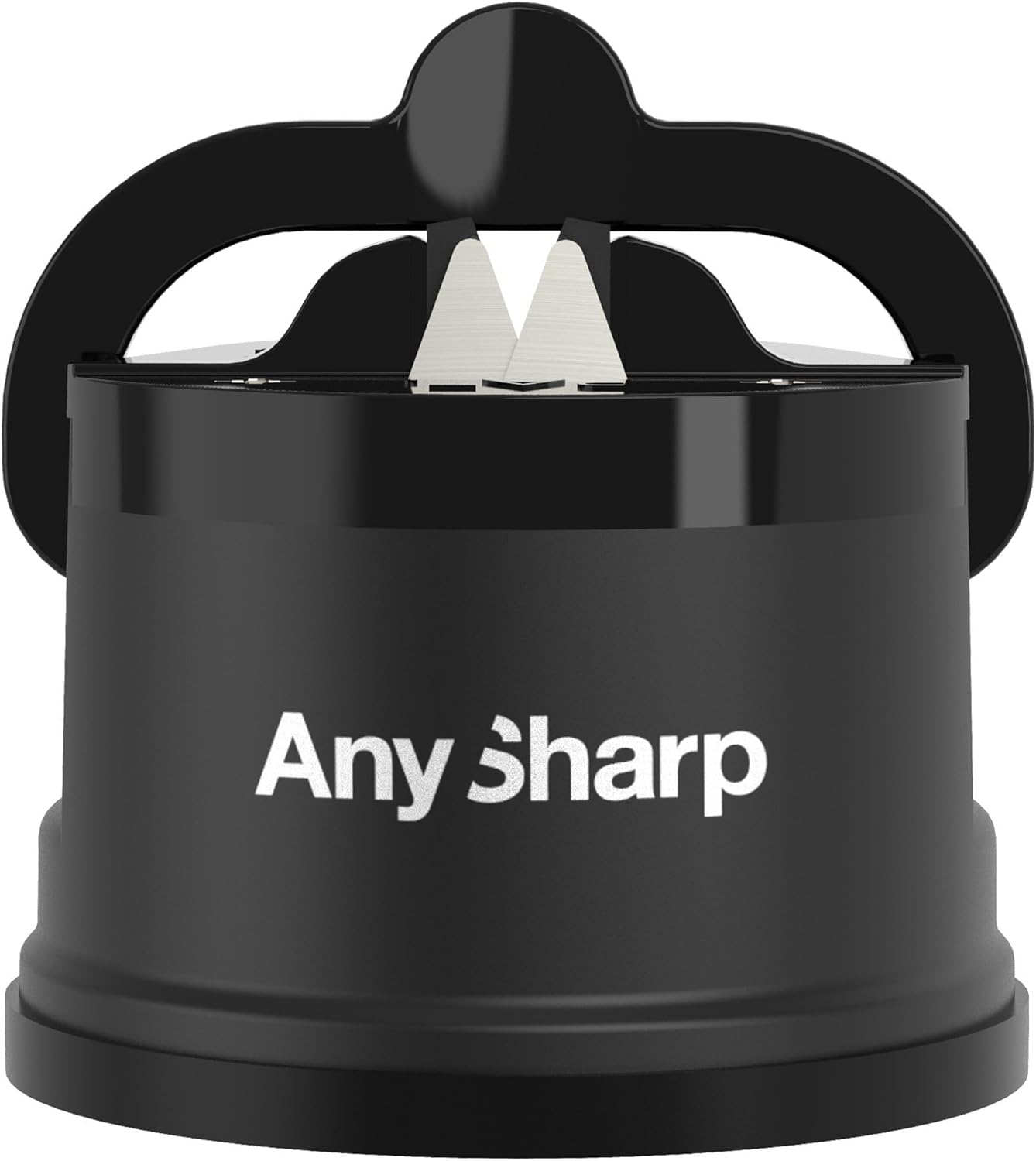
The most-reviewed sharpener anywhere — 79,547 ratings at 4.5 stars — for £8.00, and the only one here that names its angle.
Pros
- 79,547 ratings at 4.5 stars, 69 per cent five-star
- First in Amazon's Manual Knife Sharpeners category
- The only sharpener here that states its angle: 20 degrees
- Suction base keeps both hands away from the blade
- £8.00, two pounds less than the identical silver version
Cons
- Grit field says Fine for a carbide cutter
- Single stage: it sharpens, it does not polish
- 20 degrees will re-profile a thinner Japanese edge over time
- 3 per cent of its 79,547 ratings are one-star
Why it is number 1
- Angle
- 20 degrees, pre-set The only angle published in this ranking
- Grit as listed
- Fine A carbide cutter does not hone
- Material
- Plastic and tungsten carbide Two carbide blades, so it removes metal
- Mounting
- PowerGrip suction base Hands-free, and it suits a worktop
- Ratings
- 4.5 from 79,547 The largest sample in this ranking
- Price
- £8.00 The cheaper of the two colours of the same tool
What buyers actually say
Quoted from customer reviews on Amazon
Verified purchase“Great product would definitely purchase again”
Verified purchase“Was a chef for about 20 years this is one of the best sharpeners I've used. I used them in work and still use it at home”
The most-reviewed knife sharpener on Amazon and one of the most-reviewed products on this site: 79,547 ratings at 4.5 stars, 69 per cent five-star and 3 per cent one-star, for £8.00, and first in Amazon's Manual Knife Sharpeners category. It works by suction: a PowerGrip base clamps to the worktop, the knife is drawn through two tungsten carbide blades, and the hands stay away from the edge, which is both the safety claim and the reason it outsells everything else.
What it also does — uniquely in this ranking — is state the angle. Pre-set at the optimal 20-degree angle, the listing says, and that is the only angle in any of the ten sharpeners here, where the equivalent field in the knives themselves was published by one listing in ten. Twenty degrees is the European kitchen convention, the angle a German chef's knife is ground to, and knowing that a sharpener imposes it is the difference between maintaining a blade and slowly changing its character: a Japanese knife ground at twelve degrees will end up at twenty if it is put through this every week.
Its pricing is the other thing worth noticing, because this product appears twice in this ranking. The black version is £8.00 and the silver is £10.00, they share the same 79,547 ratings, and their model numbers are ANYSHARPBLACK and ANYSHARPSILVER — which is to say that the colour is the model, and it costs two pounds. The same listing records a fine grit type for a tool that removes metal rather than honing it, and its own GTIN field contains a single code where the silver version's contains two. Its reviews are the reason for the rank: a buyer who was a chef for twenty years calling it one of the best sharpeners they have used, and another who has sharpened every knife and pair of scissors in the house with it.
AnySharp Knife Sharpener Silver, Hands-Free Suction, 20 Degree

The silver version of the sharpener at number one, £2 dearer, with two barcodes in its identification field.
Pros
- The same 79,547 ratings and 4.5 stars as the black version
- First in Amazon's Manual Knife Sharpeners category
- States the 20-degree pre-set angle
- Real model number and part number, unlike the black listing
- A silver finish, if that is what the kitchen wants
Cons
- Two pounds more than the identical black version
- Two barcodes in one GTIN field
- Grit recorded as fine for a carbide cutter
- Re-profile the knife to 20 degrees every time it is used
Why it is number 2
- GTIN as listed
- Two barcodes in one field 05037430044927 and 05037430701226
- Model number
- 42535 A real code, unlike the black listing's
- Part number
- ANYSHARPSILVER The colour is in the part number
- Angle
- 20 degrees, pre-set As with the black version
- Price
- £10.00 Two pounds more than the same tool in black
- Ratings
- 4.5 from 79,547 A pool shared with number one
What buyers actually say
Quoted from customer reviews on Amazon
Verified purchase“Nice little sharpen, I have sharpened all my knives and scissors and it stayed in place all the time.”
Verified purchase“Works too good my knifes are now very very sharp and can slice through a sheet of paper no effort at all, knifes are now literally razor sharp 👌🏿”
The same tool as number one on a second listing, and two pounds more expensive for the colour. Both share the 79,547 ratings and the same 4.5 stars, both are ranked first in Manual Knife Sharpeners, both state the same pre-set 20-degree angle and the same PowerGrip suction base — and the black version costs £8.00 against £10.00 here. It is the clearest example in this ranking of a listing where the only variable is the finish, and it makes the point that £2 is what silver costs.
Its identification fields are the interesting part, and they are better and worse than the black version's at the same time. The manufacturer part number is ANYSHARPSILVER, which is a real code with the colour inside it, and the model number is 42535, which is a genuine model — both better than the black listing, whose model number is ANYSHARPBLACK. Then the GTIN field contains two barcodes separated by a comma: 05037430044927 and 05037430701226. Two global trade item numbers for one product means the field was filled from a system that had more than one record, and since a barcode is the one identifier that must be unique, it is worth knowing that this page is not certain which product it is describing.
The tool itself does what the first listing says it does, with one difference in the specification that neither version explains: the grit type is recorded as fine, which is what the black version says too, on a device that uses tungsten carbide to cut a new edge rather than a stone to refine one. Its reviews describe a buyer sharpening every knife and pair of scissors in the house, and another whose knives now slice through things that previously resisted. If you want the tool, buy the black one; if the colour matters, this is what it costs.
Smart Sharp Knife Sharpener 3-Stage with Ceramic and Carbide Slots
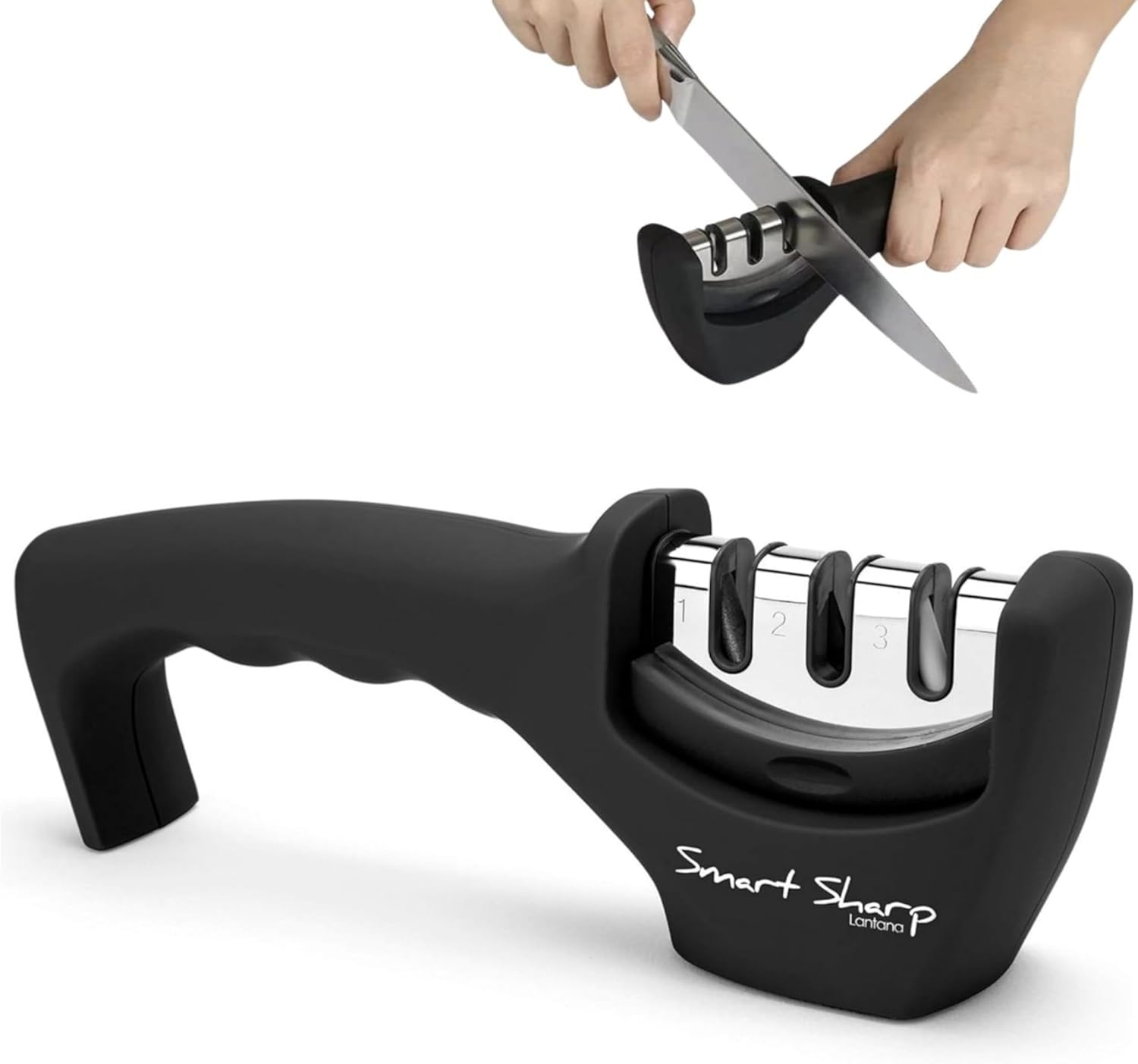
24,187 ratings at 4.5 stars for £12.99, with three stages described by one word in the specification.
Pros
- 24,187 ratings at 4.5 stars, 70 per cent five-star
- Three stages: carbide for the edge, ceramic for refining
- Non-slip base and a handle for either hand
- 185g and 7.5cm long, so it stores in a drawer
- £12.99 for three grades in one tool
Cons
- Grit field says Coarse for a three-stage tool
- Manufacturer part number reads Does not apply
- Carbide slots remove metal quickly
- 2 per cent of its 24,187 ratings are one-star
Why it is number 3
- Grit as listed
- Coarse One word for three stages
- Part number as listed
- Does not apply A refusal in a lookup field
- Materials
- Ceramic and tungsten carbide Stated, and they match the three slots
- Dimensions
- 7.5 x 4.5 x 2 cm Small enough for a drawer
- Item weight
- 185 g Light, and stable on a rubber base
- Ratings
- 4.5 from 24,187 70 per cent five-star, 2 per cent one-star
What buyers actually say
Quoted from customer reviews on Amazon
Verified purchase“Worked really well , i have nice sharpened knives now”
Verified purchase“Easy to use and leaves knives very sharp. Pleased with the purchase”
The best-selling multi-stage sharpener here and the clearest demonstration of what the grit field is for and how it is used. It is a three-stage tool — coarse, medium and fine slots, using tungsten carbide for the first and ceramic for the rest — and its grit type field says coarse. One word for a product whose entire purpose is to provide three grades, on a listing whose photographs show three labelled slots and whose bullets say 3-Stage Manual Knife Sharpener. It is not a lie; it is a field filled in with the first option available, and it makes the three sharpeners here that do the job properly stand out.
The second field is worse. The manufacturer part number is Does not apply, which is the answer a form gives when the person filling it in has decided not to, and it sits in the field a customer would use to find the right product again. The model number is KIO, which is at least a string. Against that, the materials are recorded accurately — ceramic and tungsten carbide — and the design details are real: a non-slip rubber base, a handle that works for left and right-handed users, 185 grams, and dimensions of 7.5 by 4.5 by 2 centimetres, which is small enough for a drawer.
Its record is 24,187 ratings at 4.5 stars with 70 per cent five-star and 2 per cent one-star, the second-largest sample in this ranking and the second-best distribution among the large ones, and it is ranked third in Manual Knife Sharpeners. The reviews are the ordinary ones for a tool that works: it did the job and left the knives sharp, and it is easy to use and pleases its buyer. At £12.99 it is the middle of the price range and the one to buy if you want the three grades in one body rather than one grade and a claim.
Diamond Edge No.1 Knife Sharpener, 2-Stage, Tungsten Carbide

10,515 ratings at 4.4 stars for £12.99, in a compact 70-gram body with two carbide stages.
Pros
- 10,515 ratings at 4.4 stars, 66 per cent five-star
- 70g and 6cm across: it fits in a drawer or a pocket
- Two stages, carbide and a finer pass
- Second in Amazon's Manual Knife Sharpeners category
- £12.99 for a tool with this much evidence
Cons
- Grit field says Fine for a carbide cutter
- Removes metal quickly, as its own review warns
- The angle is mentioned in a bullet but not stated
- 4 per cent of its 10,515 ratings are one-star
Why it is number 4
- Grit as listed
- Fine One word, for a two-stage cutter
- Material
- Tungsten carbide A cutter, not a hone
- Item weight
- 70 g The lightest sharpener in this ranking
- Dimensions
- 6.2 x 6.2 x 6.7 cm Compact enough to store anywhere
- Rating warning
- Reviewers note it removes metal The cost of carbide
- Ratings
- 4.4 from 10,515 66 per cent five-star, 4 per cent one-star
What buyers actually say
Quoted from customer reviews on Amazon
Verified purchase“Small but works perfectly. I’m very happy with it.”
Verified purchase“Love this little addition to my kitchen, really does a great job.”
The smallest sharpener in this ranking and the one whose reviews are most direct about what a carbide sharpener does. It is a two-stage tool weighing 70 grams, 6.2 by 6.2 by 6.7 centimetres, using tungsten carbide to cut a new edge and a finer stage to tidy it, priced at £12.99 with 10,515 ratings at 4.4 stars, 66 per cent five-star and 4 per cent one-star, and ranked second in Manual Knife Sharpeners.
One of its featured reviews says the thing no manufacturer does: takes a lot of metal off the blade, take it easy when dragging through. That is the trade of every pull-through carbide sharpener, including the ones at the top of this page, and it is worth repeating because it explains why a sharpener and a whetstone cost the same money and do different jobs. Carbide cuts a new bevel by removing steel, quickly and reliably; a stone refines the bevel that is already there, slowly and with a risk of going wrong. A knife sharpened weekly with carbide will be visibly slimmer within a year, and that is a fact about the technique rather than about this product.
Its specification has the same flaw as the sharpeners above it: the grit type is recorded as fine, which describes neither stage of a tool that starts by cutting metal. The rest is competent — a material of tungsten carbide, a weight of 70 grams, a compact shape that fits a pocket or a drawer, and a bullet claiming it is preset at an angle that the text cuts off before naming. At £12.99 for a ten-thousand-review tool, it is the right purchase for someone who wants a sharpener that disappears into a drawer, and the wrong one for a knife they care about.
Diamond Edge No.1 Knife Sharpener, Ruby Red, 2-Stage

The ruby red version of the sharpener at number four: same price, same 10,515 ratings, ten grams lighter in the fields.
Pros
- Same tool, same price and same pooled ratings as number four
- Ruby Red finish, if the drawer is that sort of drawer
- Compact and light, at 60 or 70 grams depending on the page
- Two stages of tungsten carbide
- Buyers find it better than sharper tools at a higher price
Cons
- Weight disagrees with the identical black listing by 10g
- Dimensions listed in a different order from number four
- Grit field says Fine for a carbide cutter
- Removes metal from the edge, per its own reviewers
Why it is number 5
- Item weight
- 60 g The black version says 70g for the same tool
- Dimensions as listed
- 6.2 x 6.2 x 6.7 cm The same cube, in the other listing's other order
- Colour
- Ruby Red The only real difference from number four
- Material
- Tungsten carbide A cutter rather than a hone
- Price
- £12.99 Identical to the black version
- Ratings
- 4.4 from 10,515 A pool shared with number four
What buyers actually say
Quoted from customer reviews on Amazon
Verified purchase“Takes a lot of metal off the blade take it easy when dragging through”
Verified purchase“This sharpner works well better than other sharpners at a higher price”
The same sharpener as number four in a different colour, at the same price, carrying the same 10,515 ratings and the same 4.4 stars, because Amazon pools them. The colour is Ruby Red against the other listing's Black, and the two pages differ in exactly two other places, both of them in the specification rather than the product.
The first is the weight: this listing says 60 grams and the black version says 70. Ten grams is not a rounding error on a sharpener that weighs 70, and nothing about a colour change affects it, so one of the two listings is wrong — and a buyer comparing the two by weight, which is a reasonable thing to do with a pocket tool, would conclude that red is lighter. The second is the order of the dimensions: 6.2 by 6.7 by 6.2 here against 6.2 by 6.2 by 6.7 there, which is the same cube described in two sequences with no labels. Neither error changes what arrives, and both are evidence of the same thing this article keeps finding: spec tables are copied, adjusted and never checked.
The tool is the one described at number four, with all its virtues and its one vice. It is compact, it uses tungsten carbide, and it removes metal — a buyer of this very listing writes that it takes a lot of steel off the blade and to take it easy when dragging through. Its other review is a comparison rather than a description: it works better than other sharpeners at a higher price. At £12.99 for either colour, the decision between this listing and number four is the decision between red and black, and the weight difference is a typo rather than a fact.
Amazon Basics Whetstone Dual Sided 1000/6000 Grit with Angle Guide

£11.59 for the only stone here, with 1000 and 6000 grit stated in its own specification field.
Pros
- The only grit field here with real numbers: 1000/6000
- Used with water rather than oil
- Non-slip bamboo base and a supplied angle guide
- 1,560 ratings at 4.5 stars, 71 per cent five-star
- £11.59 for the tool that maintains an edge rather than replacing it
Cons
- Requires practice, unlike a pull-through sharpener
- 953g: it lives in a drawer, not a pocket
- 2 per cent of its 1,560 ratings are one-star
- Stones need soaking and drying to last
Why it is number 6
- Grit as listed
- 1000/6000 The only numeric grit entry in this ranking
- Sharpening medium
- Water, not oil Less mess in a kitchen
- Included
- Angle guide The accessory that makes freehand sharpening repeatable
- Base
- Non-slip bamboo Holds the stone while both hands work
- Item weight
- 953 g A stone, not a gadget
- Ratings
- 4.5 from 1,560 71 per cent five-star, 2 per cent one-star
What buyers actually say
Quoted from customer reviews on Amazon
Verified purchase“I have never had sharper knifes, quit stalling and get one of these”
Verified purchase“All good great I love it works well, unable to take a photo because I am at work.”
The only sharpener in this ranking that fills its grit field with numbers, and the juxtaposition is the whole article. Nine of these listings record the grit as a word: coarse, fine, or fine, or coarse. This one records 1000/6000, which is the same information a knife maker would use, and it appears both in the title and in the specification field as 1000/6000 — one value for each side of the stone, with no ambiguity about which is which.
What the numbers mean is worth stating, because nowhere on the page does. A 1000-grit stone is a sharpening grade: it removes enough steel to raise a fresh edge and leaves it slightly toothy, which is what a kitchen knife wants. A 6000-grit side is a finishing grade, used to polish that edge on a few light strokes. A pull-through sharpener with two tungsten carbide blades and no grit numbers is doing roughly the work of a 300-grit file, which is why its own reviewers warn about the metal it removes. If you want to know whether you are maintaining a knife or grinding it away, the grit number is the answer, and this is the listing that gives it.
The rest of the product is designed for someone who has never used a stone. It is used with water rather than oil, which makes it less messy and easier to keep in a kitchen drawer; it comes with a non-slip bamboo base; and it includes an angle guide, which is the piece of equipment that makes freehand sharpening repeatable. It weighs 953 grams, measures 21.3 by 9.1 by 4.6 centimetres, and holds 1,560 ratings at 4.5 stars with 71 per cent five-star and 2 per cent one-star, ranked second among whetstones. Its reviews include one buyer who says they have never had sharper knives and tells the reader to stop stalling — which, for a product that requires an evening of practice to learn, is the most useful recommendation here.
Rolling Knife Sharpener with 400 and 1000 Mesh Diamond Discs
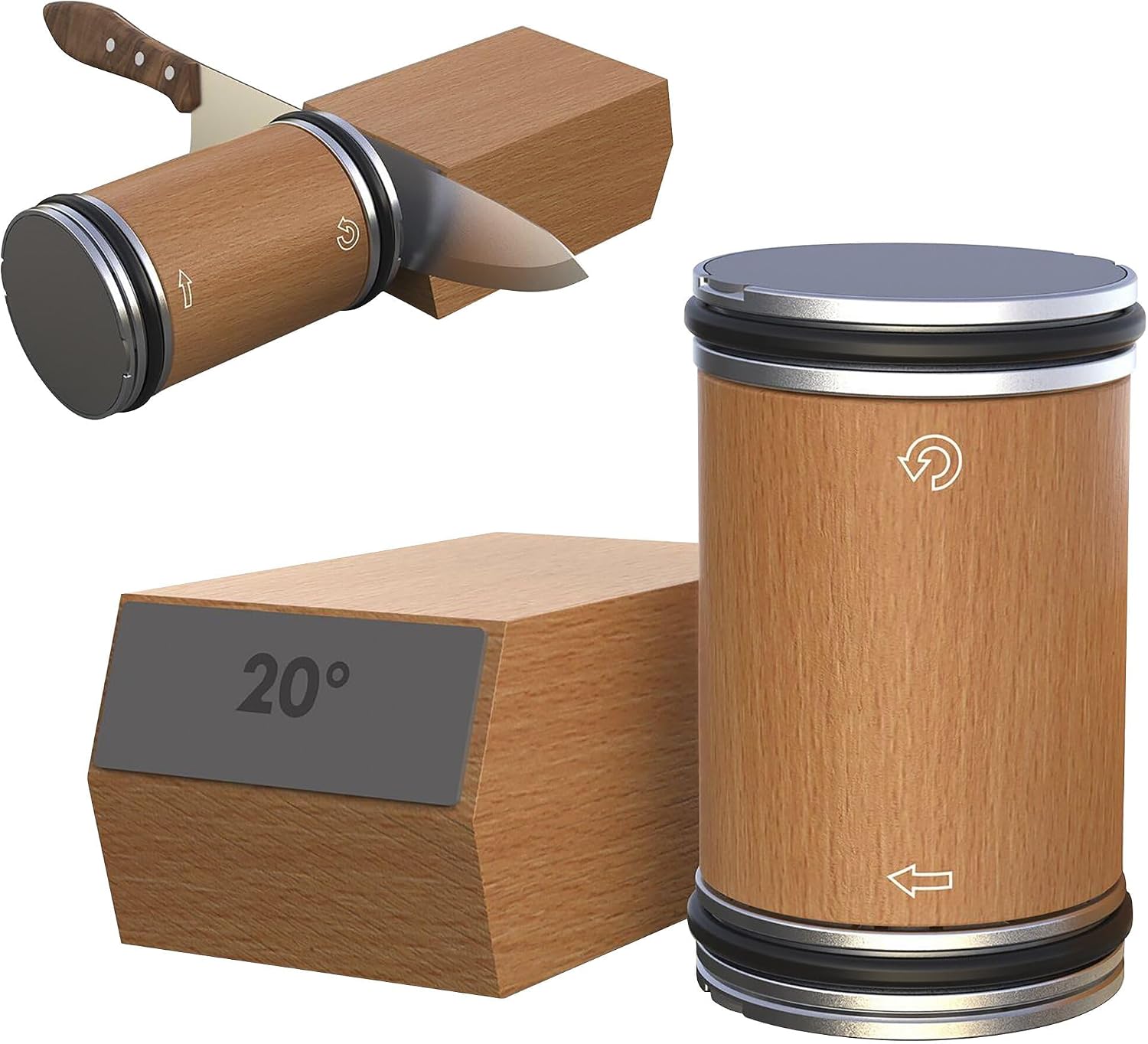
The only sharpener here that names both of its grits — 400 and 1000 mesh — for £24.99, with the field saying Fine.
Pros
- Both grits named in the bullets: 400 and 1000 mesh
- Industrial diamond discs
- The rolling motion fixes the angle without practice
- 1,351 ratings at 4.2 stars
- Keeps the blade flat rather than relying on hand steadiness
Cons
- Grit field says Fine despite two published grades
- Model number recorded as 01
- Ranked first among Sharpening Steels, which it is not
- £24.99, the dearest sharpener here, with 7 per cent one-star
Why it is number 7
- Grits in the bullets
- 400 mesh coarse and 1000 mesh fine The clearest grit information in this ranking
- Grit as listed
- Fine One word where the bullets give two numbers
- Discs
- Industrial diamond The hard-wearing option
- Model number
- 01 A dropdown value, not a model
- Category rank
- 1st in Sharpening Steels It is not a steel
- Ratings
- 4.2 from 1,351 63 per cent five-star, 7 per cent one-star
What buyers actually say
Quoted from customer reviews on Amazon
Verified purchase“Very easy to use and gives my kitchen knives a noticeably sharper edge. The rolling design makes sharpening simple and consistent. Good quality and worth the price.”
Verified purchase“This rolling knife sharpener is simple to use and works really well.It gives my kitchen knives a noticeably sharper edge with little effort.Compact, easy to store, and great value for the price.”
The sharpener with the best information in the wrong places. Its bullets give both of its grades with numbers — 400 mesh coarse on the rotating side and 1000 mesh fine on the fixed side — and explain the mechanism, which is a diamond disc that rolls the knife through at a consistent angle rather than a slot the knife is pulled through. The grit type field, meanwhile, says fine, because one word is what the field accepts and nobody chose to type two.
That gap between the bullet and the field is the article in miniature, and it appears here alongside two other familiar defects. The model number is 01, which is not a model number but the first value in a dropdown. And the category badge says this is ranked first among Sharpening Steels, which is a category for the long rods sold with knife sets; a rolling sharpener with industrial diamond discs is about as far from a steel as a sharpener can be. As with the chef's knife filed among santokus and the santoku filed among boning knives in this site's other rankings, the badge describes an algorithm rather than the product.
What the tool offers is the most controlled sharpening here without practice. The rolling motion fixes the angle for you, the discs are industrial diamond, and the design keeps the blade flat against the stone rather than relying on the steadiness of a hand — for someone who has tried a whetstone and produced a wobbly edge, that is worth paying for. It weighs 570 grams, measures 15 by 14 by 3.9 centimetres, and holds 1,351 ratings at 4.2 stars with 63 per cent five-star and 7 per cent one-star, which is the second-weakest distribution of the larger samples. Its reviews are positive about the motion: noticeably sharper edges, simple to use, and it works well. At £24.99 it is the dearest sharpener here, and the title's collection of gift keywords — birthday present, Father's Day — suggests a product that is not sure who is buying it.
Amazon Basics 4-in-1 Knife and Scissor Sharpener with Safety Glove
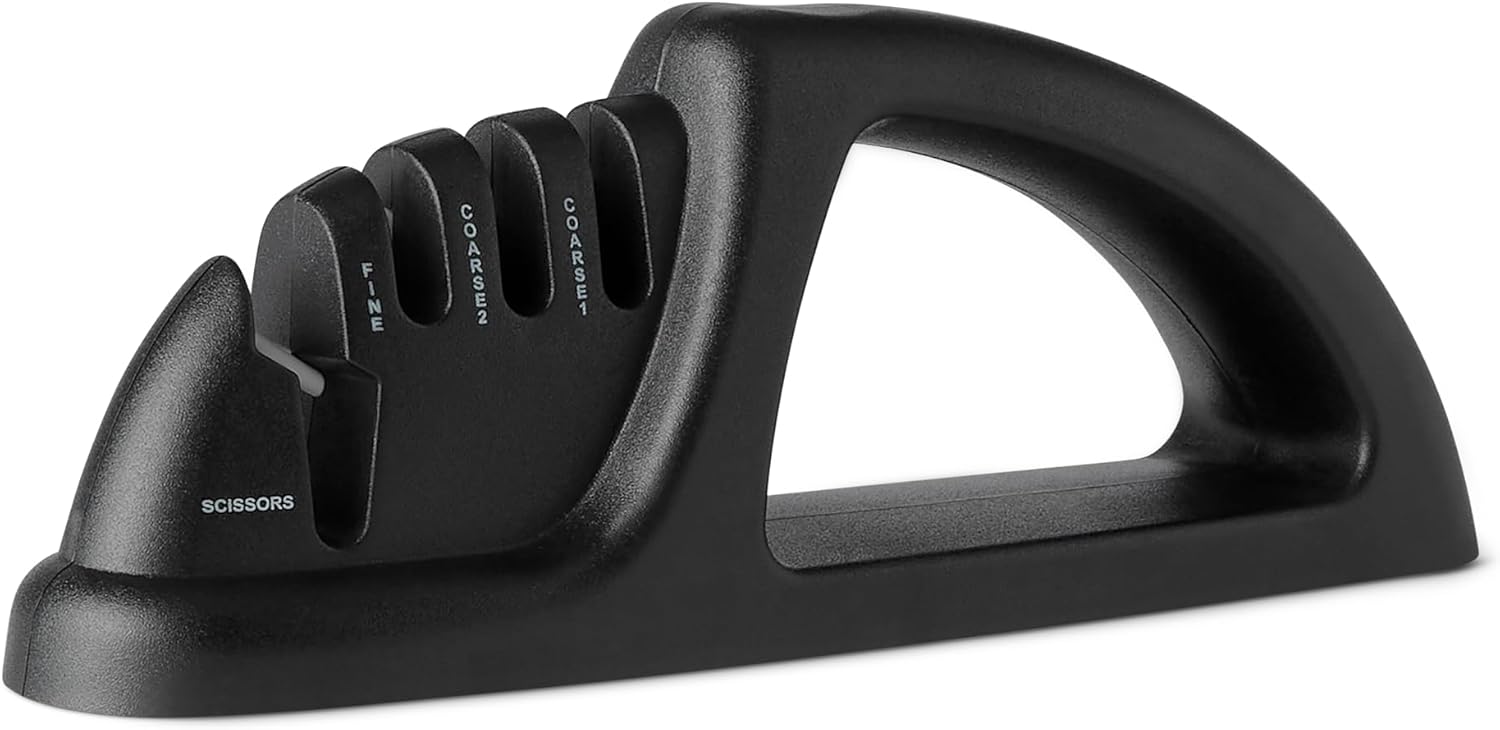
£8.89 for the only sharpener here with a scissor slot and a safety glove, and one of three that lists its grits properly.
Pros
- Grit field lists all three grades: coarse, medium, fine
- A dedicated scissor slot, which most households need
- Safety glove included in the box
- Only 1 per cent one-star reviews, among the best here
- £8.89 for a three-stage tool with two extras
Cons
- 751 ratings is a modest sample
- Pull-through carbide still removes metal
- 22.6cm long, so it needs drawer space
- No angle published
Why it is number 8
- Grit as listed
- Coarse, Medium, Fine All three grades named, unlike most here
- Functions
- 4-in-1: three stages plus scissors Explained rather than asserted
- Included
- Safety glove The only sharpener here that provides one
- Item weight
- 322 g Stable, and it needs the room
- Ratings
- 4.4 from 751 68 per cent five-star, 1 per cent one-star
- Price
- £8.89 Three stages and two extras for under nine pounds
What buyers actually say
Quoted from customer reviews on Amazon
Verified purchase“Simple, basic and easy to use. Inexpensive too boot, no brainer”
Verified purchase“Easy to use and very effective, good for work tools and Sabatier knives.”
The listing that fills the grit field the way it should be filled, and the only one that thinks about what happens to the hand holding the knife. Its three grades are recorded as coarse, medium and fine, which is the whole specification in three words rather than one, and its 4-in-1 claim is explained rather than asserted: three stages for knives plus a dedicated scissor slot, which is the fourth function and the one most households need. Scissors are the tool everyone owns, nobody sharpens, and quietly stops cutting paper years before they are thrown away.
The safety glove is the other detail no competitor here offers. A pull-through sharpener asks a user to draw a blade towards the body while holding the tool with the other hand, and a glove for the holding hand is the kind of precaution that reads as over-cautious until the first time it is needed. It is included in the box, it is recorded in the item type field as part of the product's name, and it is the sort of thing a large retailer's own brand does that a marketplace seller does not.
What you get for £8.89 is a 322-gram tool 22.6 centimetres long, with metal and plastic construction, a non-slip base, and a copy that describes it as suitable for kitchen knives, pocket knives, hunting knives and other straight-edged blades — which is a longer list than most home cooks need and a fair description of what a pull-through tool can do. Its record is 751 ratings at 4.4 stars with 68 per cent five-star and only 1 per cent one-star, the best one-star share of any listing here apart from the whetstone. The reviews are brief and satisfied: simple, basic and easy to use, inexpensive to boot, and effective on work tools as well as Sabatier knives.
Pietuley 7-in-1 Knife Sharpener with Serrated and Scissor Slots

£5.98 for a seven-function sharpener with its three grits listed correctly and its model number set to 7-in-1.
Pros
- Grits listed as coarse, medium and fine
- Slots for serrated and ceramic knives, plus scissors
- £5.98: the cheapest three-stage sharpener in this ranking
- 310g with a textured non-slip grip
- Buyers report stopping buying new knives
Cons
- Model number recorded as 7-in-1
- 224 ratings: a small sample
- 7 per cent of its 224 ratings are one-star
- The seven functions include knife types rather than grades
Why it is number 9
- Grit as listed
- Coarse, Medium, Fine Correctly completed, like two others here
- Model number
- 7-in-1 The marketing name in the model field
- Functions
- 7, including serrated, ceramic and scissors A counted claim, but the slots exist
- Material
- Plastic With a textured grip
- Item weight
- 310 g Stable for a pull-through tool
- Ratings
- 4.2 from 224 62 per cent five-star, 7 per cent one-star
What buyers actually say
Quoted from customer reviews on Amazon
Verified purchase“Works perfectly. It sharpened my old knives quickly and made them slice like new again. Easy to use, sturdy, and doesn’t slide around. Definitely worth buying.”
Verified purchase“I have been buying new knives because I don’t like blunt knives. Now I got a knife sharpener instead.It’s easy to use, great, sharpening tool for small amounts of money.”
The cheapest three-stage sharpener here, and the second of the three listings that fills the grit field properly. Its grades are recorded as coarse, medium and fine, and its bullets explain what the seven functions are: a coarse slot, a fine honing slot, a polishing slot, and slots for different knife types including serrated and ceramic blades, plus a scissor sharpener. Counting functions is how these products are sold, so the number seven is marketing — but the grits behind it are real, and this listing names them.
Where its paperwork slips into the familiar pattern is the model number, which is recorded as 7-in-1: the marketing name in the field meant for a manufacturer's code. That is the same habit as the chef's knife whose model number reads 8 inch Chef Knife and the smartwatch whose model is Extra Wide, and it has the same consequence, which is that a buyer cannot search for the product again by its identifier.
The tool is a 310-gram pull-through, 24 centimetres long, made of plastic with a grip that the bullets describe as textured and anti-slip, and it costs £5.98. Its record is 224 ratings at 4.2 stars with 62 per cent five-star and 7 per cent one-star, which is a small sample and a middling distribution, and its reviews are the ones that make the case for buying one of these at all: a buyer whose old knives were sharpened quickly and now slice properly, and another who says they had been buying new knives because they dislike blunt ones, and no longer does. At £5.98 it is the cheapest way here to get three grades in one body, and the one to choose if the question is whether a sharpener is worth having at all.
Sharp Knife Sharpener 3-Stage with Non-Slip Base, Red

£4.59 for a three-stage sharpener whose grits are named correctly and whose record, at 19 ratings, is the weakest here.
Pros
- £4.59: the cheapest sharpener in this ranking
- Grits named: coarse, fine and polishing
- Real model number and stated materials
- Thin, light and designed to be gripped
- Its two featured reviews are positive
Cons
- 19 ratings: far too few to judge a tool by
- 22 per cent one-star, the worst share here
- 3.5 stars, the lowest average in the ranking
- No angle and no brand history
Why it is number 10
- Grit as listed
- Coarse/Fine/Polishing All three stages named, though Medium is missing
- Ratings
- 3.5 from 19 44 per cent five-star, 22 per cent one-star
- Material
- Polypropylene and stainless steel Stated plainly
- Item weight
- 150 g Light, and thin enough to hold
- Model number
- 4221506 A real number, unlike several here
- Price
- £4.59 The cheapest sharpener here
What buyers actually say
Quoted from customer reviews on Amazon
Verified purchase“It does what it supposed to do. Which is all that you need.”
Verified purchase“Took a few minutes to sharpen all the kitchen knives. Very pleased with results, all like new.”
The weakest-recorded sharpener in this ranking and the cheapest, and it is worth looking at why those two facts arrive together. It has nineteen ratings, of which 44 per cent are five-star and 22 per cent are one-star, which averages to 3.5. Nineteen reviews is not a sample; it is an anecdote with a decimal point, and a product with four one-star reviews out of nineteen has failed for somebody four times. The two reviews featured on the page are both five-stars and neither is revealing — one says it does what it is supposed to do, which is all you need, and the other that it took a few minutes to sharpen all the kitchen knives.
Its specification is better than its record. The grit type reads coarse, fine and polishing, which names all three of its stages, and it is one of only three listings here that fills that field with more than one word. The materials are polypropylene and stainless steel, the weight is 150 grams, it is 21.5 by 2.5 by 5.5 centimetres — a thin tool designed to be held rather than stood on a worktop — and the model number is a real number, 4221506. It has a non-slip textured handle and a curved grip, and it costs £4.59, which is the price of a sandwich.
So the honest summary is that the cheapest sharpener here is the one with the least evidence, and that the evidence is bad rather than merely thin. Everything in this ranking costs between £4.59 and £24.99, and the difference between the top and the bottom of that range is not the ability to sharpen a knife — all of these tools will do that — but whether anything is known about how long one lasts. At £4.59 with nineteen ratings, nothing is.
Final Verdict
What we would buy. The AnySharp at £8.00 is the sharpener we would buy for a household that wants a knife sharpened in ten seconds: 79,547 ratings at 4.5 stars is the deepest sample in this ranking, it is the only tool here that states its angle, and the suction base keeps the hand away from the blade. If you would rather maintain your knives than grind them, the Amazon Basics whetstone at £11.59 is the only product here whose grit field carries real numbers, with a 1000 side and a 6000 side, used with water and supplied with an angle guide. If you want three grades in one body, the Smart Sharp at £12.99 has the second-largest sample and both carbide and ceramic slots, and the Pietuley at £5.98 does the same job for the price of a sandwich. If you want the extras, the Amazon Basics 4-in-1 at £8.89 adds a scissor slot and a safety glove and is the only listing here with a near-perfect record. If you have tried a stone and produced a wobbly edge, the rolling sharpener at £24.99 holds the angle for you and is the only one that names both of its grits — in the bullets, at least. And if the budget is £5, remember that the cheapest tool here has nineteen ratings and four of them are one star. What the listings will not tell you. Expect the grit field to hold one word where the tool has three grades, and treat the numbers in the bullets as the real specification: only three of these ten complete that field properly. Know which kind you are buying, because a pull-through cutter removes steel, a stone refines an edge and a rolling tool does something in between, and the reviews will tell you which one you have bought if you read them. Check the angle if it matters to you, since exactly one listing publishes one, and assume 20 degrees on anything that does not say. Look for an included angle guide if you choose a stone, because that is the accessory that turns practice into repeatability. Ignore the identification fields: one manufacturer part number says does not apply, another product's model number is 01, one barcode field holds two barcodes and two listings encode the colour in the model. And compare colour variants rather than trusting them, since two pounds is what silver costs and ten grams is what a typo weighs. Everything on this page comes from the Amazon listings, collected on 11 September 2026.

Written by
Felipe Iglesias
Founder & Lead Reviewer
Felipe is a computational engineering student who has been working in SEO since he was sixteen. He founded ranked10 and researches every guide on the site.
Related buying guides
All Kitchen guidesBest Oven Gloves 2026: 250 Degrees, But For How Long?
An oven glove is sold by a temperature, and no glove in this article is sold by a time. Ten pairs were collected for this ranking, from £5.99 to £11.99, and their pages are consistent about one thing only: a figure in degrees, with nothing attached to say for how long it holds. That is the difference between a glove and a glove. A pair rated to 250°C for three seconds is a pair for lifting a tray out of an oven; the same pair for thirty seconds is a pair for holding a roasting tin while the other hand finds a carving fork. The market publishes the first number and not the second, on every page, at every price — and the two best-positioned products here do not even publish the first. The Laffair pair at number four is first in its own subcategory, Oven Mitts, and describes its heat protection as double the protection of other competitors, a comparison with no unit on either side. The AH Artisan Home pair at number two has four thousand nine hundred ratings and promises that it easily handles high temperatures. Both are winning sellers. Neither has ever put a number in the field. Where figures do appear, they behave like the rest of the markets this site has examined. The AUAUY pairs at numbers six and seven state 250°C or 482°F, and the conversion is right — two hundred and fifty Celsius is four hundred and eighty-two Fahrenheit — which is rarer here than it should be. The Aouplry mitts at number eight go higher, to five hundred degrees, in a title printed with a glyph where the degree sign belongs; five hundred Celsius is a ceramics kiln, and if the claim is true it is true for a moment nobody specifies. The Premier Housewares pair at number five says only that it is designed to withstand high temperatures. The Abbey pair at number one states 250°C in a bullet, which makes it the most forthcoming of the best sellers, and still leaves the duration blank. What every specification does record is a field that has nothing to do with gloves. Eight of the ten listings carry a value under sleeping bag filling material, because that is the template a marketplace handed them and nobody has ever removed it — and the pair at number three has filled that field with a phrase instead, heat-resistant fabric, which is not a material. The same page measures itself as thirty-five by eight centimetres, where every double glove in this article is between eighty-three and ninety-one centimetres long and seventeen to eighteen across. The pair at number nine gives its length as eighty-four centimetres in one sentence and eighty-four centimetres of width in its own specification block, which would make it four times as wide as anything else here. Two colourways of one pair, at numbers six and seven, differ by seventeen per cent in weight and share exactly the same seven hundred and seventy-seven ratings. Nobody measured this category. They filled it in. One page in ten does the opposite, and it is the pair with the fewest buyers in the ranking. The Catherine Lansfield gloves at number ten use their bullet points to state the limits: suitable for use with domestic ovens only, do not use when wet, fabric gloves will not protect from spillages of hot liquid. Three sentences, each a safety warning a shopper needs, and none of them on any other page here — because the other nine are busy selling a temperature, and a temperature is the smaller half of the risk. A wet cotton glove conducts heat almost at once. A fabric glove taken near the fat in a roasting tin is a burn regardless of what it is rated for. The listing at number ten does not mention its own heat rating at all, which is consistent: a seller who tells you what a glove cannot do is not going to invent a ceiling for it.
KitchenBest Bread Bin 2026: The Capacity Field Is a Mess
A bread bin is sold by how much bread it holds, and the capacity field is where this market loses the plot. Of the ten bins below, four state a capacity in litres, three state nothing at all, one states a figure ten times too large and one — one — states one millilitre. That last figure belongs to the cream metal tin at number two, whose own storage volume field reads fifteen litres and whose dimensions multiply to 20.4 litres: three answers on one page, and the wrong one is in the field with the question's name on it. Divide 343,264 cubic centimetres — the capacity stated for the double-decker bamboo at number one — by its dimensions of 32 by 32 by 34 centimetres, and you get 9.86, which is a decimal point in the wrong place rather than a unit conversion. A buyer comparing these ten bins by their capacity fields, as any comparison site does, would conclude that the bin at number one is ten thousand times larger than the tin at number two.\n\nThe unit that replaces litres is the loaf, and a loaf has no size. One listing says that other bread boxes can only hold one loaf while its two layers hold two large loaves. A large loaf in Britain is about 800 grams and a small loaf about 400, so two large loaves is twice as much bread as two small ones, and the same sentence would be true of a bin half the size. None of the ten bins here states the loaf it was designed around, in grams, alongside the litres — which is the one measurement a buyer could actually use. The honest figures are the ones you can calculate: the cream tin, at 20.4 litres of external volume for a stated fifteen litres of bread, gives a ratio of 1.36, and the black version of the same bin gives 1.35 for a 20.2 litre box. Anything in that range is a bin whose plastic or steel is where it should be, and both of those pages are the same product listed twice, with a one millilitre error on one of them. The other two numbers that should settle a purchase are mostly missing as well. Weight tells a buyer what the bin is made of: 374 grams for a 20.4 litre metal tin against 1.29 kilograms for an 8 litre one, which is more than three times the steel per litre and the difference between a box that dents when a pan lands on it and one that does not. The ten pages here publish two weights, and they contradict each other: the cream tin says 374 grams and its own black version says 1.28 kilograms, for the same object at the same price, sold under the same three and a half thousand ratings. Ventilation is the other thing bread asks for — a sealed bin traps the moisture that makes a crust soft — and exactly one of the ten says it has any, which is the Swan at number eight, without describing how.\n\nThe one claim in this ranking that can be checked against an outside record is the FSC licence number on the Praknu box at number four: N004317, printed for the body and the lid, verifiable with the Forest Stewardship Council. Two other bins call themselves extra large, which means nothing, and one fills a features field with the words non-toxic and reusable, which are not features. Between a licence number a buyer can look up and an adjective, this category offers both, and only the number is a specification. The last useful thing in the numbers is the price: the cheapest bin here at £15.66 is the most heavily built per litre, with a bamboo board as a lid, and the dearest at £58.99 shares its entire review record with a box that costs twenty-four pounds less.
KitchenBest Meat Thermometer 2026: The Numbers That Exist
A meat thermometer is the one tool in a British kitchen whose specification publishes the two numbers that decide whether it is any good. Every listing in this ranking has a response time field in seconds, and every one of them answers it: half a second on the certified model at number one, one second on the cheap one at number four, three seconds on five of the ten, five hundred milliseconds on the OXO at number six, and ten seconds on the dearest TempPro at number eight. Some of them publish an accuracy too, from plus or minus one degree Celsius on the DOQAUS range to plus or minus three tenths of a degree, certified by the National Institute of Standards and Technology, on the ThermoMaven — which ships its certificate in the box. A frying pan never tells you its base diameter and a lunch box never tells you its usable volume; a thermometer tells you how fast it reacts and how wrong it can be.\n\nWhat it does with the rest of the page is the reason this article exists. Half a second is written as 0.5 seconds on one listing and as 500 milliseconds on another, so a buyer scanning two pages sees a number a thousand times larger and no indication that they are the same speed. The immersion depth of the probe — how deep it can safely go into a joint — is recorded in inches on four listings and in centimetres on four others, including two pages from the same brand where the same probe is 4.5 inches on one and 12 centimetres on the next. One listing files its IPX6 water rating under connectivity technology, the field meant for Wi-Fi; another answers that field with the single word no; a third records its temperature ceiling as 500 degrees Fahrenheit, in a market that cooks in Celsius. And six of the ten are marked rechargeable in a field called reusability while their own contents list a CR2032 or an AAA battery, which are the two most common cells in the world and are neither of them rechargeable. The most useful comparison in the ranking is inside one brand. TempPro sells three thermometers here, and the dearest of them is the slowest by a factor of three: the TP16 at £14.43 reads in ten seconds, while the TP03H at £8.45 reads in three, and the TP03H carries a hundred and thirty-five thousand ratings to the TP16's thirteen thousand. A buyer who chose by brand and by price — the ones with more money are better — would buy the slower thermometer for more money and never know. The TP16 is not a bad instrument: it is a different one, meant to sit in the meat with a wired probe and an alarm rather than be waved in and out, and a thermometer that stays in does not need to be fast. But the response time field does not know what the product is for, and neither does a comparison table.\n\nThat same TP03H also demonstrates the last habit of this market. It appears twice in this ranking, at number three and at number nine, and both pages print the same 135,966 ratings in full. Two listings of one instrument share one review pool, so the count is not evidence of twice the popularity — and a buyer comparing them side by side, as this page does, is looking at one product with two price tags, fifty-four pence apart. The larger lesson is the one written into the flagship DOQAUS at number two: fifty-nine thousand ratings for £7.99, a three second read and an accuracy of one degree, all three stated, which is more honest documentation than a £21 thermometer from a kitchen brand manages.
Comments
Reader comments are not checked against the manufacturer's claims above.
No comments yet
Be the first to add something we missed — a price change, a spec that turned out wrong, or how one of these held up.
Leave a comment
No account needed. Own one of these? Tell other readers how it actually performed.