Best Golf Launch Monitor 2026: 10 Ranked
By Felipe Iglesias · Updated
The short answer
The best golf launch monitor for most players is the Garmin Approach R10 at £445: 1,104 owners rate it 4.3, it reads club head speed, ball speed, swing tempo, ball spin and launch angle, and 10 hours of battery covers several range sessions before a charge. It is the right buy for anyone who wants one unit for the garage and the driving range and does not mind pairing a phone for the data.

The FlightScope Mevo names eight metrics for £269, which works out at £33.63 each, the cheapest data in this group. The Voice Caddie SC4 PRO names the same eight for £600.14, or £75.02 each, so the identical count of figures costs £331.14 more.
That gap repeats down the list. The PRGR spreads £170.14 over five figures, £34.03 each, and the Rapsodo MLM2PRO spreads £549 over thirteen, £42.23 each. The Voice Caddie SC200+ charges £269 for four figures, £67.25 each, more than double the Mevo for the same money.
The best golf launch monitor is therefore the one whose figures you will still be reading in June. A spin number you never open is worth nothing, and a cheap unit that reads carry distance every session is worth a lot.
Garmin Approach R10

For the golfer who wants one unit for the range and for indoor practice, reading club head speed, ball speed, swing tempo, ball spin and launch angle, with 10 hours of battery and a tripod, phone mount and carry case in the box.
Advantages
- 10 hours of battery, two hours more than the Rapsodo MLM2PRO
- 1,104 owners rate it 4.3, the largest rating base in the top three
- Waterproof to IPX7 for wet sessions
- Tripod stand, phone mount, carry case and microUSB cable included
- Reads ball spin as well as speed and launch angle
Disadvantages
- The full figures are read in the Garmin Golf app, so a phone has to come with you
- Virtual rounds and the weekly tournament need an active subscription
- £276 more than the Rapsodo Mobile Launch Monitor at £169
The Garmin Approach R10 is the pick for anyone who wants one portable unit that covers the garage, the garden and the driving range. It reads club head speed, ball speed, swing tempo, ball spin and launch angle, then pairs with the Garmin Golf app for a shot dispersion chart per club. It is the best golf launch monitor in this group for most players because that spread of data arrives with the strongest evidence behind it: 1,104 owners rate it 4.3.
The number that matters day to day is 10 hours of battery, two hours more than the Rapsodo MLM2PRO and four more than the Rapsodo MLM. It is waterproof to IPX7, so a wet morning on the range is not a problem, and the box holds a tripod stand, a phone mount, a carry case and a microUSB cable.
The limit is where the numbers live: they are read in the Garmin Golf app, and the 42,000 virtual courses and weekly tournament need an active subscription on top. If a built-in screen matters more than spin data, the Voice Caddie SC4 PRO has one for £155.14 more, and if the budget is tight the Rapsodo Mobile Launch Monitor at £169 is £276 less.
Rapsodo MLM2PRO Simulator
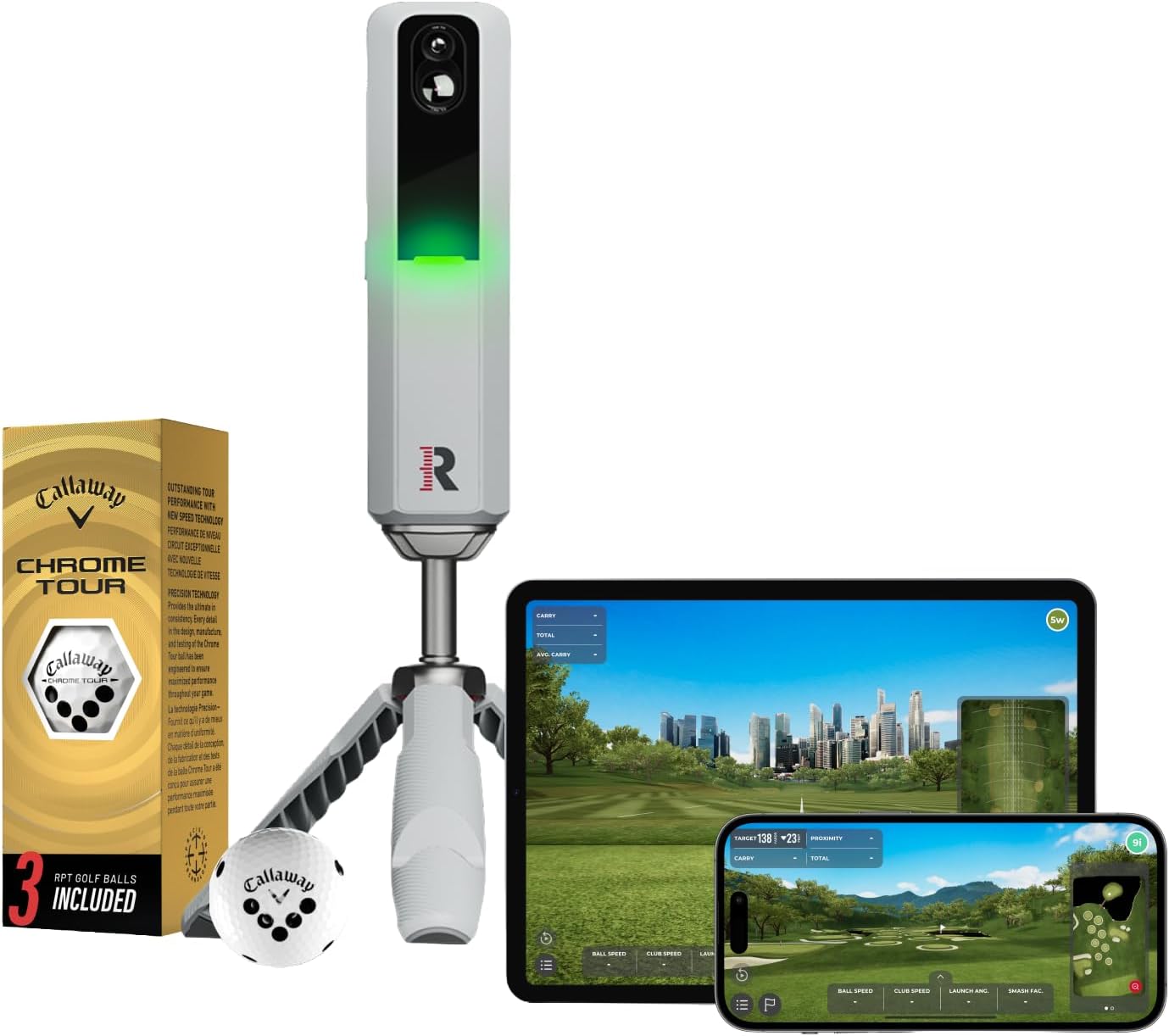
For the golfer who wants spin rate and spin axis at home plus a 30,000 course simulator, and will use the marked Callaway balls that come in the box.
Advantages
- Thirteen metrics, six of them measured, at £42.23 each
- Spin rate and spin axis for shot shape
- 30,000 courses for indoor rounds
- Three marked Callaway RPT Chrome Soft X balls in the box
- Apple and Android compatible
Disadvantages
- £104 more than the Garmin Approach R10
- Spin readings depend on marked balls
- 8 hours of battery, four fewer than the Garmin Approach G80
The Rapsodo MLM2PRO is for the golfer who wants a simulator in the garage rather than a range gadget in the bag. Dual optical camera vision works alongside radar, and 492 owners rate it 4.1. Shot Vision and Impact Vision give two replay angles, which is the part most units leave out.
Divide the £549 by the thirteen metrics it reads and each figure costs £42.23, which is £8.60 more than the FlightScope Mevo per figure and £5.15 less than the Voice Caddie Sc300i. The box holds three Callaway RPT Chrome Soft X balls, and that matters, because the spin rate and spin axis readings need marked balls to work. Simulation covers more than 30,000 courses, and the battery runs 8 hours.
The limits are the marked balls and the price. Spin figures fall away with an unmarked ball, and at £549 it is £104 more than the Garmin Approach R10, which also reads spin and lasts two hours longer. For speed and distance figures only, the Rapsodo Mobile Launch Monitor does the same job for £380 less at £169.
Rapsodo Mobile Launch Monitor

For the iPhone or iPad owner who wants real shot data and swing replay for £169 and does not need a spin figure.
Advantages
- £169, the cheapest of the ten
- 2,384 owners rate it 4.2, the largest rating base here
- Swing replay at 1920 x 1080
- Carrying case and charging cord included
- Works indoors and outdoors
Disadvantages
- iPhone and iPad only, no Android
- 6 hours of battery, the shortest of the app-based units
- No spin figure, which costs £100 more on the FlightScope Mevo
The Rapsodo Mobile Launch Monitor is for the iPhone or iPad owner who wants real shot data without buying a dedicated radar unit. It turns the phone into the sensor and shows data and insights after every shot, indoors or out. The evidence behind it is the strongest on this page: 2,384 owners rate it 4.2, more than twice the rating count of any other unit in the top ten.
At £169 it is the cheapest way into shot data here, £100 less than the FlightScope Mevo at £269. Swing replay records at 1920 x 1080, and the box holds a carrying case and a charging cord. The battery runs 6 hours, which is the shortest of the app-based units.
The limit is spin: there is no spin figure at all, so a slice stays a guess rather than a number. It is also locked to an iPhone or iPad, and Android is not supported. The FlightScope Mevo at £269 is £100 more and gives eight figures including spin, apex height and flight time.
FlightScope Mevo

For the golfer after the most data per pound: eight metrics on 3D Doppler radar, indoors or out, in a 49.8 g unit.
Advantages
- £33.63 per metric, the cheapest data here
- Eight metrics including spin, apex height and flight time
- Weighs 49.8 g and measures 8.9 x 3.8 x 6.1 cm
- 1,059 owners rate it 4.2
- Automatic video clips with data overlay
Disadvantages
- Spin without spin axis, so shot curve is not separated
- No simulator and no course play
- The app needs a phone or tablet for the video and statistics
The FlightScope Mevo is for the golfer who wants the most data per pound and practises on the range, on the course or at home with a net. It is built on 3D Doppler radar, and 1,059 owners rate it 4.2. With every club in the bag it gives carry distance, club head speed, ball speed, smash factor, vertical launch angle, spin, apex height and flight time.
That list of eight is the whole argument: £269 across eight metrics is £33.63 per figure, the lowest price per metric here and 40p less than the PRGR's £34.03. It weighs 49.8 g and measures 8.9 x 3.8 x 6.1 cm, so it lives in a golf bag pocket. The app clips and saves video with the data laid over the top, so a session can go straight to a coach.
The limit is shot shape. It reads spin, but not spin axis, so the curve of the ball is not separated from the total, which is exactly what the Rapsodo MLM2PRO does for £280 more. It is also a data unit and nothing else: there is no course play and no simulator, and the phone or tablet does the video work.
Voice Caddie Sc300i

For the golfer who wants spin rates and apex height on a built-in LCD without reaching for a phone, and rates accuracy above price.
Advantages
- 4.5 rating, the highest here
- Reads spin rates and apex height on the built-in LCD
- Speaks the distance out loud after each shot
- Remote control and USB cable included
- Adjustable loft angles for individual clubs
Disadvantages
- Only 75 owners have rated it so far
- £110 more than the FlightScope Mevo for the same eight figures
- Android support still to be confirmed
The Voice Caddie Sc300i is for the golfer who wants the numbers on the unit itself and not on a phone screen. Doppler radar feeds a built-in LCD with instant feedback, and 75 owners rate it 4.5, the highest average rating in this group. Adjustable loft angles and app connectivity with video analysis sit on top of that.
The price works out at £47.38 per metric: £379 over eight measures, which is £13.75 more per figure than the FlightScope Mevo. You get carry and total distance, smash factor, launch angle, swing speed, apex, ball speed and spin rates. It also speaks the distance out loud after each shot, with a remote and a USB cable in the box.
Two things hold it back. Only 75 buyers have rated it so far, the thinnest evidence in the top five, and the £110 difference against the FlightScope Mevo at £269 buys a screen rather than more data. The companion app runs on iOS, with Android support still to be confirmed.
PRGR Portable Launch Monitor

For the golfer who wants to switch it on, put it down and hit, with no app, no Wi-Fi and five figures on the LCD.
Advantages
- £34.03 per metric, the second cheapest here
- 1,200 owners rate it 4.2
- No app, no Wi-Fi and no downloads needed
- Scrolls back through shot history on the LCD
- Also works for tennis, football and baseball
Disadvantages
- No spin rate, apex height or launch angle
- Four AAA alkaline batteries, nothing rechargeable
- £1.14 more than the Rapsodo Mobile Launch Monitor, which records swing video
The PRGR Portable Launch Monitor is for the golfer who wants to switch it on, put it down and hit. There is no app pairing, no Wi-Fi and no download, and 1,200 owners rate it 4.2. Doppler radar and the LCD hand back swing speed, ball speed, carry distance, total distance and smash factor for each club.
£170.14 across five figures is £34.03 each, 40p behind the FlightScope Mevo and the second cheapest data here. A flight distance button switches the display between carry and total, and the scroll button walks back through the shot history. A camera screw underneath takes a tripod, and the manual shows how to use it for tennis, football and baseball as well.
The limit is depth of data: no spin rate, no apex height and no launch angle, so it is a distance and speed tool rather than a fitting tool. It runs on four AAA alkaline batteries, so pack spares for a long session and there is nothing to charge. At £170.14 it also costs £1.14 more than the Rapsodo Mobile Launch Monitor at £169, which adds swing video.
Garmin Approach G80

For the golfer who wants course GPS yardages on a 3.5 inch touchscreen first and basic radar figures second.
Advantages
- 15 hours of battery with GPS, the longest here
- 41,000 course maps on a 3.5 inch sunlight-readable touchscreen
- 679 owners rate it 4.3
- Radar reads club head speed, ball speed, smash factor, swing tempo and estimated distance
- Trolley mount and lanyard carabiner included
Disadvantages
- No spin figure for shot shape
- Club head speed accurate to +/- 5 mph
- £191.66 more buys the Garmin Approach R10's spin data
The Garmin Approach G80 is for the golfer who wants yardages on the course first and practice numbers second. More than 41,000 detailed course maps come preloaded on a 3.5 inch sunlight-readable touchscreen, with quick button access to the radar. 679 owners rate it 4.3.
The radar side reads club head speed, ball speed, smash factor, swing tempo and estimated distance, five figures that work out at £50.67 each on a £253.34 unit. Club head speed is accurate to +/- 5 mph, which is fine for spotting a trend across ten shots. Battery life reaches 15 hours with GPS, five hours more than the Garmin Approach R10, and a trolley mount and lanyard carabiner come in the box.
The limit is what the radar leaves out: there is no spin figure, so shot shape stays a matter of the eye. Most of the £253.34 pays for the mapping rather than the radar. If spin data matters as much as yardages, the Garmin Approach R10 costs £191.66 more at £445.
Voice Caddie SC4 PRO

For the iOS golfer who wants a built-in screen, a 3D driving range simulator and spin rate with side spin in one unit.
Advantages
- Spin rate and side spin for diagnosing shot curve
- Built-in screen and 3D driving range
- E6 Connect with one free course and a driving range
- 590 g unit with batteries included
- Voice output of distances
Disadvantages
- £75.02 per metric, the dearest data here
- £331.14 more than the FlightScope Mevo for eight figures
- Simulator available on iOS only, no Android
The Voice Caddie SC4 PRO is for the iOS golfer who wants a screen of their own, a simulator at home and spin data in one box. Eight key measures come off Doppler radar, and 139 owners rate it 4.1. The remote keeps the unit out of the way while you hit.
£600.14 across eight measures divides into £75.02 per figure, more than double the FlightScope Mevo's £33.63. Inside that count sit spin rate and side spin, plus launch direction and apex height, which the cheaper units leave out. It also carries its own screen and a 3D driving range, and E6 Connect includes one free course and a driving range before any subscription. The unit weighs 590 g and arrives with batteries included.
The limits are the price and the phone. The simulator runs on iOS only, so an Android handset cannot use it, and the same eight figures cost £331.14 less on the FlightScope Mevo. If you want spin axis with a camera behind it, the Rapsodo MLM2PRO at £549 is £51.14 cheaper and carries thirteen metrics.
Shot Scope LM1
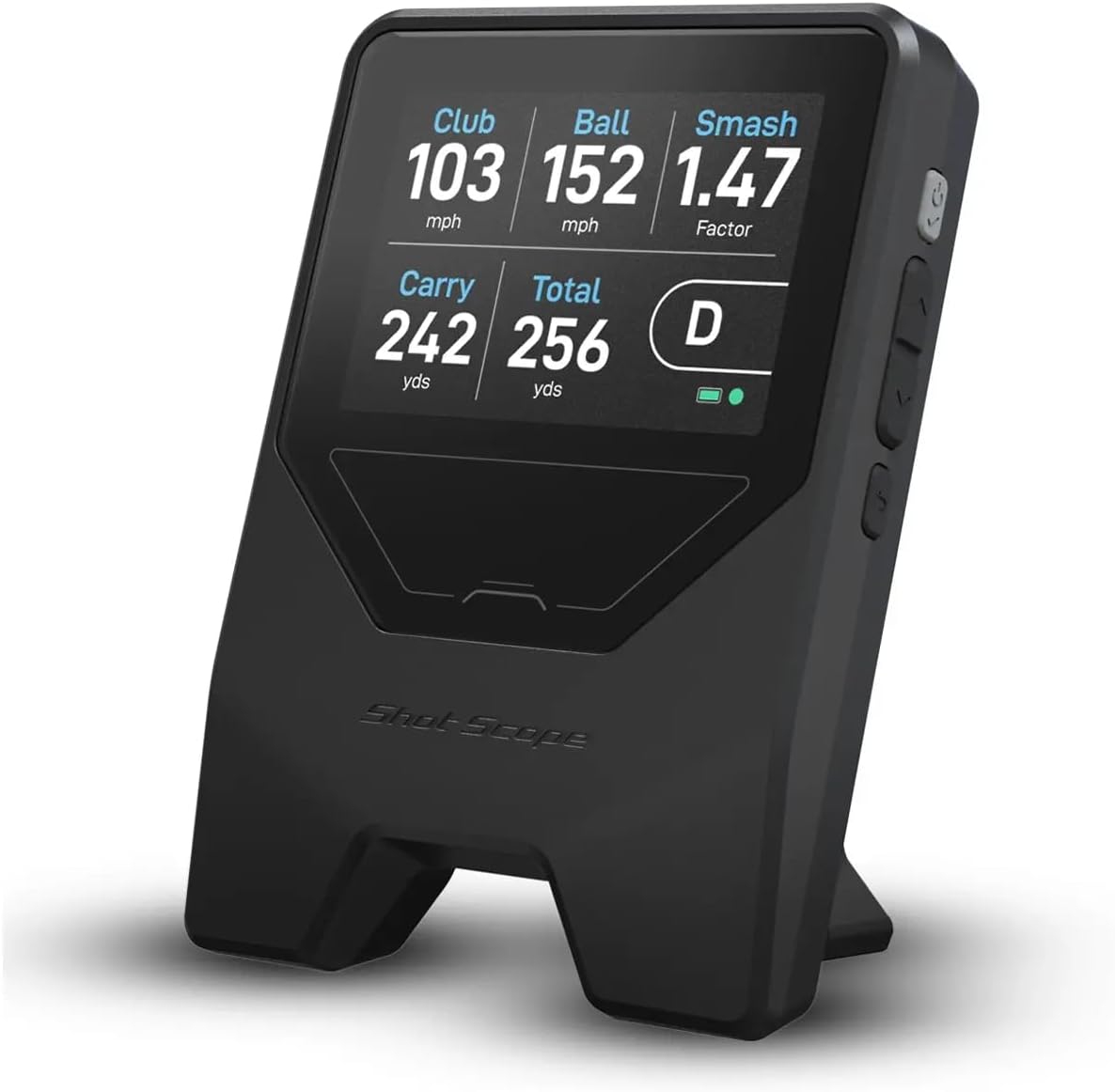
For the golfer who wants club speed, ball speed, smash factor and both distance figures in a pocket unit with a protective case.
Advantages
- £39.20 per metric
- Speed training mode for clubs and speed sticks
- Measures both carry and total distance
- Protective case, cleaning cloth and USB-C cable included
- Indoor and outdoor use
Disadvantages
- Only 58 ratings, the smallest base here
- No spin figure for shot shape
- £73 more buys the FlightScope Mevo's eight metrics
The Shot Scope LM1 is for the golfer who wants a pocket unit for club speed, ball speed and smash factor, indoors or on the range. It gives instant feedback on each shot, and 58 owners rate it 4.1. A cleaning cloth, a protective case and a USB-C cable come in the box.
The £196 price divides into £39.20 per metric across five figures: club speed, ball speed, smash factor, carry distance and total distance. The dedicated speed training mode measures swings with normal clubs and with speed sticks, which is the reason to choose it over the Rapsodo Mobile Launch Monitor at £169. It is also the only unit here whose name pairs with a speed programme rather than a round of golf.
Two limits stand out. Only 58 buyers have rated it so far, the smallest base of the ten, and there is no spin figure at all, so shot curve is invisible. The FlightScope Mevo at £269 answers both for £73 more and adds spin, apex height and flight time.
Voice Caddie SC200+

For the golfer who practises swing speed without a ball and wants the distance spoken out loud.
Advantages
- Swing speed mode that works without hitting a ball
- Voice output of the distance after each shot
- Selectable loft angle for accurate readings
- Measuring range of 30 to 320 yards
- Remote control and 12-month warranty included
Disadvantages
- £67.25 per metric, the second dearest here
- No spin, launch angle or apex height
- The same £269 buys twice the figures on the FlightScope Mevo
The Voice Caddie SC200+ is for the golfer who wants to train swing speed without a ball and hear the distance out loud. The new swing speed mode measures practice swings with no contact, and 77 owners rate it 4.2. A remote control and a 12-month warranty come with it.
Four figures at £269 works out at £67.25 per figure, more than double the FlightScope Mevo's £33.63 for the same money. The four are carry distance, swing speed, ball speed and smash factor, with a measuring range of 30 to 320 yards, selectable loft angle and barometric pressure calibration. The voice output calls the distance after each shot, so you can hit without looking up.
The catch is the count. There is no spin, no launch angle and no apex, so a fitter cannot use it and neither can anyone chasing shot shape. For the same £269 the FlightScope Mevo gives eight metrics. The ball-free swing speed mode is the one thing this unit does that nothing else on this page does.
All 10 compared
The same ranking side by side, now that the numbers have names.
1
2
3
4
5
6
7
8
9
10
| # | Product | Score | Metrics | £ per metric | Spin rate | Battery | Price | Amazon rating |
|---|---|---|---|---|---|---|---|---|
| 1 | Garmin Approach R10 | 9.2 /10 | 5+ club, ball, tempo, spin, launch angle | n/a count not published | Yes ball spin | 10 h IPX7 | £445.00 | 4.3 (1,104) |
| 2 | Rapsodo MLM2PRO Simulator | 8.9 /10 | 13 6 measured | £42.23 | Yes spin rate and spin axis | 8 h | £549.00 | 4.1 (492) |
| 3 | Rapsodo Mobile Launch Monitor | 8.6 /10 | n/a no count published | n/a | n/a | 6 h shortest here | £169.00 | 4.2 (2,384) |
| 4 | FlightScope Mevo | 8.4 /10 | 8 carry, club, ball, smash, launch, spin, apex, flight time | £33.63 cheapest here | Yes spin | n/a no hours published | £269.00 | 4.2 (1,059) |
| 5 | Voice Caddie Sc300i | 8.1 /10 | 8 incl. spin rates and apex | £47.38 | Yes spin rates | n/a improved battery life, no hours given | £379.00 | 4.5 (75) |
| 6 | PRGR Portable Launch Monitor | 7.9 /10 | 5 swing, ball, carry, total, smash | £34.03 second cheapest | n/a | 4x AAA no recharge | £170.14 | 4.2 (1,200) |
| 7 | Garmin Approach G80 | 7.6 /10 | 5 estimated distance, no spin | £50.67 | n/a | 15 h longest here | £253.34 | 4.3 (679) |
| 8 | Voice Caddie SC4 PRO | 7.4 /10 | 8 incl. spin and side spin | £75.02 dearest data here | Yes spin rate and side spin | n/a | £600.14 | 4.1 (139) |
| 9 | Shot Scope LM1 | 7.1 /10 | 5 club, ball, smash, carry, total | £39.20 | n/a | n/a | £196.00 | 4.1 (58) |
| 10 | Voice Caddie SC200+ | 6.9 /10 | 4 only four figures | £67.25 | n/a | n/a 30 to 320 yd range | £269.00 | 4.2 (77) |
How much should you pay per metric?
Divide the price by the number of metrics and the ranking changes: the FlightScope Mevo at £269 works out at £33.63 per figure, the cheapest here, while the Voice Caddie SC4 PRO at £600.14 works out at £75.02. The same sum puts the PRGR at £34.03, the Shot Scope LM1 at £39.20, the Rapsodo MLM2PRO at £42.23, the Voice Caddie Sc300i at £47.38, the Garmin Approach G80 at £50.67 and the Voice Caddie SC200+ at £67.25.
The sum is a starting point, not the whole answer, because metrics are not equal. Spin axis costs more to measure than club head speed, and a course simulator costs more to license than a distance readout. That is why the Rapsodo MLM2PRO at £42.23 per figure feels better value than a cheaper radar that repeats five numbers you already know.
Practical rule: if two units are within £5 per metric of each other, buy the one with the figures you will actually use. Past a £15 per metric gap, you are paying for a screen or a simulator rather than for data.
Do you need spin rate or spin axis?
Spin rate tells you how much the ball is spinning and spin axis tells you which way it will curve, and only two units here cover the second: the Rapsodo MLM2PRO reads spin axis and the Voice Caddie SC4 PRO reads side spin.
Spin rate on its own appears on the FlightScope Mevo and the Voice Caddie Sc300i. If you fight a slice, spin axis is the figure that identifies it before the ball lands, so it is worth the premium whenever the aim of practice is a straighter ball flight.
The catch is the ball. The MLM2PRO ships with three marked Callaway RPT Chrome Soft X balls because its spin readings need them, and standard balls have to be marked by hand before they will register.
Does a golf launch monitor work indoors?
Yes, and every unit in this group is sold for indoor and outdoor use. What changes indoors is space: a radar unit needs clear room between itself and the ball, plus a net or a screen to stop the shot, so a garage or a garden beats a hallway.
Two of the ten go further and turn the practice bay into a course. The Rapsodo MLM2PRO simulates more than 30,000 courses, and the Voice Caddie SC4 PRO adds a 3D driving range with one free E6 Connect course. Both need a phone or tablet to show the picture.
In a small room the compact units make more sense. The FlightScope Mevo measures 8.9 x 3.8 x 6.1 cm and weighs 49.8 g, so it sits out of the way of the swing.
How much battery life do you need?
Six hours is the floor and 15 hours is the ceiling here, and a range session runs about an hour, so even the shortest unit covers five or six trips before it needs a charge.
The Garmin Approach G80 lasts 15 hours, the Garmin Approach R10 lasts 10, the Rapsodo MLM2PRO lasts 8 and the Rapsodo MLM lasts 6. The PRGR runs on four AAA alkaline batteries instead, so there is nothing to charge and spares live in the bag.
A unit that speaks the distance, like the Voice Caddie Sc300i or the SC200+, still draws power for the speaker, so battery life matters as much on a talking unit as on one with a screen.
What should you check before buying?
Check three things: whether the unit needs a phone, whether the spin figures need marked balls, and whether anything you want sits behind a subscription.
Phones: the Garmin Approach R10, the Rapsodo MLM and the FlightScope Mevo hand the numbers to an app, so a charged iPhone or iPad is part of the kit. Marked balls: only the units reading spin axis or side spin need them. Subscriptions: the Garmin virtual rounds need an active subscription, and the SC4 PRO simulator includes one free E6 Connect course and a driving range before anything paid.
The common mistake is buying the biggest metric count in budget. Thirteen metrics you never open are worth less than four you check after every shot, and the price per figure above shows exactly what that mistake costs.
Do you need a screen on the unit?
Only if you want the numbers without a phone in your hand. The Voice Caddie Sc300i, the Voice Caddie SC4 PRO, the PRGR and the Voice Caddie SC200+ all show the data on the unit itself, and the SC300i, the SC4 PRO and the SC200+ speak the distance out loud as well.
The app-based units, including the Garmin Approach R10, the Rapsodo MLM, the Rapsodo MLM2PRO and the FlightScope Mevo, keep everything in an app, which is better for history, video and comparing sessions over a season.
A built-in screen costs money. The Voice Caddie Sc300i works out at £47.38 per metric against the FlightScope Mevo's £33.63, and the Voice Caddie SC4 PRO reaches £75.02.
Final Verdict
The best golf launch monitor here is the Garmin Approach R10 at £445. It reads spin as well as ball speed, club head speed, swing tempo and launch angle, it lasts 10 hours on a charge, it survives rain to IPX7, and 1,104 owners rate it 4.3.
It is not the right buy if you only want carry distance, because the Rapsodo Mobile Launch Monitor does that for £169, £276 less. It is also not the right buy for spin axis and a home simulator, where the Rapsodo MLM2PRO at £549 gives thirteen metrics for £104 more. And if every figure has to earn its place, the FlightScope Mevo at £269 stays the value pick at £33.63 per metric.
Questions people ask
What is the best golf launch monitor?
For most players it is the Garmin Approach R10 at £445, because 1,104 owners rate it 4.3 and it reads spin, ball speed, club head speed, swing tempo and launch angle with 10 hours of battery. If data per pound is the priority, the FlightScope Mevo gives eight metrics for £269, which is £33.63 each.
How much does a golf launch monitor cost?
Prices run from £169 to £600.14 for the ten units here. £169 buys the Rapsodo Mobile Launch Monitor, £269 the FlightScope Mevo and the Voice Caddie SC200+, £379 the Voice Caddie Sc300i, £445 the Garmin Approach R10 and £549 the Rapsodo MLM2PRO, while the Voice Caddie SC4 PRO tops the group at £600.14.
Can I use a golf launch monitor indoors?
Yes. All ten units in this group are built for indoor and outdoor use, and a net or impact screen is the only extra piece of kit. The Rapsodo MLM2PRO adds simulation over 30,000 courses and the Voice Caddie SC4 PRO a 3D driving range, which turn a garage session into something closer to a round.
Do golf launch monitors need a phone?
Some do, some do not. The Garmin Approach R10, the Rapsodo MLM, the FlightScope Mevo and the Shot Scope LM1 put their detail in an app, so a charged phone or tablet is part of the kit. The PRGR, the Voice Caddie Sc300i, the Voice Caddie SC200+ and the Voice Caddie SC4 PRO show the figures on the unit itself.
Are golf launch monitors accurate?
The radar units here are accurate enough to spot trends rather than to fit a tour player. Club head speed is the loosest figure, with the Garmin Approach G80 accurate to +/- 5 mph, while ball speed and smash factor are the steadiest across the group. Spin and spin axis are the readings that need marked balls and correct placement to stay reliable.
Do you need a subscription to use a golf launch monitor?
No, not for the core numbers, which are free once the unit is paired. Subscriptions only appear when you want virtual rounds or extra courses: the Garmin virtual rounds need an active subscription, and the Voice Caddie SC4 PRO includes one free E6 Connect course and a driving range before anything paid.
Which launch monitor measures spin?
Spin rate comes from the FlightScope Mevo, the Voice Caddie Sc300i, the Rapsodo MLM2PRO and the Voice Caddie SC4 PRO. Only the MLM2PRO and the SC4 PRO split that into spin axis or side spin, and those are the two to look at if the goal is diagnosing a curve rather than a total.
Is a golf launch monitor worth it?
It is worth it if you practise often without a coach watching, because the numbers show whether a change in setup or club is real or just a good day. A unit that reads carry distance and ball speed indoors and out will be used more than one that only works on a range. The cheapest here, at £169, costs less than a single new driver.
Why trust this ranking?
We rank on price, customer ratings and the specifications that decide the job, and we read each specification table against the marketing bullets on the same listing. When a number does not survive that check, we say so in the entry rather than quietly dropping the product. We also say when a product is the wrong one for you.
How we rank, in full
Written by
Felipe Iglesias
Founder & Lead Reviewer
Felipe is a computational engineering student who has been working in SEO since he was sixteen. He founded ranked10 and researches every guide on the site.
Related buying guides
Every guide below ranks ten products the same way this one does.
 Fitness
Best Inflatable Kayak 2026: 10 Ranked
The best inflatable kayak for two adults is the Intex Explorer K2 at £169.95: 180 kg of load and 4.6 from 10,669 owners. Ranked on load per pound.
 Fitness
Best Water Rowing Machine 2026: 9 Ranked, Three Share One Review Pool
Three WaterRower finishes share one 402-review pool and the same 4.3 stars, yet cost £1,199, £1,299 and £1,599. Our best water rowing machine ranking.
 Fitness
Best Smith Machine 2026: 10 Ranked, and Where the Load Claims Fall Apart
Which best smith machine? We ranked 10. The Drone2 claims 2000 lbs yet weighs 46.3 kg; the Marcy MD-9010 claims 136 kg press at 169 kg.
 Fitness
Best Mobility Scooters 2026: 10 Ranked, and Where the Numbers Disagree
The best mobility scooters ranked: one ZT500 lists at 110 cm wide, the other at 165 cm — wider than its own length.
 Fitness
Best Walking Poles 2026: 10 Ranked, Per-Pole Weights Checked
We ranked ten sets of walking poles on Amazon. On most, the per-pole weight in the bullet does not match the spec table's Item Weight.
 Fitness
Best Tennis Rackets 2026: 9 Ranked, and Why the 'Pair' Count Misleads
Best tennis rackets compared: the Senston set of 2 at £54.99 lists one racket, and weight figures clash across listings. Nine ranked here.
 Fitness
Best Kids Scooter 2026: 10 Ranked, From £20 to £160
The besrey says 'Big Wheels' but lists 80mm — less than a £21 kids scooter. We ranked 10 by spec, price and 36,000+ ratings.
 Fitness
Best Hiking Backpacks 2026: 10 Ranked, and Only Two Match Their Litres
We multiplied out the listed dimensions of ten hiking backpacks: only two reach their own litre figure. A 70L pack measures 20.1 litres.
 Fitness
Best Weight Lifting Gloves 2026: 10 Ranked, Every Price Is the Smallest Size
Every weight lifting gloves price here is the smallest size. The £12.99 adidas pair calls its XS an 18-19 cm hand; the £9.89 ATERCEL lists 2 and 4.
 Fitness
Best Boxing Pads 2026: 9 Ranked — 1 Item or a Pair?
Boxing pads ranked: 9 sets weighed on price, weight and honest specs. One page promises a pair but lists 1 item. See which sets add up.
Products you might like
The best rated products from our other Fitness guides.
-
 Amazon Basics Cast Iron Kettlebell 6kg with Textured Wide Grip Handle, Black
£18.95
4.8
in Best Kettlebell 2026: The Handle Nobody Measures
-
 Amazon Basics Cast Iron Kettlebell 10kg with Textured Wide Grip Handle, Black
£26.42
4.8
in Best Kettlebell 2026: The Handle Nobody Measures
-
Concept2 RowErg with PM5
£990.00
4.8
in Best Water Rowing Machine 2026: 9 Ranked, Three Share One Review Pool
-
besrey Kids Scooter, Foldable, LED Wheels
£56.99
4.8
in Best Kids Scooter 2026: 10 Ranked, From £20 to £160
-
 TriggerPoint The Grid 1.0 Foam Roller, Distrodensity Surface, 33cm
£29.99
4.7
in Best Foam Roller 2026: The Firmness Field Holds a Word
-
 RDX Maya Hide Pro Training Sparring Gloves
£27.99
4.7
in Best Boxing Gloves 2026: 10 Ranked, and Why the Weights Don't Match
-
 Bob and Brad Q2 Mini Massage Gun
£59.91
4.7
in Best Massage Gun 2026: 10 Ranked on Amplitude, Not Speeds
-
 ZELUS Weighted Vest Adjustable 3.6-13.6kg with Phone Pocket and Reflective Strips
£21.24
4.7
in Best Weighted Vest 2026: What the Weight Field Weighs
-
 Bob and Brad C2 Massage Gun Deep Tissue
£74.99
4.7
in Best Massage Gun 2026: 10 Ranked on Amplitude, Not Speeds
-
 Venum Elite Boxing Gloves
£99.99
4.7
in Best Boxing Gloves 2026: 10 Ranked, and Why the Weights Don't Match
-
 Eric Flag Adjustable Weighted Vest 20kg with 16 Removable Iron Weights
£109.90
4.8
in Best Weighted Vest 2026: What the Weight Field Weighs
-
 Umatoll Baby Balance Bike, 12-24 Months, with Basket
£36.99
4.7
in Best Balance Bike 2026: 10 Ranked, and the Specs That Don't Add Up
-
 Topeak Joe Blow Sport III High Pressure Floor Pump
£36.25
4.7
in Best Bike Pump 2026: 10 Ranked, and a £4.26 Price Gap
-
 Yes4All 8kg Powder Coated Cast Iron Kettlebell with Colour-Coded Ring
£18.60
4.7
in Best Kettlebell 2026: The Handle Nobody Measures
-
G4Free 40L Molle Rucksack, 1000D Polyester
£33.99
4.7
in Best Hiking Backpacks 2026: 10 Ranked, and Only Two Match Their Litres
Comments
Reader comments are not checked against the manufacturer's claims above.
No comments yet
Be the first to add something we missed — a price change, a spec that turned out wrong, or how one of these held up.
Leave a comment
No account needed. Own one of these? Tell other readers how it actually performed.