Best Yoga Mat 2026: 10 Non-Slip Mats Ranked by Thickness and Grip
By Felipe Iglesias · Updated
If you want the short answer, the PROIRON is the best yoga mat for most people: 7,756 ratings at 4.6 stars, an extra-wide 183 x 66cm surface, reinforced edges and a choice of 10mm or 15mm cushioning, for GBP 22.99. If you practise standing yoga rather than floor work, the 6mm YOGATI with printed alignment lines is the better shape of mat, and the Core Balance costs just GBP 13.59.
The number everyone gets wrong is thickness, because more is not better — it is a trade-off. A thick 10 to 15mm mat is lovely for kneeling, planks, sit-ups and anything where your joints press into the floor, but it wobbles under you in standing balance poses, because your foot sinks instead of feeling the ground. A thin 4 to 6mm mat is stable and connected for standing yoga but unforgiving on knees. So pick by what you actually do: floor work and Pilates want thick, standing yoga and balance work want thin. Material follows from that. TPE is light, cheap and does not absorb sweat; NBR gives the most cushioning per pound; and natural rubber grips best when you sweat, at the cost of weight and price. Width matters too — most mats are 61cm, and the 66 to 68cm ones here are noticeably more comfortable if you have broad shoulders.
At a glance
| # | Product | Price | Rating | Link |
|---|---|---|---|---|
| 1 | PROIRON NBR Yoga Mat, 10mm or 15mm, 183 x 66cm, Reinforced Edges | £22.99 | 4.6 | View |
| 2 | YOGATI Yoga Mat with Alignment Lines, 6mm, Double-Sided Non-Slip | £24.99 | 4.4 | View |
| 3 | Core Balance TPE Exercise and Yoga Mat, Extra Wide, Double-Sided Texture | £13.59 | 4.6 | View |
| 4 | Yogi Bare Paws Natural Rubber Yoga Mat, 4mm, 183 x 68cm, Sticky Grip | £80.00 | 4.7 | View |
| 5 | Yogii Yoga Mat, 6mm TPE, Rippled Non-Slip Base, Travel Friendly | £18.99 | 4.4 | View |
| 6 | ComFy Mat Premium TPE Yoga Mat with Waterproof Carry Bag | £24.99 | 4.5 | View |
| 7 | CAMBIVO Non-Slip TPE Yoga Mat, 6mm or 8mm, Tear-Resistant Inner Layer | £22.78 | 4.4 | View |
| 8 | Amazon Basics Yoga Mat, Extra Thick 10mm, 183 x 61cm, Carrying Strap | £19.52 | 4.4 | View |
| 9 | DH FitLife NBR Yoga Mat, 10mm, 183 x 61cm, Reinforced Edging | £23.99 | 4.5 | View |
| 10 | Les Mills MBX Dual-Sided Exercise Mat, 180 x 61cm, High-Density Eco-PVC | £72.25 | 4.6 | View |
Free WhatsApp group
Amazon deals, around the clock
Price drops and lightning deals posted the moment they go live. No spam, leave whenever you like.
Join the groupFree to join · Leave any time
PROIRON NBR Yoga Mat, 10mm or 15mm, 183 x 66cm, Reinforced Edges

The best yoga mat for most people. 7,756 ratings at 4.6 stars, extra-wide at 66cm, with reinforced edges and 10mm or 15mm cushioning.
Pros
- 7,756 ratings at 4.6 stars, the most on this page
- Extra-wide 183 x 66cm, more room than a standard mat
- Reinforced edges resist the tearing that kills cheap mats
- Weight keeps it flat instead of curling at the corners
- Waterproof surface, wipes clean, GBP 22.99
Cons
- 15mm version wobbles in standing balance poses
- NBR grips less than rubber once you sweat
- Heavier to carry than a TPE mat
- Bulky rolled up
Why it is number 1
- Customer ratings
- 7,756 at 4.6 stars The most on this page.
- Size
- 183 x 66 cm Wider than standard.
- Thickness
- 10 or 15 mm Thick suits floor work, not balance.
- Edges
- Reinforced
- Price
- £22.99
Two things put this first. It has the most ratings of any mat on the page at 7,756, scoring 4.6, and it is wider than standard: 183 x 66cm gives you five centimetres more than the usual 61cm mat, which is the difference between your hands landing on mat or on floor when you widen your stance. Reinforced edges are the other real feature, because a cheap mat almost always fails at the edge first, tearing where it gets rolled and stepped on.
At 1.1kg the weight helps it lie flat rather than curling at the corners, the surface is waterproof and wipes clean, and it is sold in 10mm and 15mm.
Be deliberate about that thickness. The 10mm is a good all-rounder; the 15mm is a floor-work mat and will feel unstable in standing balance poses. If your practice is mostly standing yoga, buy the 6mm YOGATI below instead.
YOGATI Yoga Mat with Alignment Lines, 6mm, Double-Sided Non-Slip
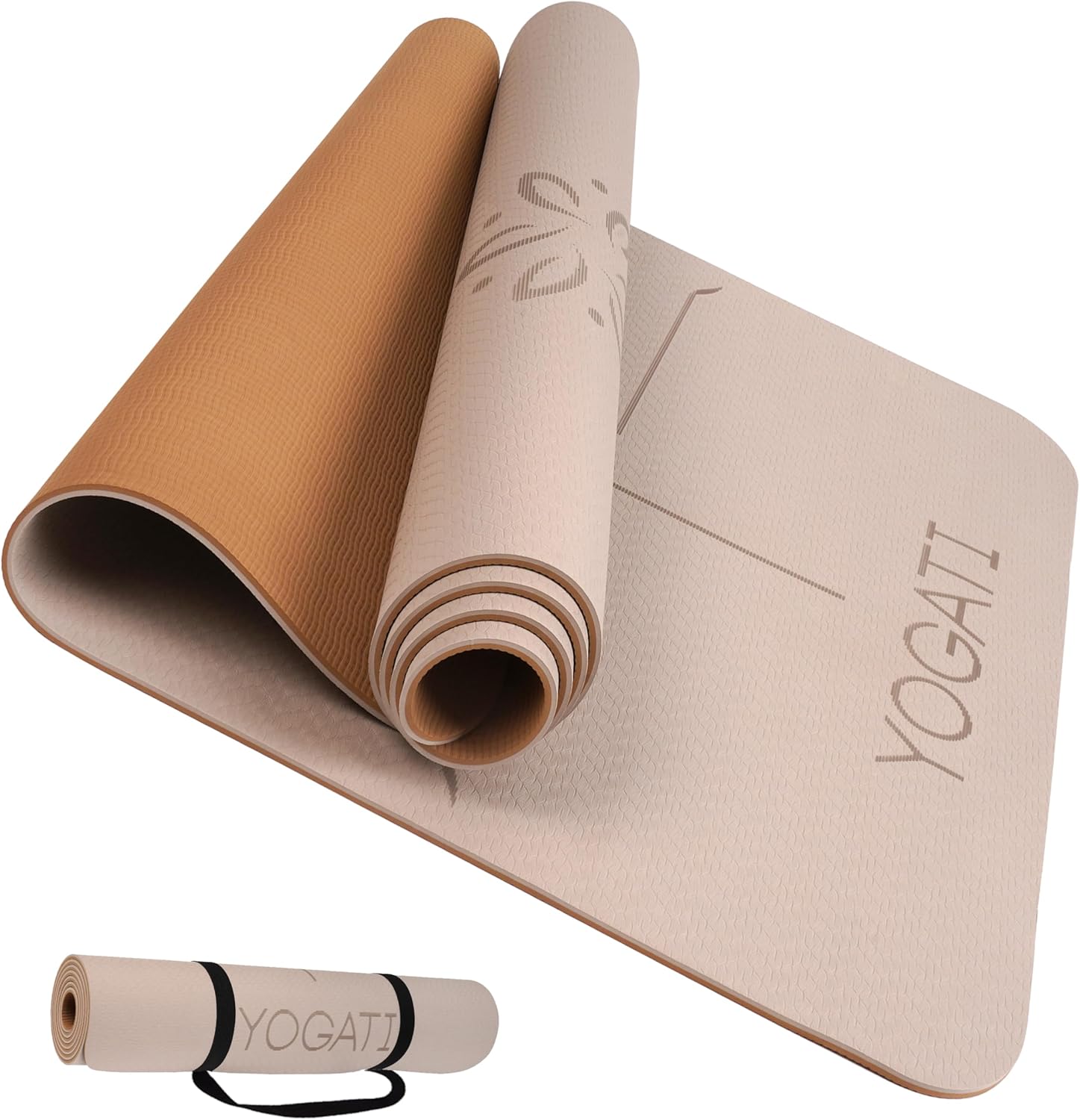
The best mat for actual yoga practice. 6mm for stability in standing poses, with printed alignment lines to place your hands and feet.
Pros
- 6mm, the right thickness for standing yoga stability
- Alignment lines help place hands and feet correctly
- 7,708 ratings, second most on this page
- Textured on both sides, no wrong way up
- Carry strap included
Cons
- 4.4 stars, below the PROIRON
- Less cushioning for kneeling and floor work
- GBP 24.99, dearer than thicker rivals
- Standard 61cm width
Why it is number 2
- Thickness
- 6 mm Stable in standing poses.
- Alignment lines
- Printed Useful when learning.
- Customer ratings
- 7,708 at 4.4 stars
- Grip
- Textured both sides
- Price
- £24.99
This is the one to buy if you do yoga rather than floor exercises. At 6mm it is thick enough to protect your knees but thin enough that you feel the floor in standing poses, which is what keeps you steady in a balance. The printed alignment lines are the reason it has nearly eight thousand ratings: they show you where hands and feet should sit, which is genuinely helpful when you are learning and have no teacher correcting you.
Both faces are textured for grip, so it does not matter which way up it lands, and it comes with a carry strap.
Its 4.4-star average is a little below the PROIRON, and at GBP 24.99 it costs slightly more for less cushioning. That is the trade you are making: stability and guidance instead of padding. For Pilates or heavy floor work, buy thicker.
Core Balance TPE Exercise and Yoga Mat, Extra Wide, Double-Sided Texture

The best value here at GBP 13.59, and rated 4.6. An extra-wide closed-cell TPE mat that does not absorb sweat.
Pros
- Cheapest mat here at GBP 13.59
- 4.6 stars over 2,228 ratings
- Closed-cell TPE does not absorb sweat or odour
- Extra-wide with double-sided texture
- Light, rolls up small, carry strap included
Cons
- Less cushioning than the 10mm mats
- TPE gets slippery with heavy sweat
- Lighter build than the reinforced-edge mats
- Plainer finish
Why it is number 3
- Price
- £13.59 The cheapest here.
- Customer ratings
- 2,228 at 4.6 stars
- Material
- Closed-cell TPE Does not absorb sweat.
- Width
- Extra wide
- Grip
- Textured both sides
At GBP 13.59 this is the cheapest mat on the page and it still scores 4.6 over 2,228 ratings, which is a rare combination. It is closed-cell TPE, meaning the foam does not absorb sweat or odour the way an open-cell mat does — you wipe it and it is clean, which matters more than people expect after a few months of use.
It is extra-wide, textured on both faces for grip, light enough to roll up and carry with the included strap, and it splits the difference between a yoga mat and a general fitness mat.
If you want the cheapest capable mat, this is it. Spend more only for a specific reason: the PROIRON for width and reinforced edges, the YOGATI for alignment lines, or the Yogi Bare for grip when you sweat heavily.
Yogi Bare Paws Natural Rubber Yoga Mat, 4mm, 183 x 68cm, Sticky Grip

The best grip here, and the mat for hot yoga. Natural rubber with a sticky top layer that holds when you sweat, at 4.7 stars.
Pros
- Sticky natural rubber keeps grip when you sweat
- 4.7 stars, the highest average on this page
- Widest mat here at 68cm
- Firm 4mm support, very stable in standing poses
- Sustainably sourced, biodegradable rubber
Cons
- GBP 80.00, by far the dearest here
- Heavy to carry compared with TPE
- Strong rubber smell when new
- 4mm is hard on knees for floor work
Why it is number 4
- Grip
- Sticky natural rubber The only mat here that grips wet.
- Average score
- 4.7 stars Highest on the page.
- Size
- 183 x 68 cm
- Thickness
- 4 mm, firm
- Price
- £80.00
Every foam mat on this page becomes slippery once your hands are wet, which is why serious practitioners buy rubber. The Yogi Bare has an ultra-sticky top layer over high-tensile natural rubber, and it keeps grip when you sweat — that is the entire reason for its price, and it is the only mat here that solves the problem. It has 1,014 ratings at 4.7 stars, the highest average on the page.
At 4mm it is firm rather than cushioned, which is deliberate: rubber gives support without sink, so standing poses are rock solid. It is 68cm wide, the widest here, has subtle alignment markers, and the rubber is sustainably sourced and biodegradable.
Two honest caveats. GBP 80 is nearly six times the Core Balance, and rubber mats are heavy and have a distinct smell when new that takes a few weeks to fade. Buy it for hot yoga or if you sweat; for a gentle home practice it is more mat than you need.
Yogii Yoga Mat, 6mm TPE, Rippled Non-Slip Base, Travel Friendly

A well-reviewed 6mm TPE mat at GBP 18.99, with a rippled base that stops it sliding on hard floors.
Pros
- 3,481 ratings at 4.4 stars for GBP 18.99
- 6mm, the balanced thickness for mixed practice
- Rippled base stops it creeping on hard floors
- Light and packs down for classes
- Closed-cell TPE, wipes clean
Cons
- No alignment lines or extra width
- 4.4 stars, mid-pack here
- Standard 61cm width
- TPE slips when wet
Why it is number 5
- Thickness
- 6 mm
- Base
- Rippled, anti-creep Helps on laminate and tile.
- Customer ratings
- 3,481 at 4.4 stars
- Price
- £18.99
- Material
- TPE
The Yogii covers the same ground as the YOGATI — 6mm TPE, the balanced thickness — for six pounds less, and has 3,481 ratings at 4.4 stars. Its distinguishing feature is the rippled underside, which is aimed squarely at the real problem on laminate and tile: the mat itself creeping across the floor while you move on it.
It is light and rolls up small enough to carry to a class, and the TPE is the usual closed-cell type that wipes clean.
It sits at fifth because it has no standout feature beyond that base — no alignment lines, no extra width, no reinforced edges — and its 4.4-star average is mid-pack. As a straightforward, cheap, well-proven 6mm mat, though, it does the job and the price is right.
ComFy Mat Premium TPE Yoga Mat with Waterproof Carry Bag

A 4.5-star TPE mat that comes with a waterproof carry bag rather than a strap — the pick if you take a mat to classes.
Pros
- Waterproof carry bag included, not just a strap
- 2,425 ratings at 4.5 stars
- Premium TPE built to resist tearing and flaking
- Eco-friendly material
- Good pick if the mat travels to classes
Cons
- GBP 24.99, dearer than very similar mats
- The mat alone is unremarkable
- Standard width
- TPE slips with heavy sweat
Why it is number 6
- Carry bag
- Waterproof, included Better than a bare strap.
- Customer ratings
- 2,425 at 4.5 stars
- Material
- Premium TPE
- Price
- £24.99
- Width
- Standard
The ComFy Mat's advantage is what comes with it. Most mats include a thin elastic strap that lets the mat get dirty on one side and rain on the other; this one comes with a proper waterproof carry bag, which is what you want if the mat travels to a studio, a park or a gym rather than living rolled in a corner.
The mat itself is a solid premium TPE aimed at not slipping, tearing or flaking apart, made from eco-friendly material, and it has 2,425 ratings at 4.5 stars.
At GBP 24.99 it is priced against the YOGATI and above the very similar Yogii, and the mat alone would not justify that. Buy it for the bag if you carry your mat; if it stays at home, the Core Balance or Yogii give you the same practice for less.
CAMBIVO Non-Slip TPE Yoga Mat, 6mm or 8mm, Tear-Resistant Inner Layer

Sold in 6mm and 8mm so you can pick your compromise, with a tear-resistant inner layer and double-sided grip texture.
Pros
- Choice of 6mm or 8mm to suit your practice
- 8mm is a good middle ground for mixed use
- Tear-resistant inner layer for durability
- Double-sided textured grip
- High-density TPE cushioning
Cons
- 4.4 stars, below the top picks
- Priced like better-reviewed mats
- 1,766 ratings, fewer than the leaders
- Standard width
Why it is number 7
- Thickness
- 6 or 8 mm 8mm is a useful middle ground.
- Durability
- Tear-resistant layer
- Customer ratings
- 1,766 at 4.4 stars
- Price
- £22.78
- Grip
- Textured both sides
CAMBIVO's useful move is offering the same mat in 6mm and 8mm. Given that thickness is the central trade-off in this category, being able to choose the middle ground — 8mm gives more knee protection than a 6mm without the wobble of a 15mm — is genuinely helpful, and the listing is clear about which is for what.
It uses high-density TPE foam with a tear-resistant inner layer for durability and a double-sided textured grip surface. It has 1,766 ratings at 4.4 stars.
It sits here because at GBP 22.78 it costs about the same as the far more reviewed PROIRON and YOGATI while scoring slightly lower. Choose it if 8mm is precisely the compromise you want; otherwise the mats above have more evidence behind them for the same money.
Amazon Basics Yoga Mat, Extra Thick 10mm, 183 x 61cm, Carrying Strap

A cheap 10mm mat for knees and floor work, with a moisture-resistant textured foam surface and a carry strap.
Pros
- 10mm cushioning for kneeling and floor work
- GBP 19.52 with a carry strap and fasteners
- Moisture-resistant textured foam
- Standard full 183 x 61cm size
- Easy returns if the thickness is wrong for you
Cons
- Too thick for standing balance poses
- No reinforced edges or extra width
- 4.4 stars, mid-pack here
- Plain, featureless mat
Why it is number 8
- Thickness
- 10 mm Floor work, not balance.
- Size
- 183 x 61 cm
- Customer ratings
- 1,677 at 4.4 stars
- Price
- £19.52
- Surface
- Moisture resistant
If your problem is knees rather than balance, this is a straightforward answer at GBP 19.52. The 10mm construction gives real shock absorption for kneeling, planks and sit-ups, the textured foam is moisture-resistant, and at 183 x 61cm it is a standard full-length mat with elastic fasteners and a carry strap. It works indoors or outdoors, and it has 1,677 ratings at 4.4 stars.
Amazon's returns policy is a quiet advantage on a product where you only discover the thickness is wrong after a session or two.
It ranks eighth because it is plain: no reinforced edges, no extra width, no alignment lines, and at 10mm it will feel unstable in standing balance poses. For floor-based work at a low price, though, it does exactly what it claims.
DH FitLife NBR Yoga Mat, 10mm, 183 x 61cm, Reinforced Edging

A 10mm nitrile rubber mat with fully reinforced edging, built to resist tearing — the durable choice for floor work.
Pros
- Tough NBR construction, denser than standard foam
- Fully reinforced edging resists tearing
- 10mm cushioning for floor exercises
- 4.5 stars over 1,008 ratings
- Suitable for indoor and outdoor use
Cons
- GBP 23.99, dearer than the wider PROIRON
- Five times fewer reviews than the leaders
- Too thick for standing balance poses
- Standard 61cm width
Why it is number 9
- Material
- NBR, dense
- Edging
- Fully reinforced
- Thickness
- 10 mm
- Customer ratings
- 1,008 at 4.5 stars
- Price
- £23.99
This is the durability pick among the thick mats. It is made from nitrile butadiene rubber, which is denser and tougher than standard foam, and it is fully edged with a reinforced border — the specific failure point on cheap thick mats, where the foam splits and then peels. At 10mm it gives proper cushioning for floor exercises, and it works indoors or out. It has 1,008 ratings at 4.5 stars.
Its score is slightly better than the Amazon Basics at a similar thickness.
Two things keep it at ninth: GBP 23.99 is more than both the Amazon Basics 10mm and the PROIRON, which is wider and has five times the reviews, and like every thick mat it is the wrong choice for standing balance work. Buy it if you want a 10mm mat that will survive heavy use.
Les Mills MBX Dual-Sided Exercise Mat, 180 x 61cm, High-Density Eco-PVC

A dual-sided studio mat from a fitness brand, with one face for yoga and one for HIIT — but only 35 ratings.
Pros
- Two surfaces: one for yoga, one for HIIT and strength
- Dense 2.2kg build stays planted during hard work
- Semi-closed-cell surface, hygienic and easy to clean
- Studio-grade quality from a known fitness brand
- 4.6 star average
Cons
- Only 35 ratings, by far the smallest sample here
- GBP 72.25, close to the far better-proven Yogi Bare
- Award citation is the brand marketing claim
- Heavy to carry at 2.2kg
Why it is number 10
- Surfaces
- Dual sided Yoga on one, HIIT on the other.
- Customer ratings
- 35 at 4.6 stars Smallest sample here.
- Weight
- 2.2 kg Stays put, harder to carry.
- Size
- 180 x 61 x 0.5 cm
- Price
- £72.25
The MBX has two different surfaces on one mat: one side tuned for yoga and one for strength and HIIT work, so a single mat covers both a flowing practice and a session with weights on it. It is a dense, semi-closed-cell 5mm mat weighing 2.2kg, which is studio-grade heft that keeps it planted rather than sliding, and it wipes clean for bare feet. Les Mills notes it was named best training mat 2021 by a magazine lab test, which is a marketing citation rather than something we verified.
It has 35 ratings at 4.6 stars.
It is last for that reason. Thirty-five ratings is by far the smallest sample on this page, and at GBP 72.25 it is close to the Yogi Bare, which has thirty times the feedback and better grip when wet. Consider it if the dual-surface idea specifically fits how you train; otherwise there is more proven kit above.
Final Verdict
For most people the best yoga mat here is the PROIRON: it has the most reviews on the page, it is wider than standard at 66cm, the reinforced edges resist the tearing that kills cheap mats, and at GBP 22.99 it is priced like a budget mat. If you mainly do standing yoga, buy the 6mm YOGATI instead — its alignment lines are genuinely useful when you are learning where your hands and feet should be — and if you just want a decent mat as cheaply as possible, the Core Balance is GBP 13.59. Two upgrades worth the money in specific cases. If you sweat — hot yoga, or simply a warm room — a TPE mat will get slippery and the Yogi Bare natural rubber mat is the one that keeps grip when wet, which is what you are paying GBP 80 for. And if your knees are the limiting factor rather than your balance, the 10mm Amazon Basics or DH FitLife mats cost about twenty pounds and will do more for your practice than any amount of branding.

Written by
Felipe Iglesias
Founder & Lead Reviewer
Felipe is a computational engineering student who has been working in SEO since he was sixteen. He founded ranked10 and researches every guide on the site.
Related buying guides
All Fitness guidesBest Electric Scooter for Adults 2026: 350W, in a 250W Country
An electric scooter for adults is sold by numbers that the law in this country does not permit. The rules that govern the machines which may be used on British roads — the rental trial scooters, and only those — are written around two figures: 250 watts of continuous motor power, and a top speed of 15.5 miles per hour. Every scooter in this article is advertised with a motor above the first figure, and not one of the eight listings mentions either. The cheapest but one sells a 350 watt motor. The one that leads its category has a 350 watt motor. Two others advertise a 500 watt peak, which is a real measurement of a different thing — the power a motor can reach briefly, rather than the power it can sustain — and is left on the page with the word peak to be noticed or not noticed. And one lists its motor as 350/500W, two figures separated by a slash, without saying which is which, so that a shopper comparing it with a 350 watt rival cannot tell whether they are looking at the same machine. The law itself appears nowhere. Privately owned electric scooters cannot legally be ridden on public roads, in cycle lanes or on pavements in the United Kingdom: ownership is legal, private land is legal, and the commute these listings are photographed for is not. One buyer of the best-selling scooter in this article writes that sentence for the seller, and it is the most important text on any of these pages. The brakes did not work, they say, it is not suitable for UK roads and is not legal, and the seller would not take it back — do not buy from them. It is one review among two hundred and eight, and most of those are five stars, so it describes an experience rather than a product. But it states, in public, the fact that every listing in this ranking withholds, and a buyer who reads only the star rating will never see it. Before any of the numbers below, that is the one worth knowing. Where the numbers are honest, they are unusually revealing. The scooter with the deepest sample here by nearly two to one — 370 ratings, where the next has 208 — is also the one that promises least: twenty kilometres of range in its own range field, and a rider limit of a hundred kilograms, against the thirty-five kilometres and one hundred and twenty kilograms claimed by brands with ten or twenty-eight reviews. That inversion is the most useful thing in this article. The market's least-reviewed scooters make its largest claims, and the one with the most buyers behind it makes the smallest — which is what a listing looks like when the specification was written by someone who expected the machines to be used. The same pattern repeats in the units: the scooter with the most thorough battery figure gives it in watt-hours, 280 of them, which can be compared across machines, where the cheaper scooters give amp-hours and leave a shopper to remember that volts multiply into the figure that matters. Two families in this ranking show the other way a specification can mislead without saying anything false. Three colourways of one scooter carry exactly 208 ratings between them, and two scooters from a second family carry exactly 28, with the same category rank, because Amazon pools reviews across a product's variations. A shopper reading the verdict of two hundred and eight buyers is reading the verdict of everyone who bought any colour of a listing. And one title promises thirty-five to forty kilometres of range while its own battery bullet, four lines down, says up to thirty-four — a fifteen per cent gap between a headline and a specification, on one screen, in a market where a scooter that runs out of charge is a scooter that has to be pushed.
FitnessBest Adjustable Kettlebell 2026: What 7-in-1 Really Means
The word seven-in-one is the strongest claim in this category and the emptiest. It counts how many weights a kettlebell can be, and it never says how far apart they are — which is the number that decides whether one adjustable bell can really replace a rack of them. The LIFERUN at number nine shows what happens when a listing fills in the rest badly. Its title names two ceilings, ten and twenty kilograms. Its own first bullet lists the seven levels it actually has, and they stop at ten: 1.5, 3, 4.5, 6, 7.5, 9 and 10 kilograms. The specification field then states an item weight of 12 kilograms, which matches neither. Three numbers on one product page, and a buyer scanning the headline has no way to tell that the top weight here is half of the largest figure on the screen, or that the £65.99 buys the smaller of the two versions. The same listing carries 26 per cent one-star reviews from six ratings, the worst histogram in this comparison. Nine other listings here have the same habit in a milder form, and five of them contradict their own headline number in the item weight field: the ATIVAFIT advertises a 20kg top level and states 18kg, the JAXJOX tops out at 19kg in its bullet and states 20kg, and the Strongology, whose title says up to 18kg, states 8kg in the field that is supposed to describe the product. When five out of ten listings disagree with themselves about the maximum, the only figure worth trusting is one you can add up or measure yourself. So use the step, not the count. The Bells of Steel at number one is the only listing here that publishes increments as fine as half a kilogram and one kilogram, and it costs £159.99, roughly double the next tier — that relationship between price and step size holds across this whole market and is the most useful thing on this page. The £90 to £100 group moves in 2.5 to 3kg jumps. The £28 to £34 group, which sells in pounds rather than kilograms, moves in 1.3 to 1.8kg jumps between three weights. If your programme asks for 12kg then 16kg, a 3kg step means you cannot land on the second number at all, and no listing here says so, because none of them knows what your programme is. The rest of the field is what you would expect from a young market. The deepest sample here is 417 ratings and five of these ten have fourteen or fewer, so a perfect score on eleven reviews is not evidence of anything — it is a small number. The handle field, which decides whether both hands fit and whether a heavy bell stays controllable, is the most chaotic line in every table: two listings state it properly, in millimetres and centimetres, and one states a figure that cannot be a kettlebell grip at all. Read the weight that is stated, look for the step, and treat the count in the title as a headline rather than a specification. One more thing decides whether an adjustable kettlebell is worth owning, and almost no listing here answers it: what the empty unit weighs, and what happens when the mechanism fails. The BRAINGAIN at number two is the only one that publishes the weight of the bell with nothing loaded — 4kg — and the only one with a stated warranty, two years, from a UK brand. The Bells of Steel at number one ships with eighteen plates and an Allen key, which tells you that changing weight is a manual job rather than a twist. Everything else leaves you to infer the empty weight by subtracting the plates you can see from the total you were promised, which is precisely the arithmetic that five of these listings get wrong.
FitnessBest Skipping Rope 2026: The Length Nobody States
A skipping rope is bought by its length, and the length is the one number these listings cannot agree on how to write. In this ranking of ten, it appears in metres on two listings, in centimetres on five, in inches once and in feet once — and the same rope turns up in two of those units depending on which page you open. The little KK rope is 9.5 feet on one listing and 290 centimetres on its twin. Worse, two products state two different lengths for themselves on the same page. The Blukar at number two has a specification saying 2.8 metres and a bullet saying the length of the rope is 3M. The BONTNGE at number seven advertises 270 centimetres in its title and 300 centimetres in its length field, which is thirty centimetres of disagreement about the product you are buying. And one of the two Blukar listings omits the length entirely, leaving a buyer to guess from the photograph. There is a reason none of it settles the question, and it is the same reason the makers are relaxed about it: every adult rope arrives longer than it needs to be, and the owner trims it to their own height. The correct length is a personal measurement, roughly three times your height for a beginner and less as your technique improves, and no seller can print it on a box. What they can print — and mostly do not — is the thickness of the cord and the diameter of the handle, because those two decide whether the rope whips properly and whether your hand can close around it at speed. The cord thickness appears once in ten listings, on the rope at number six: six millimetres of PVC with an inner string. The handle diameter appears five times, and three of those five are unusable — five inches, which is a coffee mug; 2.2 inches, which is a mug handle; and 1.5 and 3, with no unit at all. Only the Gritin at number one and the Muza at number five publish a figure a hand could be measured against. The decision that actually separates these ten ropes is not the length or the handle: it is how the rope adjusts, because that one choice is permanent. A steel-wire rope is shortened by cutting it, once, at the right place, and never lengthened again. The Blukar listings at numbers two and three are that kind, and their reviews say so in the plainest terms available — one buyer recorded using wire cutters to shorten the wire rope, and another loved the product but had no tools and found they were needed. A rope with a clamp or a screw collar can be adjusted as many times as you like, and among these ten only the Titan Armour at number eight names such a mechanism, with a self-locking system and a spare cable in the box. The cheap ropes at numbers nine and ten simply say to trim the excess, which is honest and unforgiving. So if you already know your length to the centimetre, a wire rope is the better instrument; if you are learning, or your height is still doing its last growing, buy the clamped one. Then there is the matter of what a sample is worth here, and this category is a good lesson in pools. The Gritin at number one has 33,317 ratings, which is the largest number in this ranking. The Blukar has 28,430 ratings on the listing Amazon ranks first and 28,430 on a second listing for the same rope, because they share the pool. The two KK listings share 107. And one of the reviews of the cheapest rope describes it as the best hose the buyer has ever owned, which tells you what pooled and recycled review data is worth when it arrives from a different product entirely. Read the distribution as well as the average: the Elite Jumps at number six has 82 per cent five-star from 1,248 buyers, which is the strongest signal here, and the £3.95 rope has 10 per cent one-star from 107, which is the weakest.
Comments
Reader comments are not checked against the manufacturer's claims above.
No comments yet
Be the first to add something we missed — a price change, a spec that turned out wrong, or how one of these held up.
Leave a comment
No account needed. Own one of these? Tell other readers how it actually performed.