Rank #4 in Best MIDI Keyboard Controller 2026: 10 Ranked on Price Per Key
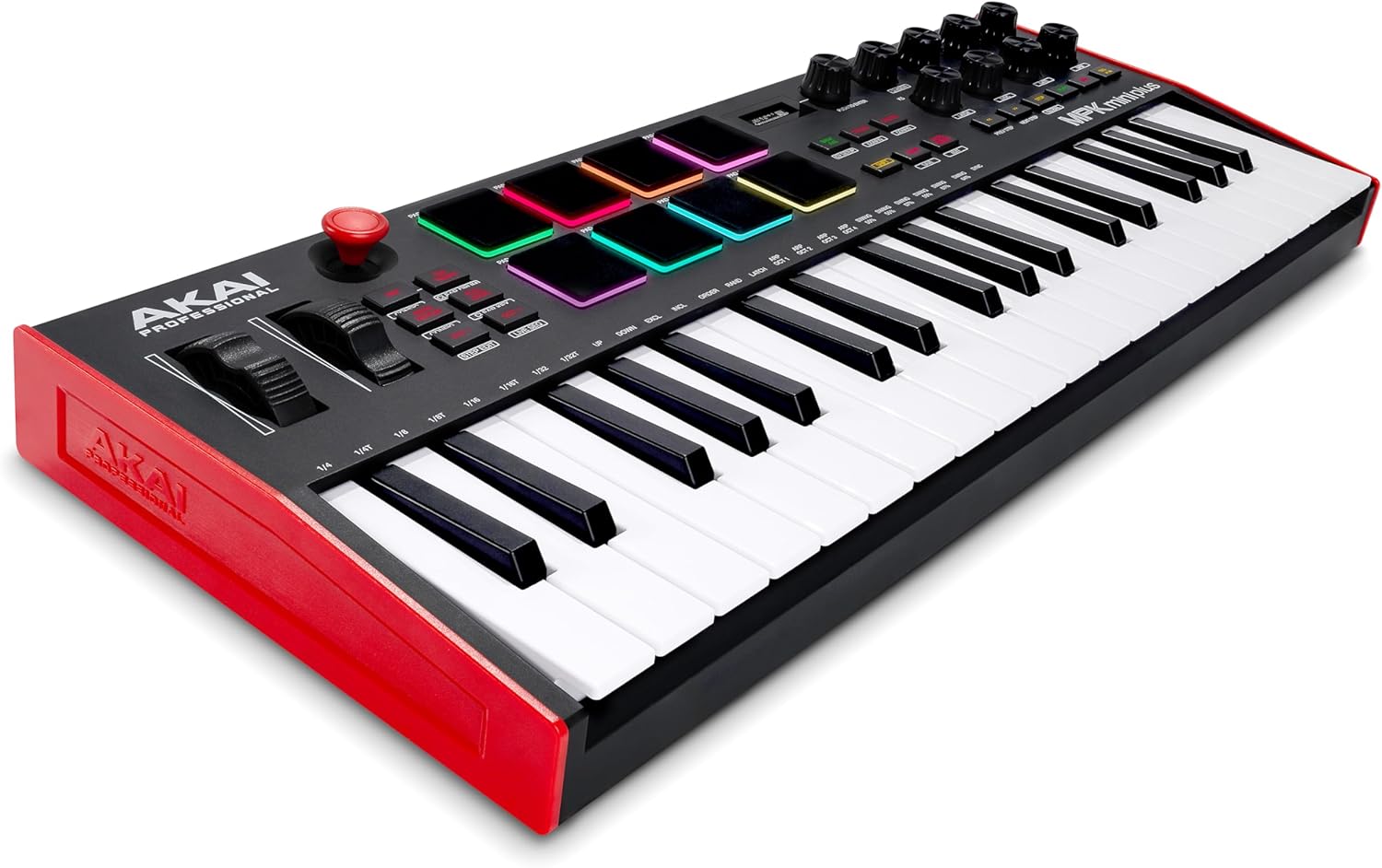
Akai Professional MPK Mini Plus 37-Key MIDI Controller
Price and rating as shown on Amazon when we collected them. Both change.
The Akai Professional MPK Mini Plus is a 37-key USB MIDI keyboard controller selling for £123.00, and it sits at number four in this guide. It is the largest of the mini boards here, spanning three full octaves, but it is also the most expensive per key: £123.00 across 37 keys works out at roughly £3.32 a key, against £1.53 on the 49-key M-Audio Keystation 49 MK3 at £75 and £1.31 on the 49-key Nektar SE49 at £64. It costs £44 more than the £79 25-key Akai and gives you 12 more keys, while carrying a fraction of the ratings — 2,168 against 30,642.
What the extra money buys beyond keys is written on the listing: 8 MPC RGB pads, knobs, a 64-step sequencer that runs one drum track and one melody or chord track without a computer, CV/Gate and MIDI I/O, and bundled software. Two details on the same listing are worth flagging. The control method is given as "Touch", which is an odd label for something the listing itself describes as a keyboard with knobs and pads. And the supported software field names MPC Beats Software, while a bullet offers a choice of one of three Komplete 15 Select bundles — two different software claims in one listing.
Every figure on this page is taken from the Amazon listing and the customer ratings attached to it, not from our own testing.
How those 2,168 ratings break down
An average hides its own shape. This is the spread behind the 4.6 stars.
Specification
Exactly as published on the Amazon listing, field for field.
| Price | £123.00 |
|---|---|
| Amazon rating | 4.6 out of 5, from 2,168 ratings |
| Price per key | About £3.32 (calculated from the listing price and key count) |
| Number of keys | 37 |
| Weight | 1.3 kg |
| Dimensions | 18D x 45.1W x 5.2H cm |
| Connectivity | USB and USB powered; also CV/Gate and MIDI I/O |
| Control method | Touch (as listed) |
What buyers actually say
Quoted from customer reviews on Amazon
Verified purchase“As you would expect from Akai, the quality is excellent. I plug into a Mac and use logic. Easy to map buttons and map controllers and pads. Very good keyboard. Perfect for travelling, but you may need a little travel case as it's a bit of a faf in and out of the box.”
Verified purchase“I bought this to control the virtual synths on my iPad. I used USB adapter in the iPad which allows me to charge it whilst also playing this keyboard and using a scarlet 2 channel audio output for the sound. It's amazing how it just works.”
What it is up against
The rivals it was ranked against in Best MIDI Keyboard Controller 2026: 10 Ranked on Price Per Key.


Questions people ask
How many keys does the Akai MPK Mini Plus have?
37, described in the listing as a dynamic 37-key MPK Mini keybed giving three full octaves.
Does it need a computer to work?
The listing says you can record and compose without a computer by connecting to your production station and using the built-in 64-step sequencer, which has one track for drums and one for melodies or chords.
What software comes with the Akai MPK Mini Plus?
The supported software field lists MPC Beats Software, and a bullet offers a choice of one of three complimentary Komplete 15 Select bundles: Beats, Band or Electronic.
How does it connect?
It is USB powered and connects over USB; it also has CV/Gate and MIDI I/O for modular gear, sound modules and synthesizers.
What is the price per key on this controller?
At £123.00 for 37 keys it works out at about £3.32 a key, against £1.31 for the 49-key Nektar SE49 at £64 in the same guide.
Does the rating count match the price?
The Akai MPK Mini Plus carries 4.6 stars from 2,168 ratings, while the £79 25-key Akai in this guide carries 30,642.
Comments
Reader comments are not checked against the manufacturer's claims above.
No comments yet
Be the first to add something we missed — a price change, a spec that turned out wrong, or how one of these held up.
Leave a comment
No account needed. Own one of these? Tell other readers how it actually performed.