Best Binoculars 2026: 10 Ranked
By Felipe Iglesias · Updated
The short answer
The best binoculars for most people are the Celestron Outland X 8x42 at £85: its 5.25 mm exit pupil is the widest here, so the image holds its brightness at dusk when a 3.5 mm pair goes grey, and it comes nitrogen purged with a limited lifetime warranty. If £25 is the budget, the Kylietech 12x42 at £25.99 gives 3.5 mm of exit pupil and 18,949 ratings behind it.
The exit pupil is what separates the best binoculars at this price, and it is simply the objective lens divided by the magnification: the £25.99 Kylietech 12x42 works out at 3.5 mm, the £34.99 occer 12x25 at 2.08 mm, so the cheaper pair gathers about 2.8 times as much light. That one division explains why the pair with 32,171 ratings does not lead here.
In practice, 4 mm and above keeps the view usable from first light to last, 3.5 mm covers the middle of the day and most of the evening, and anything under 2.5 mm is a daytime instrument. A 20x70 reaches 3.5 mm and a 12x50 reaches 4.2 mm, because the objective grows with the magnification.
The ten pairs below fall into four jobs: the all-season 42 mm pair that keeps its brightness, the value 12x pairs under £30, the long-range 20x pairs that want a rest, and the pocket compacts for a coat pocket. Read the exit pupil in each entry before you read the price.
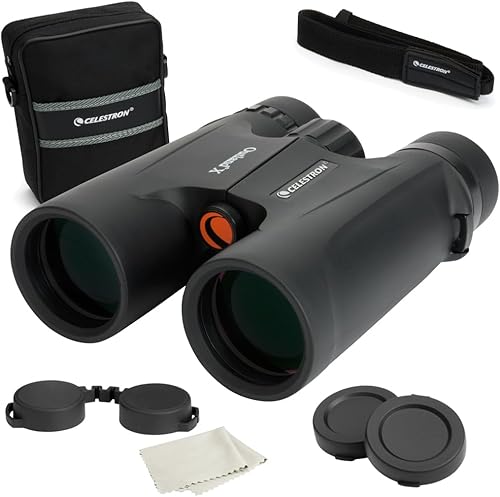
Celestron Outland X
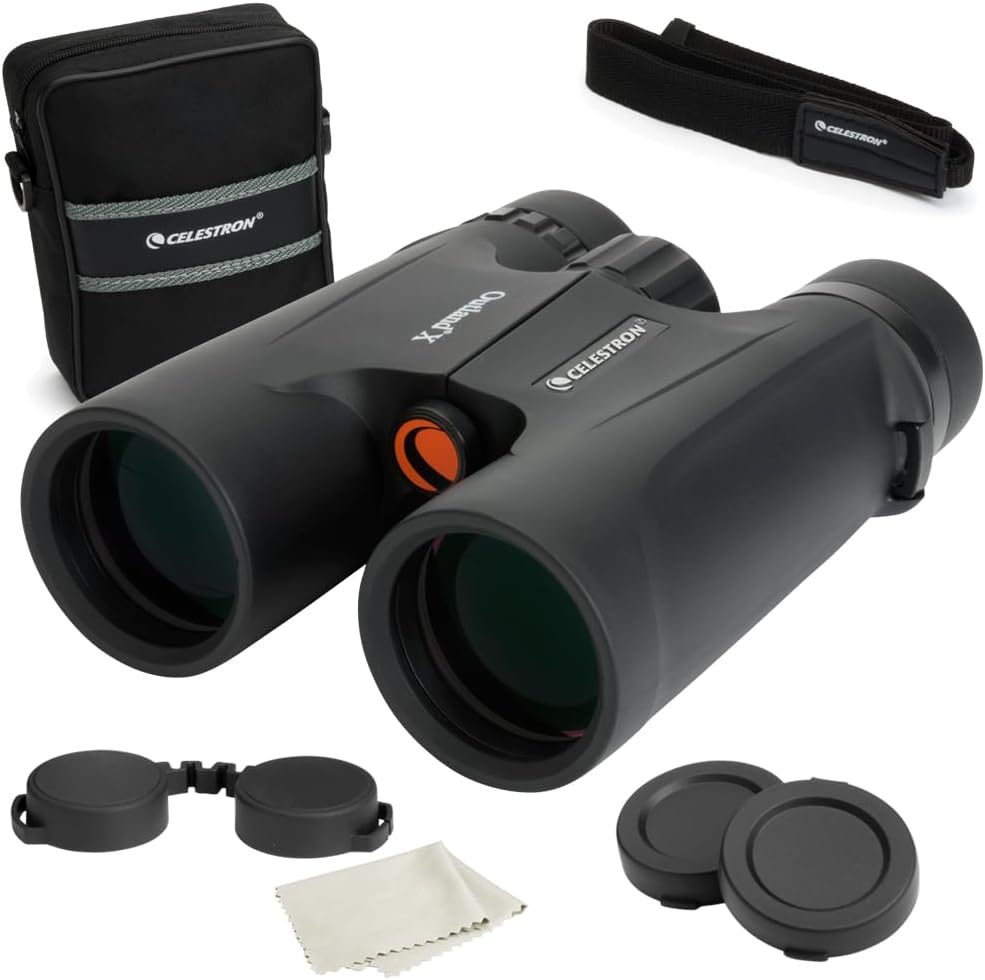
The best all-round buy for birdwatchers who want one pair for every season: its 5.25 mm exit pupil is the brightest here, it is nitrogen purged against fogging and it carries a limited lifetime warranty.
Advantages
- 5.25 mm exit pupil, the widest on this page, against 3.5 mm on the Kylietech 12x42
- Nitrogen purged to stop internal fogging on cold mornings
- Limited lifetime warranty, the longest cover here
- 17.8 mm eye relief gives glasses wearers the full field
- 8x holds steady in the hand, so a hedge-side wobble does not spoil the focus
Disadvantages
- £59 more than the Kylietech 12x42 at £25.99
- Only 8x, so a bird at 100 m looks much smaller than through a 12x pair
- Multi-coated glass rather than the multilayer coatings of the Nikon, which shows in flare when you look towards the sun
This is the pair for the birdwatcher who wants one instrument for the whole year rather than a bright-day compact. At 8x42 and £85 it leads on the number that matters, and 2,079 owners rate it 4.6.
Its exit pupil is 42 mm divided by 8x, which comes to 5.25 mm, against 3.5 mm on the Kylietech 12x42 and 2.08 mm on the occer 12x25. That is the difference between a sharp view and a grey one at 8pm. The dry nitrogen fill keeps the inner lenses clear when you come in from the cold, and 17.8 mm of eye relief means glasses wearers keep the full field.
The trade-off is magnification and money. At 8x a warbler at 100 m sits much smaller in the eyepiece than through a 12x pair, and £85 is £59 more than the Kylietech 12x42 at £25.99 for half the zoom. Take the Kylietech if distant detail matters more than light; step up to the Nikon PROSTAFF P7 at £189 if you want a magnesium body and 1 m waterproofing.
Kylietech 12x42 Fogproof

The value pick for anyone who wants a 42 mm objective without spending £30: 18,949 owners rate it 4.5 and it still comes with a smartphone adapter.
Advantages
- 3.5 mm exit pupil for £25.99, against 2.08 mm on the £34.99 occer
- 18,949 owners rate it 4.5
- 330 ft field of view at 1,000 yds, the widest of the sub £30 twelve-power pairs
- Smartphone adapter included, so you can shoot through the eyepiece
- Twist-up eyecups and a dioptre ring for each eye
Disadvantages
- 12x shows every shake in your hands, so it wants a tripod or a rest
- 15 mm eye relief, tighter than the Celestron's 17.8 mm for spectacles wearers
- No tripod in the box; the 12x42 with Tripod at £29.99 adds one for £4
This is the pair to buy if you want 42 mm of glass and you do not want to spend £30. At £25.99 it undercuts the Celestron Outland X by £59 while keeping the same objective size, and 18,949 owners rate it 4.5.
Its exit pupil is 42 divided by 12, so 3.5 mm. By comparison the occer 12x25 at £34.99 gives 2.08 mm, roughly a third of the light for £9 more. The 330 ft field at 1,000 yds is the widest of the 12x pairs under £30, and the twist-up eyecups and dioptre ring let you set each eye separately.
The limit is the magnification. At 12x your pulse shows in the view, so a hedge or a tripod becomes part of the kit. The other Kylietech on this page, the 12x42 with Tripod at £29.99, adds the tripod and the same phone adapter for £4 more. The 15 mm eye relief is also tighter than the Celestron's 17.8 mm, so spectacles wearers lose some field.
Adasion 12x42 HD

Best if you want to shoot photos or video through the eyepiece: a universal phone adapter and a 2.2 in tripod come in the box, and 16,711 buyers rate it 4.5.
Advantages
- 367 ft field of view at 1,000 yds, the widest of the twelve-power pairs here
- Phone adapter and a 2.2 in tripod in the box
- IP55 body for rain and spray
- Eye relief adjusts from 13.6 mm to 19.6 mm, so it works with or without glasses
- 1.25 lb on a crossbody case, which keeps both hands free on a walk
Disadvantages
- £64.99 is £35 more than the Kylietech 12x42 with Tripod at £29.99 for the same 3.5 mm exit pupil
- At 12x and 1.25 lb it wants a rest for long viewing
- 13.6 mm of eye relief at its lowest setting loses field for some spectacles wearers
This is the pair for someone who wants stills and video of the bird, not just a look at it. A universal phone adapter and a 2.2 in extending tripod come with it, and 16,711 buyers rate it 4.5.
The exit pupil is 3.5 mm, the same as the £25.99 Kylietech 12x42, because both are 42 mm at 12x. The field is wider at 367 ft per 1,000 yds, and that extra width is what makes a moving bird easier to find in the eyepiece. The IP55 body shrugs off rain and spray, and the eyecups twist up for a 13.6 mm to 19.6 mm eye relief range.
You are paying £35 more than the Kylietech 12x42 with Tripod at £29.99 for that wider field and the 1.25 lb build. If you mostly watch and only occasionally film, the cheaper Kylietech leaves £35 in your pocket.
Nikon PROSTAFF P7 10x42

For birders who want premium glass and a body that stays dry for 10 minutes at 1 m, and who are happy to pay £189 for it.
Advantages
- 4.2 mm exit pupil at 10x, about 44 per cent more area than the Kylietech's 3.5 mm
- Waterproof to 1 m for 10 minutes and fog free
- 15 mm or more of eye relief, so spectacles stay on
- 62.9 degree apparent field of view
- Oil and water repellent coating on both lens surfaces
Disadvantages
- £189, or £116 more than the Gosky 10x42 at £72.99 for the same 4.2 mm exit pupil
- Only 540 owners have rated it so far, against 32,171 on the occer
- 10x will not pull a detail out at 200 m the way a 12x pair does
This is for the birder who has decided the glass matters and will pay for it. At £189 it is the most expensive pair on the page, and 540 owners rate it 4.6.
Its exit pupil is 42 mm divided by 10x, so 4.2 mm, about 44 per cent more light-gathering area than the 3.5 mm Kylietech 12x42. The 62.9 degree apparent field is a wide window for a 10x roof prism pair, and the oil and water repellent coating on the objective and eyepiece lenses means a fingerprint wipes off at the hide instead of smearing. Waterproofing runs to 1 m for 10 minutes.
That said, £189 buys less than it looks next to the Gosky 10x42 at £72.99, which also gives 4.2 mm. What you gain is the magnesium body, the 1 m waterproofing, the 15 mm or more of eye relief for spectacles and a name that holds value. If none of that matters, the Gosky saves you £116.
Kylietech 12x42 with Tripod

The pair to take if you want the tripod and the phone adapter bundled in one box, rated 4.6 by 1,595 owners.
Advantages
- Tripod and phone adapter in the box for £4 more than the plain 12x42
- 3.5 mm exit pupil at £29.99
- Waterproof and shockproof body
- 1,595 owners rate it 4.6
- +/-5 dioptres of adjustment for each eye
Disadvantages
- 1,595 ratings against 18,949 on the £25.99 Kylietech 12x42, so the record is much thinner
- 12x still shakes in the hand, so the tripod has to come with you
- 3.5 mm exit pupil dims earlier than the 5.25 mm Celestron Outland X
This is the same 12x42 formula as the cheaper Kylietech, sold with the two accessories that make 12x usable. At £29.99 it is £4 more than the plain pair, and 1,595 owners rate it 4.6.
The exit pupil is 42 divided by 12, so 3.5 mm, which is roughly 2.8 times the light-gathering area of the occer 12x25 at £34.99. The tripod takes the shake out when you want to watch a nest for half an hour, and the phone adapter fits most handsets. The body is waterproof and shockproof, with +/-5 dioptres of adjustment for each eye.
The catch is the smaller track record: 1,595 ratings against 18,949 on the £25.99 version, which is the same glass without the tripod. If you already own a tripod, buy the cheaper one and save £4. If you want steady video of a bird, this is the pair.
usogood 12x50 Bird Watching
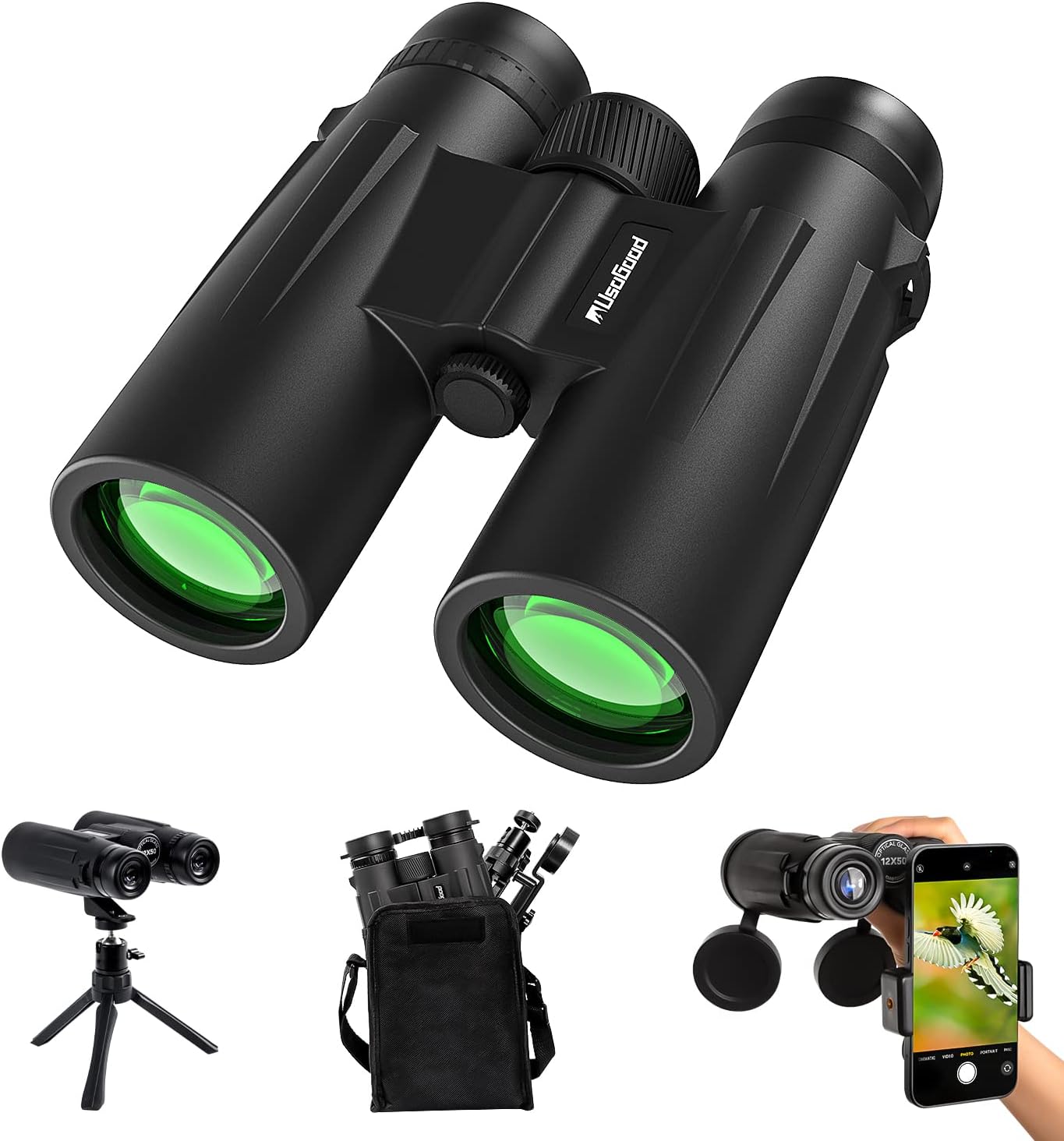
For long sessions in a hide or under the stars: the 50 mm objective, the tripod and the phone adaptor come together, backed by a two-year warranty.
Advantages
- 4.2 mm exit pupil for £30.49, the same as the £189 Nikon
- 374 ft field of view at 1,000 yds, the widest twelve-power view on this page
- Tripod and phone adaptor included
- Two-year warranty
- Phase coated 16.5 mm BaK-4 prisms
Disadvantages
- The 50 mm tubes add weight on a long walk
- Closest focus of 5 m, so it will not do butterflies at 2 m
- Two-year warranty, shorter than the Celestron's limited lifetime cover
This is for the walker who wants more light than a 42 mm tube and still wants to spend around £30. At £30.49, 6,014 owners rate it 4.5.
Its exit pupil is 50 mm divided by 12x, so 4.2 mm, the same as the Nikon PROSTAFF P7 at £189 and about 44 per cent more light-gathering area than the 3.5 mm pair of Kylietechs. The 374 ft field at 1,000 yds is the widest 12x view on the page, which makes tracking a gull over water easier, and the closest focus is 5 m. A two-year warranty comes with it.
The 50 mm objective means a heavier tube on a neck strap, and 5 m of closest focus rules out butterflies and pond life. If close work is what you want, look at the Hontry 10x25 at 260 g and £25.99 instead.
occer 12x25 Compact

The safest bet if you want a pocket pair with 32,171 ratings behind it, as long as you accept that a 25 mm lens gives away a lot of light to a 42 mm.
Advantages
- 20 mm eye relief, more than the Nikon PROSTAFF P7's 15 mm
- 32,171 owners rate it 4.4, the largest record on this page
- Folds to a one-hand size with a strap in the box
- Fully multi-coated with a BaK-4 prism
Disadvantages
- 2.08 mm exit pupil, about a third of the light of the £25.99 Kylietech 12x42
- £9 more than the Kylietech 12x42 for less light and a smaller objective
- ABS plastic body, so treat it as a pocket pair rather than a rough-use one
This is the pair for a jacket pocket and a bright afternoon. It has more ratings than anything else on this page, 32,171 at 4.4, and it folds into one hand.
Its exit pupil is 25 mm divided by 12x, so 2.08 mm, roughly a third of the light-gathering area of the Kylietech 12x42 at £25.99. That is fine at a football match or in a sunny garden, and less fine in a wood at 7pm. The 20 mm eye relief is generous for a pocket pair, more than the Nikon PROSTAFF P7's 15 mm.
The honest reading is that £34.99 buys 2.08 mm of exit pupil when the Kylietech 12x42 gives 3.5 mm for £9 less. Buy this one for the size and the eye relief, not for the light. The Hontry 10x25 at £25.99 is the other pocket option, with 2.5 mm and 260 g.
Hontry 10x25 Compact

Suits a family: the 60 mm to 75 mm interpupillary range and the 260 g body fit children and adults alike, with 22,834 owners rating it 4.5.
Advantages
- 260 g, the lightest pair on this page
- Eye spacing adjusts from 60 mm to 75 mm, so children can use it
- 2.5 mm exit pupil at £25.99, against 2.08 mm on the occer at £34.99
- 22,834 owners rate it 4.5
Disadvantages
- 10 mm eye relief, the shortest here, so glasses wearers lose field
- Water repellent, not waterproof
- 25 mm objective is a daylight instrument, dimmer than any 42 mm pair here
This is the pair to hand a child and an adult from the same box. The eye spacing adjusts from 60 mm to 75 mm, and at 260 g it is the lightest on this page. 22,834 owners rate it 4.5.
Its exit pupil is 25 mm divided by 10x, so 2.5 mm, better than the occer 12x25's 2.08 mm at the same £25.99 and still a daylight figure. The 10x magnification is also the steadier choice for small hands.
The eye relief is 10 mm, the shortest on the page, so anyone in glasses will lose part of the field and should look at the occer 12x25 with its 20 mm instead. The body is water repellent rather than waterproof, so keep it out of a downpour.
Aurosports 20x70 Binoculars

The most glass per pound here: 70 mm of objective for £43.99, though it is not water resistant, so keep it out of the rain.
Advantages
- 70 mm objective, the largest on this page
- 3.5 mm exit pupil at 20x, equal to the £25.99 Kylietech 12x42
- 2.8 times the light collection of a 42 mm pair
- 26 mm eyepiece and 26 mm eye relief for glasses wearers
Disadvantages
- Not water resistant, so rain stops play
- 20x shows every tremor, so it needs a tripod or a window ledge
- 525 ratings, against 32,171 on the occer
This is the pair for a kitchen window, a balcony or a hide with a tripod. At £43.99 it gives 70 mm of objective, the largest here, and 525 owners rate it 4.4.
Its exit pupil is 70 mm divided by 20x, so 3.5 mm, the same as the Kylietech 12x42 at £25.99, and the 70 mm lens collects about 2.8 times the light of a 42 mm pair. The 26 mm eyepiece gives a big window for a long session, and the 26 mm eye relief suits glasses wearers.
The catch is durability and steadiness: the body is not water resistant, so a shower ends the session, and 20x needs a rest of some kind. If you want light gathering that survives the weather, the waterproof usogood 12x50 at £30.49 is the safer buy.
Gosky 10x42 Roof Prism

A steady 10x42 for £72.99 that delivers the same 4.2 mm exit pupil as the Nikon, with a phone adapter and tripod in the box.
Advantages
- 4.2 mm exit pupil for £72.99, the same as the £189 Nikon
- Phone adapter and tripod included
- 16 mm eye relief with shock-resistant rubber armour
- Waterproof body for British weather
Disadvantages
- Only 130 owners have rated it, the thinnest record among the pairs above
- 306 ft field of view at 1,000 yds, narrower than the Adasion 12x42's 367 ft
- The Kylietech 12x42 at £25.99 is £47 cheaper and reaches further at 12x
This is the middle of the road pair: proper 10x42 glass at £72.99 with the accessories already in the box, and 130 owners rate it 4.4.
Its exit pupil is 42 mm divided by 10x, so 4.2 mm, the same as the Nikon PROSTAFF P7 at £189 and about 44 per cent more light-gathering area than the 3.5 mm Kylietech 12x42. The 306 ft field at 1,000 yds is narrower than the Adasion's 367 ft, while the shock-resistant rubber armour and 16 mm eye relief make it a comfortable all-day carry.
The weakness is the track record: 130 ratings is the thinnest among the pairs above, so you are buying on a small sample. If you want 4.2 mm with a long history behind it, put the £116 towards the Nikon PROSTAFF P7 at £189.
All 10 compared
The same ranking side by side, now that the numbers have names.
1
2
3
4
5
6
7
8
9
10
| # | Product | Score | Magnification | Objective Lens | Exit Pupil | Field of View | Price | Amazon rating |
|---|---|---|---|---|---|---|---|---|
| 1 | Celestron Outland X | 9.2 /10 | 8x steady in the hand | 42 mm | 5.25 mm brightest here | n/a | £85.00 | 4.6 (2,079) |
| 2 | Kylietech 12x42 Fogproof | 9.0 /10 | 12x | 42 mm | 3.5 mm 68% wider than the occer | 330 ft/1,000 yds | £25.99 | 4.5 (18,949) |
| 3 | Adasion 12x42 HD | 8.8 /10 | 12x | 42 mm | 3.5 mm | 367 ft/1,000 yds widest 12x here | £64.99 | 4.5 (16,711) |
| 4 | Nikon PROSTAFF P7 10x42 | 8.7 /10 | 10x | 42 mm | 4.2 mm | 62.9 degrees apparent | £189.00 | 4.6 (540) |
| 5 | Kylietech 12x42 with Tripod | 8.6 /10 | 12x | 42 mm | 3.5 mm | n/a | £29.99 | 4.6 (1,595) |
| 6 | usogood 12x50 Bird Watching | 8.5 /10 | 12x | 50 mm | 4.2 mm | 374 ft/1,000 yds | £30.49 | 4.5 (6,014) |
| 7 | occer 12x25 Compact | 8.4 /10 | 12x | 25 mm | 2.08 mm daylight only | 273 ft/1,000 yds | £34.99 | 4.4 (32,171) |
| 8 | Hontry 10x25 Compact | 8.2 /10 | 10x | 25 mm | 2.5 mm | n/a | £25.99 | 4.5 (22,834) |
| 9 | Aurosports 20x70 Binoculars | 8.0 /10 | 20x needs support | 70 mm biggest here | 3.5 mm | n/a | £43.99 | 4.4 (525) |
| 10 | Gosky 10x42 Roof Prism | 7.9 /10 | 10x | 42 mm | 4.2 mm | 306 ft/1,000 yds | £72.99 | 4.4 (130) |
What do the numbers on binoculars mean?
The two figures on binoculars are the magnification and the objective lens diameter in millimetres, so 10x42 means ten times closer through a 42 mm front lens. The first number makes a bird look bigger; the second decides how much light the pair can collect and how much fine detail it can resolve.
Divide the second number by the first and you have the exit pupil, the shaft of light leaving the eyepiece. A 10x42 gives 4.2 mm, a 12x42 gives 3.5 mm and a 12x25 gives 2.08 mm, and those three figures describe very different instruments even though all three are sold for watching birds.
What is the exit pupil and why does it matter more than magnification?
The exit pupil is the objective lens divided by the magnification, and it decides how much light reaches your eye, so a 42 mm lens at 12x gives 3.5 mm while a 25 mm lens at 12x gives 2.08 mm. Your own pupil opens to roughly 2 mm to 3 mm in daylight and 5 mm to 7 mm at dusk, and the closer a pair gets to that figure, the brighter the image.
Do the division before you look at the price. The £25.99 Kylietech 12x42 at 3.5 mm gathers about 2.8 times as much light as the £34.99 occer 12x25 at 2.08 mm, so the cheaper pair gives you nearly three times the view for £9 less. The Celestron 8x42 reaches 5.25 mm, which is why it holds detail past sunset when the 12x25 pairs have gone grey. Magnification is the headline number; the exit pupil is the product.
What magnification should I choose?
Choose 8x or 10x if you will hold the binoculars in your hands, and go to 12x or more only if you will use a rest. Up to 10x a normal pulse barely moves the image; from 12x up every heartbeat shows, and 20x is a tripod instrument.
Higher magnification also narrows what you can see at once and dims the view for the same objective size, because the exit pupil shrinks as the first number climbs. A 12x42 gives 3.5 mm and a 20x42 would give 2.1 mm, which is a bright-day pair despite the bigger number on the body.
Do I need a tripod with binoculars?
Above 10x, yes, and even then only for long sessions. A tripod or a window ledge turns a 20x pair into something you can watch a nest with for half an hour, which is impossible hand-held.
Phone adapters are the other accessory worth having: they clamp your handset to the eyepiece and let you keep a record of what you saw. A tripod mount socket on the binocular body is what makes both possible, and most pairs here have one.
How much do the best binoculars cost?
Most people find what they need between £25 and £85, and the money above that goes on coatings, a sealed body, lighter materials and warranty rather than on magnification. Under £30 buys the Kylietech 12x42 at £25.99, the Hontry 10x25 at £25.99 and the usogood 12x50 at £30.49.
Between £30 and £75 you can add magnification and light: the occer 12x25 at £34.99, the Aurosports 20x70 at £43.99, the Adasion 12x42 at £64.99 and the Gosky 10x42 at £72.99. From £85 the Celestron 8x42 brings a nitrogen fill and a limited lifetime warranty, and £189 buys the Nikon PROSTAFF P7 with a magnesium body and waterproofing to 1 m for 10 minutes.
Which features do not matter as much as the marketing says?
Digital zoom, night vision labels and four-figure magnification numbers are the three claims to treat with care. No pair gathers more light than its objective allows, so a 25 mm lens cannot show you anything in the dark however it is described.
Night vision usually means a large objective and multi-layer coatings, which help at dusk and do nothing at midnight. The same goes for a 200x figure on a small tube: divide 25 mm by 200 and you get a 0.13 mm exit pupil, which no eye can use. Buy on the objective and the exit pupil, and let the rest of the box go.
Do I need waterproof binoculars?
Yes, if you use them outdoors in Britain. Fogging comes from moisture inside the tube, and a sealed, nitrogen purged body is what stops it, which is why the Celestron's dry nitrogen fill matters as much as its glass.
Water resistance runs from a repellent coating to full submersion: the Nikon is rated to 1 m for 10 minutes and the Adasion is IP55, while the Aurosports 20x70 has no water resistance at all. If you watch in the rain, pay for a sealed pair, and let cold binoculars warm up in their case before you take them out of a warm car.
Final Verdict
The Celestron Outland X 8x42 at £85 takes the top spot because it delivers 5.25 mm of exit pupil, the most light on this page, with a dry nitrogen fill and a limited lifetime warranty behind it. It is not for you if you want to read a ring number on a bird at 150 m, because 8x will not pull that detail in.
For that job the second name is the Kylietech 12x42 at £25.99, which gives 3.5 mm of exit pupil, 18,949 ratings at 4.5 and £59 back in your pocket. So the best binoculars here split by light: the Celestron for the darkest evenings and the widest view, the Kylietech when the money matters and most of your watching happens in daylight.
Questions people ask
What are the best binoculars?
For most people it is the Celestron Outland X 8x42 at £85: its 5.25 mm exit pupil is the widest on this page, so it stays bright from first light to last, and the nitrogen fill plus the limited lifetime warranty make it a long-term buy. If £25 is the budget, the Kylietech 12x42 at £25.99 gives 3.5 mm of exit pupil with 18,949 ratings behind it.
What is the best magnification for bird watching?
8x or 10x for most birdwatchers, because both hold steady in the hand and give a wide enough field to find a moving bird. 12x pulls in more detail but shakes without a rest, and 20x needs a tripod. A 10x42 also gives a 4.2 mm exit pupil, which stays usable into the evening.
Are 10x42 binoculars good for beginners?
Yes. 10x is steady enough to hand-hold and 42 mm gives a 4.2 mm exit pupil, which stays usable well past sunset. It is the most common all-round formula for a reason, and the magnification is high enough to settle an identification at 100 m without the shake of a 12x.
How much do I need to spend on binoculars?
£25 to £85 covers most people, and the exit pupil matters far more than the price above that. Below £25 you usually lose coating quality and a sealed body. Above £85 you are paying for coatings, magnesium, waterproofing and warranty rather than for a brighter view.
Can binoculars be used in the rain?
Only if the body is sealed, and nitrogen purged pairs are the ones to look for, because the gas keeps moisture off the inner lens surfaces. A pair rated to 1 m for 10 minutes will handle a downpour. A pair with no water resistance will fog inside and stay fogged.
How do I clean binocular lenses?
Use a blower or a soft brush first, then a microfibre cloth with a drop of lens fluid, working in circles from the centre outwards. Never wipe dry grit across the coating, and never use household glass cleaner. Clean the eyepieces the same way, and let the pair reach room temperature first.
Do I need a tripod with binoculars?
Above 10x, yes, and the 12x pairs shake enough that a tripod or a window ledge makes the difference between reading a ring number and guessing at it. At 8x or 10x you can hand-hold all day. A phone adapter is worth having if you want photographs of what you saw.
Are expensive binoculars worth it?
Above about £85 you are paying for coatings, a sealed body, lighter materials and warranty, not for magnification. The view does not get three times better between £73 and £189, but the durability does. Buy the cheaper pair if you watch in daylight and keep it in a case.
Why trust this ranking?
We rank on price, customer ratings and the specifications that decide the job, and we read each specification table against the marketing bullets on the same listing. When a number does not survive that check, we say so in the entry rather than quietly dropping the product. We also say when a product is the wrong one for you.
How we rank, in full
Written by
Felipe Iglesias
Founder & Lead Reviewer
Felipe is a computational engineering student who has been working in SEO since he was sixteen. He founded ranked10 and researches every guide on the site.
Related buying guides
Every guide below ranks ten products the same way this one does.
 Tech
Best Mini Projector 2026: 10 Ranked
The best mini projector here is the XuanPad 40000L at £129.99: native 1080p and Netflix built in. We rank 10 and compare the real ANSI lumens.
 Tech
Best Gaming Motherboard 2026: 10 Ranked
Best gaming motherboard 2026: the £127.99 ASUS TUF Gaming B650-Plus WiFi wins with 14 power stages at £9.14 each, half the £16.22 a stage of a dearer board.
 Tech
Best Floorstanding Speakers 2026: 10 Ranked
Best floorstanding speakers 2026: the Q Acoustics 3050i wins with two 165 mm drivers per tower, and the Fenton SHF700B pair costs £159.90.
 Tech
Best Camcorder 2026: 10 Ranked
The best camcorder for most buyers is the FIREFOTO 4K 64MP at £59.99, working out at £0.94 a megapixel against £2.49 on the 8K PITIKI.
 Tech
Best OLED Gaming Monitor 2026: 10 Ranked, Brightness Listed Four Ways
The best OLED gaming monitor picks ranked by panel, refresh rate and price — brightness is listed four different ways across these listings.
 Tech
Best 128GB SD Cards 2026: 10 Ranked, and Three Adverts That Contradict Themselves
Every 128GB SD card here leads with read speed. Three listings contradict their own specs — we show you both numbers before you buy.
 Tech
Best DAB Radios 2026: 9 Ranked, and the 30W Claim That Doesn't Add Up
The best DAB radios compared: one claims 30W yet a 2,000mAh battery lasting 10 hours — that averages 0.74W. Nine models ranked on their own figures.
 Tech
Best CPU Air Cooler 2026: 10 Ranked, One Sold Twice at Two Prices
We ranked the best CPU air cooler picks on Amazon, including the same Peerless Assassin 120 SE listed twice at £29.99 and £35.90.
 Tech
Best Case Fans 2026: 9 Ranked by What a Fan Actually Costs
The best case fans are rarely sold singly: a £21.49 five-pack is £4.30 a fan, while £18.99 buys one. Nine ranked by cost per fan and quoted noise.
 Tech
Best Camera Tripods 2026: Nine Ranked, and the Spec Tables That Contradict the Copy
Best camera tripods ranked: nine Amazon listings where the spec table fights the sales copy — a 33 lb claim against a 13 lb spec, and worse.
Products you might like
The best rated products from our other Tech guides.
-
Noctua NF-P12 redux-1700 PWM 120mm Quiet Fan
£12.95
4.8
in Best Case Fans 2026: 9 Ranked by What a Fan Actually Costs
-
 WD_BLACK SN850X 4TB NVMe SSD
£499.99
4.8
in Best 4TB SSD for PS5: 10 Ranked, and the Speed Numbers That Don't Add Up
-
 Canon EF 50mm f/1.8 STM
£129.00
4.8
in Best 50mm Lens 2026: 10 Ranked, Spec Sheets Cross-Checked
-
Noctua NH-D15 Dual Tower CPU Cooler
£99.95
4.8
in Best CPU Air Cooler 2026: 10 Ranked, One Sold Twice at Two Prices
-
 Corsair MP600 PRO LPX 4TB PS5 SSD
£415.01
4.8
in Best 4TB SSD for PS5: 10 Ranked, and the Speed Numbers That Don't Add Up
-
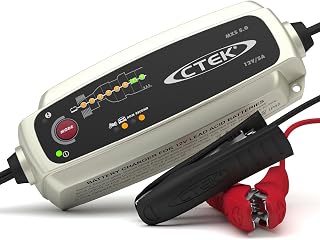 CTEK MXS 5.0 5A Battery Charger with Temperature Compensation
£74.49
4.8
in Best Car Battery Charger 2026: 10 Ranked, and Two Share a Model Number
-
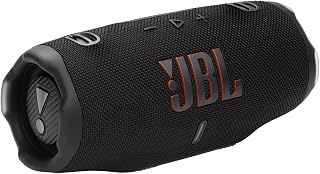 JBL Charge 6 Portable Bluetooth Speaker, 24H, Built-in Powerbank
£159.00
4.8
in Best Bluetooth Speaker 2026: 10 Portable Speakers Ranked
-
 Acer Predator GM7 1TB NVMe Gen4
£155.99
4.8
in Best 1TB SSD for PS5: 10 Ranked, From £135.99 to £199.99
-
Acer Predator GM7 2TB SSD, Gen4 NVMe 2.0, 7200MB/s, Graphene Thermal Pad
£228.99
4.8
in Best 2TB SSD for PS5 in 2026: 10 Ranked Against Sony’s Own Rules
-
 Wharfedale Diamond 9.1 Bookshelf Speakers (Pair, Walnut)
£129.00
4.8
in Best Bookshelf Speakers 2026: 10 Ranked, From £94.99
-
 WD Elements 1TB Portable Hard Drive
£93.00
4.7
in Best 1TB External Hard Drive 2026: 10 Ranked, and the 625 MB/s Myth
-
WD 2TB Elements Portable External Hard Drive
£99.99
4.7
in Best 2TB External Hard Drive: 8 Ranked, and the Speeds That Don't Add Up
-
 Crucial BX500 1TB 2.5" SATA SSD
£149.99
4.7
in Best 1TB SATA SSD: 10 Ranked, and Why £190 Buys 10MB/s
-
 soundcore Anker 2 Portable Bluetooth Speaker, 12W Stereo, IPX7, 24H
£28.49
4.7
in Best Bluetooth Speaker 2026: 10 Portable Speakers Ranked
-
 SanDisk Extreme 1TB microSD Card + Adapter
£157.99
4.7
in Best 1TB microSD Card 2026: 10 Ranked, Read vs Write
Comments
Reader comments are not checked against the manufacturer's claims above.
No comments yet
Be the first to add something we missed — a price change, a spec that turned out wrong, or how one of these held up.
Leave a comment
No account needed. Own one of these? Tell other readers how it actually performed.