Best USB Microphone 2026: 10 Ranked, and Why the Big Numbers Lie
By Felipe Iglesias · Updated
The biggest audio numbers in this set of ten sit on the cheapest mics. The £25.49 K KASONIC advertises 24-bit/192 kHz recording — a sample rate and a bit depth, not a range of sound — while the £129 Shure MV6 tops out at 15 kHz on maximum frequency. Signal-to-noise ratio is quoted just as loosely: the £48.99 MAONO PD100X claims 99 dB against 60 dB for the £169 RØDE PodMic USB. In practice, three listings print an 'audible noise' figure identical to their signal-to-noise figure to the decibel (78, 75 and 73 dB), which reads as a copy-paste rather than two separate measurements. Meanwhile the zealsound K66 quotes 85 dB of signal-to-noise and 66 dB of audible noise on the same page. The catch is simple: none of this makes them bad microphones, but it does mean the headline numbers are a poor way to choose which usb microphone to buy.
We ranked ten contenders for the best usb microphone on Amazon on three things you can check without trusting a box: how many owners left a rating and what they gave it, what the price actually buys in the spec table, and whether the spec table contradicts itself. Every figure below comes from the listing.
At a glance
| # | Product | Price | Rating | Link |
|---|---|---|---|---|
| 1 | FIFINE AM8 Dynamic XLR/USB Gaming Microphone | £56.99 | 4.6 | View |
| 2 | MAONO PD200XS XLR/USB Dynamic Podcast Mic with Boom Arm | £80.99 | 4.4 | View |
| 3 | Shure MV6 USB-C Gaming and Streaming Microphone | £129.00 | 4.5 | View |
| 4 | RØDE PodMic USB Dynamic Broadcast Microphone | £169.00 | 4.2 | View |
| 5 | TONOR TC310+ RGB USB Condenser Gaming Microphone Kit | £27.98 | 4.4 | View |
| 6 | MAONO PD100X XLR/USB Dynamic Gaming Microphone, Black | £48.99 | 4.4 | View |
| 7 | FIFINE K688CT Dynamic Podcast Microphone Kit with Boom Arm | £67.97 | 4.5 | View |
| 8 | MAONO DGM20 RGB USB Condenser Microphone for PC | £28.49 | 4.5 | View |
| 9 | zealsound K66 USB Podcast Microphone with Echo Function | £31.44 | 4.4 | View |
| 10 | K KASONIC RGB Gaming Microphone Kit with Boom Arm, 24-bit/192kHz | £25.49 | 4.4 | View |
Free WhatsApp group
Amazon deals, around the clock
Price drops and lightning deals posted the moment they go live. No spam, leave whenever you like.
Join the groupFree to join · Leave any time
FIFINE AM8 Dynamic XLR/USB Gaming Microphone

Top of the list because 856 ratings land at 4.6 stars, the strongest score-and-volume pair here, and the listing sits third in Amazon's Dynamic Microphones category.
Pros
- 4.6 stars from 856 ratings, the strongest score-and-volume pair in this set
- Third best seller in Amazon's Dynamic Microphones category
- XLR and USB outputs on the same body, so an interface upgrade does not mean a new mic
- Gain knob, tap-to-mute and a headphone jack with dedicated volume, all without software
- A dynamic capsule, so it hears less of the room than the condensers ranked below it
Cons
- Frequency response stops at 16 kHz, lower than the £25.49 K KASONIC and the £27.98 TONOR
- No sample rate and no signal-to-noise ratio anywhere in the spec table
- No boom arm or stand extension in the box
- 2% of ratings are one star and 2% are two star
What buyers actually say
Quoted from customer reviews on Amazon
Verified purchase“I've been really impressed with this microphone, particularly with the clarity and quality of the audio. My voice comes through clean, crisp and natural, making it ideal for gaming, streaming, podcasts and everyday use. The real-time monitoring is also a great feature, allowing you to hear your own voice instantly with no noticeable delay.One of the biggest positives is how easy it is to use. The USB plug-and-play setup means there's no complicated installation or software required — simply connect it to your computer and you're ready to go. The hardware mute button is extremely convenient too, giving you instant privacy with a clear LED indicator to show when you're muted.The microphone also offers plenty of control, including headphone volume adjustment and precise gain control, so you can quickly get your audio levels exactly where you want them without having to rely on post-editing.The RGB lighting is another nice touch. You get 3 lighting modes and 8 solid colours, giving you 10 options in total. It adds some personality to your setup without being too distracting.Overall, this is a fantastic microphone for anyone looking for clear audio, simple setup and useful built-in controls. The combination of real-time monitoring, instant mute, headphone controls, gain adjustment, USB plug-and-play and RGB lighting makes it a great all-round option, especially for streamers and gamers.”
Verified purchase“The microphone is absolutely perfect! It fits perfectly onto my Mac and the sound quality is amazing, especially for voiceovers. I love that you can customise the lighting with a variety of different colours, which makes it look great on my desk setup.I highly recommend this microphone for anyone who is into gaming. My friends have even noticed that they can hear me much more clearly while gaming and during calls. It's a great quality product and has really improved my overall setup.”
It takes the top spot on evidence rather than headline numbers. A 4.6 average from 856 ratings is the best combination of score and sample size in this set, and the listing sits third in Amazon's Dynamic Microphones category. The spec table is modest by comparison: a 50Hz–16KHz frequency response, and no signal-to-noise claim at all.
In use, the AM8 is a bus-powered usb gaming microphone with two outputs. Run it on USB-C straight out of the box, or take the XLR feed into an interface later without buying a second mic. There is a gain knob and a tap-to-mute button on the body, plus a headphone jack with its own volume control for zero-latency monitoring. The dynamic capsule and the 1.25 kg of metal in the stand make it a desk object rather than something you clip on.
That said, buyers who need the last octave should look elsewhere. The 16 kHz ceiling is below the £25.49 K KASONIC and the £27.98 TONOR, and no sample rate is quoted anywhere on the page. The box contains the microphone only, so a boom arm is a separate purchase. Around 4% of its ratings are one or two stars.
MAONO PD200XS XLR/USB Dynamic Podcast Mic with Boom Arm

The largest review base here — 3,641 ratings at 4.4 stars — and the only sub-£100 mic that ships with a boom arm and both XLR and USB-C.
Pros
- 3,641 ratings at 4.4 stars, the largest review base in this set
- USB-C and XLR outputs on one body for £80.99
- Boom arm, shock mount and pop filter included rather than sold separately
- One 2-in-1 knob controls both mic gain and headphone volume
- 80 dB signal-to-noise ratio claim, the second highest here
Cons
- Audible noise is quoted at 25 dB against an 80 dB signal-to-noise ratio on the same page
- The compatible-devices list omits games consoles, though the title names PS4/5
- 16 kHz maximum frequency, no better than the £48.99 PD100X
- RGB lighting and EQ need the MAONO Link download; 9% of ratings are one or two stars
What buyers actually say
Quoted from customer reviews on Amazon
Verified purchase“What stood out:Dual USB/XLR Versatility: The hybrid connectivity makes this an easy recommendation. You can plug it straight in via USB-C for immediate plug-and-play recording, while having the balanced XLR port ready to hook directly into a mixer or dedicated audio interface when expanding your setup.Dynamic Off-Axis Rejection: Unlike sensitive condenser mics that pick up every room echo, mechanical keyboard clatter, or PC fan whoosh, the cardioid dynamic capsule does a great job isolating your voice. It delivers a warm, broadcast-style proximity effect when speaking close.Onboard Controls & Zero-Latency Monitoring: The multi-function control knob makes adjusting mic gain and headphone volume straightforward on the fly. The tap-to-mute button with a clear LED indicator is responsive and avoids noisy mechanical clicks on stream.Software & Aesthetics: The RGB ring adds a clean accent that can be customised or completely turned off via the Maono Link software. The desktop app also lets you tweak digital EQ, a limiter, and a compressor when running in USB mode.Keep in mind:As with most dynamic broadcast microphones, proximity is key. You'll get the fullest, richest vocal tone by staying within 5–10 cm of the capsule.When running over XLR, the onboard volume/mute controls and RGB lighting are bypassed, as power then relies entirely on your external interface/mixer.An XLR cable is not included in the bundle, so you'll need to grab one separately if you plan to connect straight to an interface.A standout value for streaming, gaming, and podcasting that punches way above its price point while offering a direct upgrade path to XLR.”
Verified purchase“Really pleased with this. It's been excellent and dead easy to use from the start. Sound quality is good, and the included boom arm is sturdy and holds position well — it sits exactly where I want it and stays put. The controls on the mic itself are intuitive and easy to reach, and the LED ring is a nice touch. The software is straightforward too, so configuring the mic took no time at all. No complaints — would happily recommend.”
The PD200XS earns second place on the size of its feedback pool: 3,641 ratings at 4.4 stars, the largest in this list. The spec table backs that up with an 80 dB signal-to-noise ratio, a 40Hz–16kHz range and a 45 dB sensitivity figure.
This is an xlr usb microphone in the literal sense, because both connectors are on the body. USB-C is plug-and-play over the supplied 8.2ft cable; the XLR output feeds a mixer or interface when you want one. A single 2-in-1 knob handles gain and headphone volume, the RGB and EQ live in the MAONO Link app for Windows, Mac and Android, and the 350 g body hangs on an adjustable boom arm included in the box.
However, two rows in the spec table do not agree with each other. Audible noise is listed at 25 dB while signal-to-noise is listed at 80 dB — a 55 dB gap for figures that normally track together. The compatible-devices field names an audio interface, laptop, Mac, PC and smartphone, with no games console, despite the title naming PS4/5. In theory a 16 kHz ceiling is fine for voice; in practice it is the same limit as the cheaper MAONO PD100X.
Shure MV6 USB-C Gaming and Streaming Microphone

The lowest audible-noise figure here at 20 dB, and the only mic with auto level and a real-time denoiser — but also the lowest maximum frequency, at 15 kHz.
Pros
- 20 dB audible noise, the lowest figure quoted in this set of ten
- Auto level adjusts gain in real time, which no other mic here claims
- Digital popper stopper and real-time denoiser built into the onboard DSP
- 4.5 stars from 1,269 ratings, in a metal enclosure
- USB-C plug-and-play: no interface and no drivers
Cons
- 15 kHz maximum frequency — the lowest of the ten, below every sub-£30 mic here
- No XLR output, so there is no upgrade path to an interface
- No headphone monitoring jack listed, unlike mics costing £57 and £81
- 8% of ratings are one or two stars, a higher low-star share than the £25.49 K KASONIC
What buyers actually say
Quoted from customer reviews on Amazon
Verified purchase“Just a disclaimer that I am by no means a microphone or audio connoisseur. This mic is actually my very first external one used primarily for gaming/discord chats. Really really simple set up procedure, just one cable that's all, the software you get is basic enough but you can still do a lot with it. Great features in thge software with good background noise cancellation, pop filtering and a high pass filter if you require. This along with all the audio features in discord then the mic acts brilliantly.I am that annoying guy that usually has background music coming through his mic in the chat while we are all trying to play a game haha but I was pleasantly surprised with this as the noise cancellation and the correct adjustments to gain, my chat could not hear any background noise whatsoever, whether that was my music, football on the tv or the rattling of my mechanical keyboard so that was a big big plus!The design is fairly basic but clean enough and slick, the green isn't my favourite colour but if that's one of my main comlaints I guess the mic itself does a great job.The sound quality is fantastic and I really do love the mute button located on the body/casing of the mic, its a flat non-press button so a simple tap is enough, I just wish the light indicator was a little better because it's almost impossible to tell if you're on mute or not at a simple glance, unless maybe if you're in the dark.Overall, I am delighted with the purchase and I can not reccomend this mic anymore, especially for the price. Brilliant value.”
Verified purchase“The cable it comes with is too small so make sure you buy a longer cable, (usb-a to usb-c is what I use)10/10 works amazing, sounds very good and the software you download from the shure website is super well done!I use this for streaming and it sounds SO GOOD!”
The MV6 is the most expensive single microphone in this list at £129, and it holds 4.5 stars from 1,269 ratings. Its 20 dB audible-noise figure is the lowest quoted here. Its maximum frequency, 15 kHz, is the lowest too.
Shure sells this as a usb microphone for streaming, and the useful features are all software-side. Auto level rides the gain in real time, so shouting and whispering land at the same volume. A digital popper stopper handles plosives without a physical filter, and the real-time denoiser and voice isolation run on a dynamic cardioid capsule with a 50Hz floor. Setup is USB-C into a PC or laptop, with no interface and no drivers. The enclosure is metal.
Worth noting what is not in the table. There is no XLR output, so this is a dead end if you later want an interface, and no headphone monitoring jack appears in the spec list — the £56.99 FIFINE AM8 and the £80.99 MAONO PD200XS both include one. 8% of ratings are one or two stars, split evenly at 4% each, which is a high low-star share for a Shure.
RØDE PodMic USB Dynamic Broadcast Microphone

The only mic here with a full 20Hz–20kHz range and a real 20 kHz top end, and also the lowest star rating: 4.2 from 1,429 reviews.
Pros
- 20Hz–20kHz frequency range, wider than anything else in this list
- XLR and USB-C outputs on the same body
- Internal shock mount plus twin pop filters, with no accessories needed
- Dual 3/8-inch and 5/8-inch threads on the swing mount
- Headphone port with its own volume control
Cons
- 13% one-star and 5% two-star ratings — the highest low-end share in this set
- Signal-to-noise quoted at 60 dB while audible noise reads 94 dB
- 862 g needs a serious boom arm, and one is not included
- At £169 it costs more than the TONOR, MAONO DGM20, K KASONIC and zealsound K66 combined at £113.40
What buyers actually say
Quoted from customer reviews on Amazon
Verified purchase“USB C straight into the pc, no setup needed and no interface needed. Works perfectly and sounds great. A bit pricy but if you want a high quality plug and play experience then go for it, you won't be disappointed. Just make sure to buy the rode boom arm or an equivalent quality one as the thing is heavy.”
Verified purchase“Can hear some background noise but if your in a quiet room it's fine when I got it the cable they gave didn't work but I used another one”
The PodMic USB is the widest-response microphone in this group: 20Hz to 20kHz, top to bottom, with both XLR and USB-C on the body. It is also the lowest rated, at 4.2 from 1,429 reviews — the only mic here below 4.4 stars.
The internal DSP is what you pay for. RØDE Central unlocks the APHEX Aural Exciter and Big Bottom processors, which is a different approach from the EQ knobs on the cheaper mics. An internal shock mount and a built-in pop filter sit behind an external one, the swing mount carries both 3/8-inch and 5/8-inch threads so no adaptor is needed, and the headphone port has a dedicated volume control for zero-latency monitoring. At 862 g it is the second heaviest mic here.
The catch is in the two numbers that sit furthest apart. Signal-to-noise is quoted at 60 dB — the lowest in this list — while audible noise reads 94 dB on the same page. That is a 34 dB gap, and if it is a typo it has gone uncorrected at £169. The RØDE also carries the heaviest low-end feedback here: 13% of ratings are one star and 5% are two star.
TONOR TC310+ RGB USB Condenser Gaming Microphone Kit
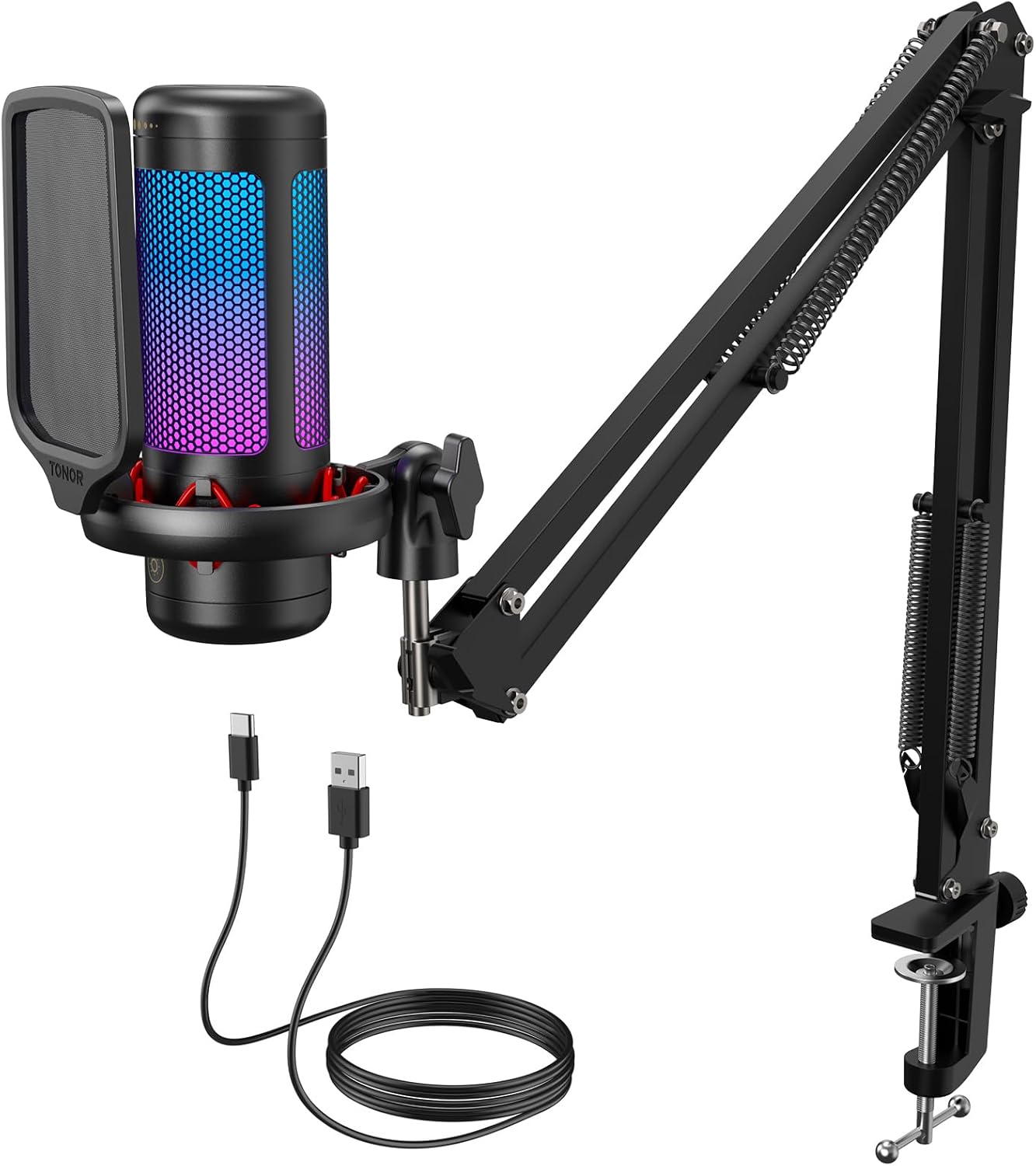
The cheapest complete kit here at £27.98, with 2,481 ratings at 4.4 stars — the second-largest review base in the list.
Pros
- £27.98 with a boom arm, shock mount, pop filter and stand in the box
- 2,481 ratings at 4.4 stars — the second-largest review base here
- 20Hz–20kHz frequency range, wider on paper than the £56.99 FIFINE AM8
- 78 dB signal-to-noise ratio claim
- Four RGB modes with a brightness dial on the base
Cons
- Audible noise and signal-to-noise are both listed as 78 dB
- 2.2 kiloohm impedance is the same figure the MAONO DGM20 lists
- Spec table says one nonstandard battery is required while the power source reads corded electric
- A condenser capsule will pick up more room than the dynamic mics ranked above it
What buyers actually say
Quoted from customer reviews on Amazon
Verified purchase“Surprisingly great quality for the price. Packaging is superb, boom arm seems sturdy and the microphone looks great with very simple controls. Easy to set up, it's just plug and play and connects instantly.”
Verified purchase“If you are in the market for a good budget mic this is the one. I bought this a couple of weeks ago and it is amazing for its price. I would highly recommend.”
For £27.98 the TC310+ brings 2,481 ratings at 4.4 stars, second only to the MAONO PD200XS, plus a 20Hz–20kHz range and a 78 dB signal-to-noise ratio. On paper it looks like more microphone than the £56.99 FIFINE AM8.
This is a usb condenser microphone, and that shapes how it behaves in a room. A condenser capsule with a 10 dB sensitivity figure and a unidirectional pattern picks up more of what is behind you than the dynamic mics above it. The kit covers the practical details: a metal boom arm with a clamp that fits desks up to 2.36 inches, a shock mount, a pop filter and a stand. Four RGB modes run from the touch panel, and rotating the base changes brightness. Mute is a tap on the top; gain is a twist.
That said, two rows of the spec table are hard to take at face value. Audible noise is listed at 78 dB, exactly the same as the signal-to-noise ratio. Impedance is listed at 2.2 kiloohms, identical to the £28.49 MAONO DGM20, which suggests a shared template rather than two separate measurements. The power section also says one nonstandard battery is required while the power source reads corded electric.
MAONO PD100X XLR/USB Dynamic Gaming Microphone, Black

Quotes the highest signal-to-noise ratio in this set, 99 dB, for £48.99 — on a mic whose frequency response row contradicts its own bullet points.
Pros
- 99 dB signal-to-noise ratio claim — the highest in this set
- 24-bit/48kHz recording and a 48Hz–16kHz range on the bullet points
- USB-C and XLR on the same body for £48.99
- 2-in-1 knob for gain and headphone volume, plus one-touch mute with LED
- 3.5mm jack for real-time monitoring
Cons
- The frequency response row reads 40 Hz alone, while the bullets say 48Hz–16kHz
- XLR cable is not included, despite XLR being half the selling point
- Not compatible with Xbox or iPhone, per the listing's own note
- The 50% more sound detail claim cannot be checked against anything on the page
What buyers actually say
Quoted from customer reviews on Amazon
Verified purchase“Good quality sound - huge jump over my (high quality) headset for recording training video VO in my job. Feels very solid - only little niggle is that I wish the gain indicator was a bit more easy to tell what it was set to. The light bar is cool, but it's not the best if you want to know exactly what it is set to.”
Verified purchase“Sounds nice and clear looks nice and simple plus its own app to control the mics other stuff”
The PD100X claims 99 dB of signal-to-noise for £48.99. The £169 RØDE PodMic USB claims 60 dB. By contrast, there is no DSP here: it is a plain dynamic capsule with RGB lighting and a mute button.
It records at 24-bit/48kHz and covers 48Hz–16kHz according to the bullet points. A 2-in-1 knob handles gain and headphone volume, the mute button carries an LED, and monitoring runs through a 3.5mm jack. RGB offers three modes and nine colours. USB-C and XLR are both on the body, which makes it an XLR-capable usb microphone for under £50 — though the XLR cable is not in the box.
However, the listing disagrees with itself. The frequency response field reads 40 Hz on its own, while the bullet points say 48Hz–16kHz, so a row meant for one clear figure has been left half-filled. The claim that sound detail improves by 50% over a 16-bit/48kHz competitor is not something a buyer can check. The XLR cable is listed as not included, and the compatibility note rules out Xbox and iPhone.
FIFINE K688CT Dynamic Podcast Microphone Kit with Boom Arm

4.5 stars, but from only 265 ratings — the thinnest evidence base in the top half of this list.
Pros
- 4.5 stars from 265 ratings
- Boom arm, integrated shock mount and pop filter come in the kit
- Dynamic capsule rated for peaks up to 130 dB
- USB and XLR outputs with a low-latency headphone port
- One-touch mute plus dials for volume and monitoring, with no software needed
Cons
- Only 265 ratings, the thinnest sample in the top seven
- No signal-to-noise ratio anywhere in the spec table
- 130 dB is filed under audio sensitivity, where every other mic here quotes 10–45 dB
- 1.28 kg, the heaviest item in this set
What buyers actually say
Quoted from customer reviews on Amazon
Verified purchase“For the price, it feels like a steal.No need for XLR allows for an easy, lesser expensive experience whilst delivering on audio quality.The microphone lacks a preset EQ, but they are easy to initialize through third party programs such as OBS, Wave link and Voice mod in return.”
Verified purchase“Microphone is very very good, clear and crisp, the arm on the other hand started squeaking after a week and it's not very sturdy, it's easy for it to move about, had to purchase fifines other boom arm that's £50 at the moment and is extremely sturdy almost too sturdy”
The K688CT scores 4.5 from 265 ratings, which ties it with the Shure MV6 and the MAONO DGM20 on stars and leaves it well behind them on volume. It is also the only mic here whose spec table quotes no signal-to-noise ratio at all.
It arrives as a kit: the microphone with an integrated shock mount and pop filter, a heavy-duty metal boom arm, and a USB cable. The dynamic capsule is rated for peaks up to 130 dB, roughly the level a snare drum produces. Controls are all on the body — a one-touch mute button and dials for volume and monitoring — and there is a low-latency headphone port. USB and XLR are both available, so it goes straight into a laptop or through a mixer.
Even so, 265 ratings is a thin sample for a £67.97 purchase. The 130 dB figure sits under audio sensitivity, a field every other mic here uses for a value between 10 and 45 dB. And at 1.28 kg it is the heaviest single item in the list, so the arm has to be clamped somewhere solid.
MAONO DGM20 RGB USB Condenser Microphone for PC

The best balance of price and proof here: £28.49, 4.5 stars from 1,120 ratings, and a 50Hz–20kHz range.
Pros
- £28.49 with 4.5 stars from 1,120 ratings
- 50Hz–20kHz range, wider than the FIFINE AM8, K688CT, PD200XS and PD100X
- One-touch noise reduction and a gain knob on the body
- Desk stand, shock mount, pop filter and boom adapter all included
- Works with PC, Mac, PS4 and PS5 over USB-C
Cons
- Signal-to-noise (73) and audible noise (73 dB) are the same number
- 2.2 kiloohm impedance, identical to the £27.98 TONOR
- Not compatible with Xbox, per the listing
- A condenser capsule, so it hears more of the room than the dynamic mics above
What buyers actually say
Quoted from customer reviews on Amazon
Verified purchase“This mic is a godsend; rather than buying something very expensive, this product is at a reasonable price. The sound quality is very clear, especially when it's on the noise cancellation, which does a great job of reducing the background noises, which makes my voice sound more professional!Features like the touch mute button and the RGB lighting are simply amazing.I would recommend!!”
Verified purchase“So i use this mic for my YouTube Channel and its amazing!The setup is super speedy, just connect and go.The sound quality is amazing with no background noise added.Its compatible to all PC's and even Xbox Controllers.And all the light settings on the mic lets you customise it to your liking!An amazing first mic for anyone!”
At £28.49 the DGM20 pairs a 4.5-star average with 1,120 ratings — more evidence than every mic above it except the PD200XS and the TONOR. It also claims a 50Hz–20kHz range, wider than anything ranked above it apart from the £169 RØDE.
The DGM20 is pitched as a usb microphone for pc and works with Mac, PS4 and PS5 through the bundled USB-C to USB-A/USB-C 2-in-1 cable. Noise reduction is a three-second press, mute is one tap on top, and a gain knob sits on the body. There are nine RGB modes. The kit includes a desk stand, shock mount, pop filter and a 5/8-inch to 3/8-inch boom adapter, so it moves to an arm later without extra parts.
That said, the same template problem appears here as on the TONOR. Signal-to-noise is listed as 73 and audible noise as 73 decibels — the same value stated twice. Impedance is 2.2 kiloohms, matching the TONOR exactly. The listing also notes it is not compatible with Xbox.
zealsound K66 USB Podcast Microphone with Echo Function

The only mic here with a reverb knob and a Lightning adapter for iPhone, at £31.44 from 1,232 ratings.
Pros
- 4.4 stars from 1,232 ratings at £31.44
- 85 dB signal-to-noise ratio claim, the second highest here
- Gain, echo and monitor volume as separate physical knobs
- USB-A cable, USB-C adapter and Lightning adapter for iPhone included
- Works with PC, Mac, PS4/5 and Android without drivers
Cons
- Frequency range is listed as 48kHZ, a sample rate in a frequency field
- Impedance reads 2.2 ohm, where two other listings read 2.2 kiloohms
- 80 Hz minimum frequency, the least low-end reach in this set
- Signal-to-noise (85 dB) and audible noise (66 dB) are 19 dB apart
What buyers actually say
Quoted from customer reviews on Amazon
Verified purchase“Great birthday present for my daughter who has started recording podcasts. Good crisp audio that syncs up with camera well. Easy to set up. Reduces the background noise and looks really professional.”
Verified purchase“Perfect for a podcast setup.Easy to use and setup.Sound quality is great and picks up 2 people talking with no problem”
The K66 sits ninth on 4.4 stars from 1,232 ratings. Its signal-to-noise claim is 85 dB, the second highest in this list; its audible-noise figure, on the same page, is 66 dB.
The design is unusual: a 360-degree rotatable top-address body on a metal base, with separate knobs for gain, echo and monitor volume. Echo is the odd one out, because no other mic here offers a reverb control. Noise reduction is a long press on the mute button. The box covers PC, Mac, iPhone, PS4/5 and Android without drivers, and includes a USB-A cable, a USB-C adapter and a Lightning adapter. Minimum frequency is 80 Hz.
However, two rows of the spec table do not do their job. The frequency range field reads 48kHZ — a sample rate sitting where a frequency range belongs, and the only entry in that row. Impedance reads 2.2 ohm, which is a thousand times lower than the 2.2 kiloohm figure two other listings here carry. Separately, 80 Hz is the highest low-frequency limit in this set, so the bottom end is the thinnest.
K KASONIC RGB Gaming Microphone Kit with Boom Arm, 24-bit/192kHz

Last, but carrying the biggest number in the article: £25.49 for 24-bit/192 kHz and a boom arm, with a 199-rating sample and no frequency response row to match.
Pros
- £25.49 with a boom arm, pop filter and heavy-duty base included
- 24-bit/192kHz recording claim, the highest bit depth and sample rate here
- 75 dB signal-to-noise ratio
- 3.5mm headphone jack for zero-latency monitoring
- Two-year manufacturer warranty and 1.22 kg total weight
Cons
- 199 ratings, the smallest sample in this set
- No frequency response row in the spec table, so the 192 kHz claim answers nothing
- Signal-to-noise (75 dB) and audible noise (75 dB) are identical
- 24-bit/192 kHz is a sample rate and bit depth, not a measure of how much sound the mic captures
What buyers actually say
Quoted from customer reviews on Amazon
“He montado este micrófono en mi escritorio para las partidas y algo de grabación y la verdad es que va muy bien. Al ser USB es conectar y listo, el ordenador lo reconoce al momento sin tener que instalar nada raro. La calidad de sonido se nota limpia y clara gracias a los 24 bits, por lo que para hablar con los amigos en Discord o para grabar un podcast cumple de sobra, sin ruidos molestos de fondo.El kit viene completísimo. El brazo articulado es bastante firme, se sujeta bien a la mesa y se puede orientar sin que se caiga por el peso. Además, la iluminación RGB le da un toque estético genial al set up que luce un montón en streaming. Al principio me preocupaba que los materiales fueran endebles, pero en general se percibe todo bastante robusto para el precio que tiene. Un pack muy recomendable si buscas mejorar tu audio sin gastar una fortuna.”
“This microphone and boom arm set looks like something a professional streamer would use, and compared to my old basic microphone, this is better in every aspect.The audio quality is phenomenal. It could be that my expectations are low, considering I've never owned a great microphone before, but the sound is very clear and controlled. I've connected my headphones via the headphone jack, and it's very useful for hearing myself so I can adjust the mic gain and sound level. The audio playback is instant with no noticeable delay.There are also touch buttons at the top of the mic for muting, noise reduction and RGB. It feels responsive, and it's convenient to have right in front of me. The boom arm is definitely my favourite addition because it makes me look like a steamer, and it doesn't take up desk space. I can easily manoeuvre it, so I can have it near me when in use and then push it away when I'm not using the mic. It clamps onto my desk, and it feels very sturdy.I'm surprised this is 35.99 because this is so much better than my previous microphone, which isn't that much cheaper than this. I haven't used a high-end microphone before, so for me, this is perfect, and I would recommend this for a beginner on a budget.”
The K KASONIC is the cheapest item here at £25.49 and it advertises the loudest figure in the article: 24-bit/192kHz audio from a 14mm condenser capsule, with a 75 dB signal-to-noise ratio. It has 199 ratings at 4.4 stars, the smallest sample in this set — worth knowing before you buy the cheapest budget usb microphone here.
The bundle is the point. A boom arm with a heavy-duty base, a pop filter, RGB lighting, a mute button, a one-touch noise-reduction button, a gain knob and a 3.5mm headphone jack for zero-latency monitoring, all for less than most boom arms sold alone. It is 1.22 kg in total and carries a two-year manufacturer warranty.
In short, treat the 192 kHz as a footnote. It describes bit depth and sample rate, not the range of sound the microphone captures, and this listing has no frequency response row at all — so there is no other figure to set the claim against. Meanwhile the 75 dB signal-to-noise and 75 dB audible-noise entries are the same number twice. And 199 ratings is the thinnest basis for a ranking in this article.
Final Verdict
For most buyers the £28.49 MAONO DGM20 is the sensible first usb microphone: a gain knob, a 50Hz–20kHz range and 1,120 ratings at 4.5 stars. If you record in a shared room or want the least fussy setup, the £129 Shure MV6 is worth the stretch — auto level and a real-time denoiser, though it stops at 15 kHz. Anyone planning to move to an audio interface later should look at the £56.99 FIFINE AM8 or the £80.99 MAONO PD200XS, both of which carry XLR and USB in the same body. And if you simply want the cheapest complete usb microphone with boom arm, the £25.49 K KASONIC kit is the one to buy — just do not buy it for the 192 kHz figure.

Written by
Felipe Iglesias
Founder & Lead Reviewer
Felipe is a computational engineering student who has been working in SEO since he was sixteen. He founded ranked10 and researches every guide on the site.
Related buying guides
All Tech guidesBest DAB Radios 2026: 9 Ranked, and the 30W Claim That Doesn't Add Up
A radio that claims 30 W of output and a battery that lasts over 10 hours is claiming something the arithmetic will not support. The AZATOM Spitalfields 2 lists 30 W maximum speaker output; the same listing says its 2,000 mAh battery runs for over 10 hours. A 2,000 mAh cell at the 3.7 V that appears in these spec sheets holds about 7.4 Wh, so ten hours averages 0.74 W. At a genuine 30 W, that pack would be empty in about 15 minutes. That is the problem with shopping for the best DAB radios on wattage alone: the Mycket, at £29.99, declares 5 W against a 2,200 mAh battery and 12 hours — around 0.68 W average, the same order of magnitude as the AZATOM. The '30 W' and the '5 W' are not the same measurement, which is why a £29.99 radio looks six times more powerful than a £44.95 one. We ranked nine of the best DAB radios on Amazon on preset count, power source, battery type, display and how well each listing's own numbers agree with each other. Every one of the dab radios reviewed here was checked against its spec table, not against its marketing headline. Price runs from £21.59 to £99.00, and the most expensive model is not the one with the biggest wattage claim.
TechBest CPU Air Cooler 2026: 10 Ranked, One Sold Twice at Two Prices
The same cooler appears twice in this best cpu air cooler shortlist, at two different prices. The Thermalright Peerless Assassin 120 SE is listed at £29.99 with 3,133 ratings and again at £35.90 with 307 ratings — £5.91 more for a name that is identical. The two listings cannot both be right about the hardware: one records 12 Volts and 265 watts, the other 5 Volts and 3 watts. Those watts are not power draw. The cooler's own fan is a 4-pin, 12-volt part moving 66.17 CFM, and the 265 W sitting in the Wattage field is the thermal capacity quoted in the bullet text, not the current the product consumes. The pattern repeats. be quiet! sells two Pure Rock Pro 3 coolers at the same £41.98, yet one lists 3.6 watts and the other 250 watts. Cooler Master's MasterLiquid describes a 394 mm radiator in its copy while its own dimensions field says 15.7 cm long. We ranked ten of the best cpu air cooler options on Amazon on three criteria: the published price and rating counts, the socket support each listing actually states, and whether a product's own specifications agree with each other.
TechBest Case Fans 2026: 9 Ranked by What a Fan Actually Costs
Almost nothing in this list of the best case fans is sold as a single fan, so the price on the page is not the price of a fan. The £21.49 ARCTIC five-pack works out at £4.30 a fan. The £18.66 ARCTIC pack works out at £3.73. Meanwhile the £18.99 be quiet! Light Wings buys you one fan. The same be quiet! Light Wings 120mm PWM high-speed fan is listed twice — £18.99 on its own and £44.99 as a three-pack with an ARGB hub. That is £15.00 a fan, and £11.98 less than three singles. The noise numbers cannot be lined up either: ARCTIC quotes 0.3 sones on both its five-packs, Noctua quotes 25.1 dB(A), be quiet! 31 dB and Corsair 36 dB. As a result the spec tables are not all in the same unit, and Noctua is the only brand here quoting airflow in cubic metres rather than CFM. We ranked nine of the best case fans on Amazon on three measures a buyer can check: the price divided by the number of fans in the box, the specification each manufacturer actually publishes, and the review count behind the star rating. There is no test bench here. Where a listing contradicts itself — and several do — we say so, with both numbers.
Comments
Reader comments are not checked against the manufacturer's claims above.
No comments yet
Be the first to add something we missed — a price change, a spec that turned out wrong, or how one of these held up.
Leave a comment
No account needed. Own one of these? Tell other readers how it actually performed.