
A log burner fan is the only fan in the world with no motor, no cable and no battery. It sits on top of a stove, the heat of the fire passes through a thermoelectric junction — the same Peltier effect that cools a picnic box — and the few watts that junction produces turn a brushless fan. Three of the ten listings below name that engine in the field reserved for it, saying thermoelectric; two describe the fuel instead, saying heat powered; the rest leave the row empty. Where the energy comes from is a sentence; what the engine is, is a specification.\n\nThe rest of the specification describes an appliance that does not exist, and the evidence is in the wattage. The VALIANT fan at number three states 4 watts, and the Signstek at number four states 5.7 — those are the numbers a thermoelectric junction can actually deliver once a stove is up to temperature. The Christmas-patterned fan at number six states 50 watts, which is nine to twelve times the honest figure and more than many laptop chargers supply. It is the same species of error that this site found on the head torches, where a 1200 milliamp-hour cell was advertised as producing 2000 lumens: a number typed into a field that nobody expected a buyer to check. The same page carries a standby power figure of 100 per cent for a device with no standby, and a power levels row that reads one; a fan whose speed is decided entirely by how hot the stove is has neither settings nor an idle state.
The standby power row is the best evidence in this article that these tables are filled in by hand. Four fans answer it four different ways, and none of them with an idle draw. One says 100 per cent; one says A++, which is the European energy efficiency class that goes on a fridge, appearing here on a device that uses no energy at all; one writes three marketing phrases — high heat distribution efficiency, eco-friendly operation, cost-effective — where a figure belongs; and one answers in French, with a sentence about reducing firewood consumption by 28 per cent. That last one is not a typo but a seam: a listing assembled from several European versions at once, exactly as the frying pan in this site's kitchen ranking prints its model name in French and a dressing gown lists its contents in German. The row exists on the form whether or not the product has anything to put in it, and a tenth of this comparison is what happens when the form wins.\n\nWhat can be measured on these pages is short and worth reading. The operating range appears on one listing only: the JossaColar at number one publishes 50 to 350 degrees Celsius, which is when the fan starts turning and when its protection has to intervene. Every other listing gives a starting figure — 60 or 80 degrees — and stops, which is half a specification and the wrong half, because a fan that waits for 80 degrees does nothing for the first hour of a fire. Noise is the other real number, and it varies more than the fans look like they should: 20 decibels on the twelve-blade dual-motor fan at number seven, 24 and 25 across five others, and 45 decibels on the VALIANT at number three — which is the most expensive fan here and, at arm's length, about four times as loud as the quietest. Its own copy calls it exceptionally quiet, two inches above the number that contradicts it.
JossaColar Log Burner Fan, 10 Blades, 50-350°C, Heat Powered

£36.99 for the only fan here that states where it starts and where it stops: 50°C to 350°C, with 5,522 ratings.
Advantages
- 5,522 ratings at 4.6 stars, the deepest sample here
- The only fan here publishing a full range: 50°C to 350°C
- 25 decibels, stated in a field
- Ten blades, with the airflow idea explained rather than asserted
- Aluminium blades on a metal base
Disadvantages
- £36.99, the second-dearest fan here
- Motor type says heat powered, not thermoelectric
- No wattage published, unlike the two fans that give 4 and 5.7 watts
- Ten blades is a marketing number: the stove decides the speed
The only fan in this ranking that publishes the number which describes the whole of its working life: its applicable temperature range is 50 to 350 degrees Celsius. Every other listing here gives a starting temperature — 60 or 80 degrees — and stops there, which tells a buyer half of what a heat-powered fan does. A thermoelectric junction needs a temperature difference to make its few watts, so the bottom of the range is when it begins to turn and the top is when the protection has to intervene, and 350 degrees is the point at which a stove is being run hard. Between those two figures is the only complete specification in this article, and it belongs to the fan with the deepest sample: 5,522 ratings at 4.6 stars.\n\nIts ten blades are the marketing number, and the listing gives the honest half of that too: ten blades direct the rising warm air outwards rather than letting it gather at the ceiling. More blades is not more airflow unless there is something to drive them, and this fan's engine is the stove. Its noise level is 25 decibels, the same figure as several other fans here, and its motor type field says heat powered, which is where the energy comes from rather than what the engine is.\n\nIts record is the deepest here and its price is the second-highest, and its reviews are about moving warm air into a room rather than about anything breaking. At £36.99 it is the fan to buy if the stove is the main heat in the house, because it is the only one whose range can be checked against the temperature the stove actually reaches.
Tomersun Log Burner Stove Fan, 6 Blades, with Thermometer

£18.69 for the second-most-reviewed fan here, with 24 decibels stated and a stove thermometer included.
Advantages
- 5,476 ratings at 4.3 stars, the second-deepest sample
- 24 decibels stated, within a decibel of the quietest
- Motor type correctly given as thermoelectric
- A stove thermometer included, to check the surface
- £18.69, the cheapest in the well-reviewed half
Disadvantages
- No wattage published
- No operating range, only a starting principle
- Six blades, against ten and twelve elsewhere
- 590 grams of aluminium to sit on a hot stove
The second-deepest sample in this ranking and the only fan that comes with the instrument to check it: a stove surface thermometer is included in the box, which turns the fan's own specification into something a buyer can test. The listing states an operating principle and a temperature to watch, so a thermometer is the logical accessory, and it is the sort of detail that separates a listing written by somebody who has used the product from one that has been filled in.\n\nIts motor type field reads thermoelectric, in lower case, which is the correct name for the engine: a junction that converts the temperature difference between the hot base and the cooler air into the few watts that turn a brushless fan. Its power source is stated as heat powered with no electricity or battery required, and its noise level is 24 decibels — within a decibel of the quietest fans here. It weighs 590 grams, which is typical for a six-blade aluminium fan of this size.\n\nIts record is 5,476 ratings at 4.3 stars, and the listing reads like a product rather than a template: the blades are counted, the noise is measured, the engine is named and the thermometer is included. At £18.69 it is the second-cheapest fan in the well-reviewed half of this ranking, and the one to choose if the stove has never been measured.
VALIANT Premium IV Heat Powered Stove Fan, 4 Blades, 4 Watts

£39.99 for the fan that states the two numbers no one else does: 4 watts of consumption and 45 decibels of noise.
Advantages
- Publishes 4 watts, the only real consumption figure here
- 2,226 ratings at 4.5 stars over many seasons
- Dynamically balanced blades and a thermally controlled actuator
- A British brand with a long history in stove accessories
- Four blades, the fewest here and the quietest design to balance
Disadvantages
- 45 decibels: the loudest fan in this ranking
- Its own bullets call it exceptionally quiet
- £39.99, the dearest fan here
- 4 watts is stated where its rivals state nothing at all
The dearest fan in this ranking and the one that settles the argument about wattage. Its specification says four watts, which is what a thermoelectric fan actually draws once the stove has generated the current — a figure in the same range as the 5.7 watts of the fan at number four. Against those two numbers, the Christmas-patterned fan at number six claims fifty watts, which is twelve times the honest figure and more than most laptop chargers supply; it is the same species of error as the head torches claiming 2000 lumens from a 1200 milliamp-hour cell.\n\nThe same page is also honest about the one number buyers would rather not read. Its noise level is 45 decibels, against 20 to 25 on every other fan here. Forty-five decibels is a quiet conversation, and the difference between 25 and 45 is not a small one: every ten decibels is a doubling of perceived loudness, so this fan is about four times as loud in the room as the quietest one in the article. Its own bullets call the operation exceptionally quiet, which is a claim that the specification two inches above it contradicts.\n\nWhat the money buys is a British brand with a long history in stove accessories, four dynamically balanced blades, a thermally controlled actuator and a build that reviewers describe as continuing to work after several seasons. At £39.99 it is the most expensive fan here, and the one whose specification lets a buyer decide what they are trading: silence, or the £10 difference to the next fan up the list.
Signstek Heat Powered Stove Fan, 6 Blades, 5.7 Watts

£19.59 for the second fan here to state a real wattage, 5.7 watts, with anodised aluminium blades.
Advantages
- 5.7 watts stated: a real consumption figure
- Anodised aluminium blades, named in the right field
- Starts operating at 80°C, stated
- 1,356 ratings at 4.4 stars
- £19.59, mid-range here
Disadvantages
- Standby power field holds a fuel-saving claim
- 38 per cent is unverifiable from the page
- 80°C start means it does nothing early in a fire
- Six blades, against ten and twelve elsewhere
The second fan in this ranking to publish a real consumption figure: 5.7 watts, against the 4 watts of the VALIANT above it and the 50 watts claimed by the Christmas-patterned fan below. Those three numbers are the whole argument about how this category documents itself: two listings measured the current a thermoelectric junction makes and one wrote a number that would be closer to a vacuum cleaner than to a fan. A buyer comparing this page with that one is comparing a specification with a guess.\n\nThe same table contains the best example in the article of a field being used for something it was never meant to hold. In the row for standby power shutoff — a field that exists to describe what a device draws when it is idle — this listing has written: improves fuel utilisation by 38 per cent. That is a claim about the stove, in a row about electricity, on a product that consumes none. Its six anodised aluminium blades are stated in the right field, and its starting temperature is the common 80 degrees Celsius.\n\nThe record is 1,356 ratings at 4.4 stars, and the reviews are about quiet circulation and about heat reaching the other end of a room. At £19.59 it is priced between the two fans above it and the two below, and it is the one to buy if the wattage matters to you more than the blade count.
Wood Stove Fan, 4 Blades, Thermoelectric, 25dB, 80°C Start

£16.99 for a fan with no cable, no battery and a noise level of 25 decibels, powered by the fire under it.
Advantages
- Motor type correctly given as thermoelectric
- 25 decibels stated in a field
- Blades start rotating at 80°C, stated
- Nothing to plug in, charge or switch on
- £16.99, among the cheapest fans here
Disadvantages
- 8 per cent of its ratings are one-star
- High-temperature protection without the temperature
- 80°C start: an hour of nothing on a cold fire
- No wattage and no operating range published
The clearest page in this ranking for understanding what a stove fan is, because it names the engine in the field designed for it. The motor type row reads thermoelectric: a junction sits between the hot base of the fan and the cooler air above it, the temperature difference generates a small voltage, and that voltage turns a brushless fan. There is no cord, no battery and no switch, which is why the power source row says heat powered and why two other rows on other listings here — a wattage and a standby field — are describing an appliance that does not exist.\n\nThe numbers that do exist on this page are the two that matter. Its noise level is 25 decibels, which is below a fridge and about the level of a quiet room, and the listing states that the blades begin to rotate when the stove surface reaches 80 degrees Celsius — a temperature, not a time, which is the honest way to describe something with no controls. It also states that the fan has high temperature protection, without saying at what temperature it intervenes; that figure is the one the fan at number one publishes as 350 degrees.\n\nIts record is 1,659 ratings at 4.2 stars with 8 per cent one-star, which is a real tail for a simple device, and the reviewers describe moving warm air off a fire into the room. At £16.99 it is one of the two cheapest fans here, and it is the one to buy if the specification being correct matters to you.
Wood Stove Fan, 4 Blades, Heat Powered, Christmas Pattern

£15.99 for a heat powered fan with a festive pattern and a wattage claim twelve times the honest figure.
Advantages
- £15.99: the cheapest stove fan in this ranking
- 25 decibels stated, like the fans above it
- Starts at 80°C, stated
- A Christmas pattern, if that is what is wanted
- Power source correctly given as heat powered
Disadvantages
- Wattage row claims 50 watts: twelve times the honest figure
- Standby power shutoff is a row with no meaning here
- 12 per cent one-star, the weakest tail in this ranking
- The decoration will date
The listing that turns this article's argument into arithmetic. This fan is heat powered, as its own power source row says: it has no cable, no battery and nothing inside it that draws current from the mains. And the row above it states a wattage of fifty watts. The VALIANT at number three measured 4 watts and the Signstek at number four measured 5.7, which is what a thermoelectric junction can supply when a stove is running properly — so this page claims between nine and twelve times the honest figure. Fifty watts is the sort of number a laptop charger supplies, and no stove fan of this size has ever consumed it.\n\nThe same table carries two more rows that describe an electric appliance. Standby power shutoff reads 100 per cent, on a device with no standby and no power to shut off, and the number of power levels is one, which is true in the sense that having no controls is having a single setting. Three fields describe a corded product; one, the power source, describes the fan.\n\nWhat is honest here is worth keeping: a noise level of 25 decibels, the same as most fans in this ranking, a starting temperature of 80 degrees, and a Christmas pattern printed on the blades that the listing presents as its distinguishing feature. Its record is the weakest here — 689 ratings at 4.1 stars with 12 per cent one-star — and at £15.99 it is the cheapest fan in this comparison.
12-Blade Stove Fan, Dual Motor, Heat Powered, 20dB

£34.99 for the quietest fan in this ranking at 20 decibels, with two motors driving twelve blades.
Advantages
- 20 decibels: the quietest fan in this ranking
- Two thermoelectric junctions driving twelve blades
- 4.6 stars from 832 ratings
- Aluminium blades on a black aluminium base
- A genuine upgrade over single-motor fans, per its buyers
Disadvantages
- Standby power field contains an A++ energy class
- Motor type says heat powered rather than thermoelectric
- £34.99, the third-dearest fan here
- Twelve blades is still a marketing number: the stove sets the speed
The quietest fan in this article and the clearest example of a specification that has been filled in by habit. Its noise level is 20 decibels, which is quieter than a library and the lowest figure here — three of its rivals state 25 and the VALIANT states 45. The rest of the page is the twelve blades and the two motors that drive them: two thermoelectric junctions instead of one, each pushing six blades, which is the honest way to double the airflow from a device with no engine of its own. More junctions mean more current, more fan, more air moved, and the listing presents it as the upgrade it is.\n\nThen there is the row for standby power shutoff, and the answer in it is A++. That is the European energy efficiency class, the label that goes on a fridge or a washing machine to say how much electricity it uses. It appears here in a field meant to describe what a device draws when it is idle, on a fan that draws nothing at all and has no standby to shut off. Somewhere between writing the product and filling the form, the two ideas met, and the result is a page that claims an energy rating for something that does not use energy.\n\nIts motor type row says heat powered, which is a description of the fuel rather than the engine — the fans at numbers five and eight both say thermoelectric, which is what the thing actually is. Its record is 832 ratings at 4.6 stars, and the reviews describe a real step up in warm air movement over single-blade versions. At £34.99 it is the third-dearest fan here and the one to buy if the room is long and the fan is within earshot of a television.
Log Burner Fan, 6 Blades, Thermoelectric, with Thermometer, 5 Speeds

£26.99 for the best-rated fan in this ranking, with six blades, a thermometer and five claimed power levels.
Advantages
- 4.7 stars from 762 ratings, the best rating here
- Motor type correctly given as thermoelectric
- 25 decibels stated, with a thermometer included
- Aluminium blades and body
- Buyers report a visible difference in room warmth
Disadvantages
- Claims five power levels: the stove sets the speed
- £26.99, more than the other six-blade fans here
- No wattage and no operating range published
- The thermometer is the second of two identical offerings here
The best rating in this ranking, on a sample of 762: 4.7 stars. Its engine is named correctly as thermoelectric, its noise is stated as 25 decibels, its blades are aluminium and it comes with a stove thermometer, which is the accessory that makes the rest of the page testable. On the material side it is one of several fans here in the same aluminium-and-black livery, and it is priced between the cheap six-blade fans and the premium VALIANT.\n\nThe row that interests us is the one for the number of power levels, and the answer is five. This fan has no switch, no dial and no cable: its speed is set entirely by how hot the stove is, which is the whole point of a thermoelectric fan. A specification claiming five power levels describes a fan with a controller, and it is the third variety of this error in the article — one listing claims a wattage of 50, another claims a standby figure of 100 per cent, another claims A++, and this one claims five speeds. Each of those rows exists on the form because somebody filled it in without deleting it.\n\nWhat is not in doubt is the record: 4.7 stars from 762 ratings is the best of the ten, and its buyers describe quiet operation and a visible difference in how quickly a room warms. At £26.99 it costs more than the other six-blade fans and less than the twelve-blade one, and it is the one to buy if you want the best-reviewed fan and can ignore a row of the specification that describes a different product.
Mini Stove Fan, 6 Blades, Heat Powered, 11.8cm Tall
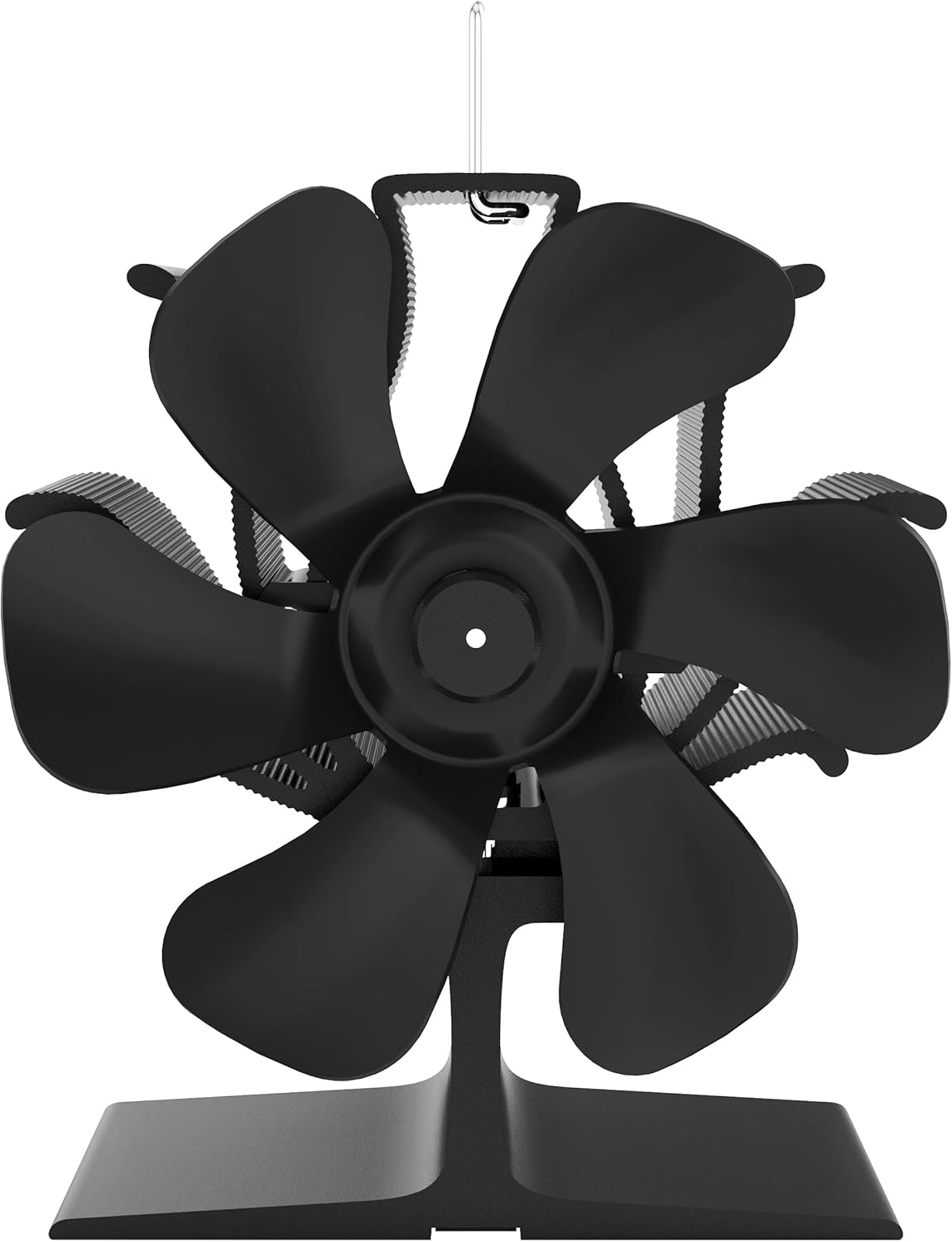
£16.99 for the smallest fan here, 13.6 centimetres tall, with the clearest explanation of how it works.
Advantages
- The smallest fan in this ranking at 13.6cm tall
- Explains the temperature difference in words
- 25 decibels stated
- £16.99, one of the two cheapest here
- Six aluminium blades on a small base
Disadvantages
- Standby field holds three marketing phrases
- 287 ratings, the smallest sample here
- No starting temperature published
- Small blades move less air than the twelve-blade fan
The smallest fan in this ranking and the one whose copy explains the physics. It is 5.8 centimetres deep, 9 wide and 13.6 tall — a compact unit for a flat-topped stove rather than a deep range — and its bullet describes the mechanism without naming it: the fan operates through the temperature difference between the heated base and the cooler upper section. That sentence is the whole principle, and it is more useful than the motor type field on most of these pages, which either says heat powered (the fuel) or thermoelectric (the junction) without explaining what either means in practice.\n\nIts specification also contains the loosest use of the standby power field in this article. Where the twelve-blade fan decided that field was for an A++ energy class, and the Signstek used it for a fuel-saving claim, this listing has written three marketing phrases: high heat distribution efficiency, eco-friendly operation, cost-effective. Three adjectives, none of them a number, in a row about what the device draws when it is idle. The row exists on the form; the product has nothing to put in it; the phrases are what got typed instead.\n\nWhat the small size costs is airflow: six blades, 25 decibels and a stated starting temperature that the listing does not give. Its record is 287 ratings at 4.3 stars, and a buyer describes the heat circulating well once the fan reaches its maximum speed — which is the honest description of a small fan on a big stove. At £16.99 it is one of the two cheapest fans here.
Stove Fan, 8 Blades, Heat Powered, with Thermometer

£21.99 for an eight-blade fan with a thermometer and a standby field written in French.
Advantages
- 4,800 ratings at 4.5 stars, one of the deepest samples here
- Eight aluminium blades, two more than standard
- 25 decibels stated, with a thermometer included
- 570 grams, specified in the weight field
- A stance and size that suit a mid-sized stove
Disadvantages
- Standby power field is a sentence in French
- The 28 per cent saving cannot be checked
- Shares its 4,800-rating pool with a sibling listing
- No starting temperature and no wattage published
The listing that completes the collection of impossible standby fields. This one answers the row with a French sentence: a 28 per cent reduction in wood consumption, operation without a power supply, and the beginnings of a third clause. It is the fourth variety of the same error in this article — a percentage, an energy class, three marketing phrases and now a fuel-saving claim in another language — and it is the most revealing, because a page written in English for British buyers does not normally acquire a French sentence by accident. It arrives when a listing is assembled from several European versions at once, the same way a frying pan reviewed elsewhere on this site prints its model name in French and a dressing gown lists its contents in German.\n\nAround that row, the fan is one of the better documented here. Its eight blades are aluminium on an aluminium base, it weighs 570 grams, it measures 11 by 16 by 17 centimetres, its noise is 25 decibels in its own field and it comes with a stove thermometer. The blades are two more than the standard six and four fewer than the twelve-blade fan, and the listing makes the airflow case for them without claiming a number.\n\nIts rating count is the interesting one: 4,800 ratings at 4.5 stars, which is the same figure as a fan in this search that was excluded from the ranking for having no British reviews. Two listings, one product family, one shared pool — and the excluded sibling's page was the one that named the engine a thermoelectric Seebeck effect motor, which is the most precise description of a stove fan anybody wrote. At £21.99, this is the one to buy if eight blades is the shape you want and the thermometer is the accessory you want with it.
All 10 compared
The same ranking side by side, now that the numbers have names.
4
7
9
10
| # | Product | Price | Amazon rating |
|---|---|---|---|
| 1 | JossaColar Log Burner Fan, 10 Blades, 50-350°C, Heat Powered | £36.99 | 4.6 (5,522) |
| 2 | Tomersun Log Burner Stove Fan, 6 Blades, with Thermometer | £18.69 | 4.3 (5,476) |
| 3 | VALIANT Premium IV Heat Powered Stove Fan, 4 Blades, 4 Watts | £39.99 | 4.5 (2,226) |
| 4 | Signstek Heat Powered Stove Fan, 6 Blades, 5.7 Watts | £19.59 | 4.4 (1,356) |
| 5 | Wood Stove Fan, 4 Blades, Thermoelectric, 25dB, 80°C Start | £16.99 | 4.2 (1,659) |
| 6 | Wood Stove Fan, 4 Blades, Heat Powered, Christmas Pattern | £15.99 | 4.1 (689) |
| 7 | 12-Blade Stove Fan, Dual Motor, Heat Powered, 20dB | £34.99 | 4.6 (832) |
| 8 | Log Burner Fan, 6 Blades, Thermoelectric, with Thermometer, 5 Speeds | £26.99 | 4.7 (762) |
| 9 | Mini Stove Fan, 6 Blades, Heat Powered, 11.8cm Tall | £16.99 | 4.3 (287) |
| 10 | Stove Fan, 8 Blades, Heat Powered, with Thermometer | £21.99 | 4.5 (4,800) |
Final Verdict
What we would buy. The JossaColar ten-blade fan at £36.99 is the one we would buy, because it is the only fan in this ranking that publishes the two figures a heat-powered fan actually has: a range of 50 to 350 degrees and a noise level of 25 decibels, on the deepest sample here at 5,522 ratings. If the stove has never been measured, the Tomersun at £18.69 is the cheapest well-reviewed fan and the only one that ships a stove thermometer, so the temperature range that decides everything can be read off the stove itself. If what matters is how little you hear it, the twelve-blade dual-motor fan at £34.99 states 20 decibels and moves more air than anything else here, at the cost of one specification row containing an A++ rating. If the fan has to sit on a flat-topped stove in a small room, the mini at £16.99 is 13.6 centimetres tall and cheapest of the two; and if a warranty and a long history matter, the VALIANT at £39.99 is the dearest here, states its 4 watts like an adult and is four times as loud as the quietest fan in the article.\n\nWhat the listings will not tell you. Look at the wattage row before anything else, because a heat-powered fan consumes nothing and the honest figure is 4 to 6 watts: a listing claiming 50 is describing a vacuum cleaner, not a fan. Ignore the standby power row entirely — one fan here answers it with A++, another with a French sentence about firewood, and none has an idle state to report. Treat the number of power levels as decoration, since the stove is the only control these fans have. Find the operating range rather than the starting temperature: 80 degrees is the common figure and it is late, and a fan that starts at 50 will be working while the other one is stationary. Compare decibels rather than blade counts, because ten decibels is a doubling of loudness and the difference between 20 and 45 is a different appliance in the same room. And remember what you are buying: a few watts generated by a temperature difference, which is silent, free and slow — not a fan that can be turned on.
Why trust this ranking?
We rank on price, customer ratings and the specifications that decide the job, and we read each specification table against the marketing bullets on the same listing. When a number does not survive that check, we say so in the entry rather than quietly dropping the product. We also say when a product is the wrong one for you.
How we rank, in full
Written by
Felipe Iglesias
Founder & Lead Reviewer
Felipe is a computational engineering student who has been working in SEO since he was sixteen. He founded ranked10 and researches every guide on the site.
Related buying guides
Every guide below ranks ten products the same way this one does.
 Home
Which Electric Toothbrush Is Better in 2026? 10 Ranked
Which electric toothbrush is better? For most people, the £29.99 Oral-B Pro 1, the cheapest with a pressure sensor. Oral-B vs Sonicare, 10 ranked.
 Home
Best Loft Ladder 2026: 10 Ranked
The best loft ladder is the Abru 37000 at £86.99: a full 3 m of reach for £29.00 a metre, with a stowing pole, fittings and 150 kg capacity.
 Home
Best Electric Bike for Adults 2026: 10 Ranked
The best electric bike for adults in 2026 is the URLIFE E26 at £419. We rank 10 and compare watt-hours, not claimed range, from £359 to £1,499.
 Home
Best Dining Table 2026: 10 Ranked
The best dining table 2026: the VASAGLE Golden Oak at £59.99 gives 175 cm2 of tabletop per pound. Ten tables ranked on area per pound, seats and load.
 Home
Best Dining Chairs 2026: 10 Ranked
Best dining chairs for 2026: the Amazon Basics metal set wins at £31.67 a chair, with load ratings and price per chair compared across 10 sets.
 Home
Best Bandsaw 2026: 10 Ranked
The best bandsaw is the Scheppach HBS261 at £219: 130 mm of cut height. We rank 10 saws by depth per pound, and the £119 model beats the £398 one.
 Home
Best Rise and Recline Chairs 2026: 10 Ranked, and Two Share 828 Ratings
Rise and recline chairs ranked: two MCombo listings share 828 ratings and a 4.4 average yet sit £155.91 apart, and Elite Care prices are VAT-exempt only.
 Home
Best Electric Wheelchair 2026: 10 Ranked, and Two Are the Same Chair
Two ByteTecpeak listings at £529.99 are the same electric wheelchair: same 20.5 kg, 12ah battery and 4.2 stars. We ranked ten on the numbers.
 Home
Best Electric Recliner Sofas: 10 Ranked by the Numbers
Electric recliner sofas: the door widths and weights on these ten listings disagree with each other. We rank them on the numbers that do add up.
 Home
Best Electric Cool Box 2026: 10 Ranked, and Why the Litre Count Misleads
Electric cool box capacity often overstates usable space: 25L net vs 32L gross, 40L vs 45L. We ranked ten on price, spec and reviews.
Products you might like
The best rated products from our other Home guides.
-
 Siebenschläfer Medium All Year Round Duvet, 10.5 Tog, King Size
£27.89
4.8
in Best 10.5 Tog Duvet 2026: 10 Ranked, Two Listings Contradict Themselves
-
Siebenschläfer Light Summer Duvet 4.5 Tog, Double
£23.95
4.8
in Best 4.5 Tog Duvet 2026: 10 Ranked, and Why 'Heavyweight' Means 4.5 Tog
-
 BabbleRoo Baby Changing Bag Backpack, 26L (Light Grey)
£31.97
4.8
in Best Baby Changing Bag 2026: 10 Ranked, Pocket Counts Checked
-
 DEWALT 18V XR Brushless Oscillating Multi-Tool, Tool Only
£75.99
4.8
in Best Oscillating Multi Tool 2026: 10 Ranked, Spec by Spec
-
 BEDLORE Waterproof Double Mattress Protector
£19.87
4.8
in Best Mattress Protector 2026: 8 Ranked by How Honest the Listing Is
-
 Audio-Technica LP120XUSBBK Manual Direct-Drive Turntable (Analogue & USB) Black
£245.00
4.8
in Best Turntable 2026: Ten Decks Ranked on Pools
-
 Dripex Foldable Playpen, 124 x 124 cm
£33.59
4.8
in Best Baby Playpen 2026: 10 Ranked by Floor Space, Not Panels
-
 BONTEC 4-Step Folding Ladder with Tool Tray, 150kg
£58.97
4.8
in Best Step Ladder 2026: 10 Ranked, and the Spec Numbers That Contradict Each Other
-
 Makita HR2630 26mm SDS Plus Rotary Hammer Drill, Blue
£160.99
4.8
in Best SDS Drill 2026: 10 Ranked, and Why the Amps Don't Add Up
-
 Bosch Professional GWS 7-125 Angle Grinder, 720W, 125mm
£78.64
4.7
in Best Angle Grinder 2026: 10 Ranked, and the Wattage Claims That Fail
-
 Dikaslon Large Baby Changing Bag Backpack, 19 Pockets
£30.59
4.7
in Best Baby Changing Bag 2026: 10 Ranked, Pocket Counts Checked
-
 Silentnight Warm & Cosy Duvet, 13.5 Tog, King Size
£29.99
4.7
in Best Winter Duvet 2026: 10 Warm Duvets Ranked by Tog
-
 DeWalt DCS391 165mm XR Circular Saw, 18V Bare Unit
£95.00
4.8
in Best Circular Saw 2026: 10 Ranked, and Why the Page Price Isn't What You Pay
-
 Deconovo Blackout Curtains, Foil Printed Thermal Insulated Eyelet, 46 x 54 Inch, 2 Panels
£10.18
4.7
in Best Thermal Curtains 2026: The Number Nobody States
-
 Blukar Head Torch Rechargeable, 2 Pack, 8 Modes, Stepless Dimmable
£13.97
4.7
in Best Head Torch 2026: The Lumen Is Not a Measurement
Comments
Reader comments are not checked against the manufacturer's claims above.
No comments yet
Be the first to add something we missed — a price change, a spec that turned out wrong, or how one of these held up.
Leave a comment
No account needed. Own one of these? Tell other readers how it actually performed.