Best Power Bank 2026: 10 Ranked on Real Delivered Capacity
By Felipe Iglesias · Updated
A 20,000mAh power bank does not put 20,000mAh into your phone. It puts in roughly 13,000, and the reason is physics rather than fraud. The lithium cells inside are rated at 3.7 volts, but USB delivers at 5 volts, so the stored energy has to be stepped up before it leaves the case. Twenty thousand milliamp hours at 3.7V is 74 watt hours of energy, which at 5V works out at 14,800mAh before you account for conversion losses of ten to fifteen percent. Every power bank on this page is affected identically and none of the ten publishes a watt hour figure, so the printed mAh is the only number you get. The useful part is that the charge counts in the bullet points give the game away. Anker quotes 3.79 charges of a Samsung S24, UGREEN quotes 5.2 charges of an iPhone 15, and both land at roughly 65 to 70 percent of their printed capacity, exactly where the arithmetic says they should. One brand in this guide claims eight full charges from 30,000mAh, which its own listing cannot support. So we ranked the best power bank options on delivered capacity, output wattage and whether the claims survive a calculator.
At a glance
| # | Product | Price | Rating | Link |
|---|---|---|---|---|
| 1 | INIU Power Bank 20000mAh, 22.5W PD3.0 QC4.0 | £22.41 | 4.6 | View |
| 2 | Anker Zolo Power Bank 20,000mAh, 30W, Built-in USB-C Cable | £28.99 | 4.5 | View |
| 3 | Charmast Power Bank 10000mAh with 4 Built-in Cables | £16.14 | 4.5 | View |
| 4 | INIU 45W Fast Charging Power Bank, 20000mAh | £27.99 | 4.4 | View |
| 5 | UGREEN Nexode 140W 25000mAh Power Bank, 3-Port | £49.99 | 4.3 | View |
| 6 | Anker Power Bank 25,000mAh, 165W with Built-in Cables | £69.99 | 4.5 | View |
| 7 | JIGA Power Bank 27000mAh, 22.5W Fast Charging | £24.99 | 4.2 | View |
| 8 | Belkin BoostCharge 20000mAh Power Bank, 3-Port | £21.99 | 4.4 | View |
| 9 | Power Bank 27000mAh with 4 Built-in Cables, 22.5W | £27.99 | 4.5 | View |
| 10 | VEGER Power Bank 30000mAh, 20W PD Fast Charging | £26.99 | 4.4 | View |
INIU Power Bank 20000mAh, 22.5W PD3.0 QC4.0

With 32,329 ratings at 4.6 this is the most reviewed power bank on Amazon UK, at £22.41, with a three-year warranty and USB-C in and out.
Pros
- 32,329 ratings at 4.6, by far the largest sample in the category
- £22.41, the cheapest well-evidenced 20,000mAh here
- Three-year warranty, the longest in this guide
- USB-C works as both input and output
- Charges low-current devices like earbuds and watches
Cons
- No watt hour figure published, like every rival here
- 22.5W output is fine for phones but will not charge a laptop
- No built-in cable, so you carry one
- Charge count claims are given as percentages rather than a figure
Nothing else in this category comes close on evidence. A sample of 32,329 ratings at 4.6 is more than double the next largest, built up over years rather than a launch push, and for a product whose failure mode is a battery that quietly loses half its capacity in eighteen months, that depth of feedback is the most valuable thing on the page.
The specification is well chosen for what most people actually need. Twenty thousand milliamp hours is 74 watt hours of stored energy, delivering somewhere around 13,000mAh to your devices, which is three to four full phone charges. The 22.5W output with PD3.0 and QC4.0 charges a modern phone to about 61 percent in half an hour, and there are three ports so you can share it. Crucially the USB-C port works as both input and output, which a surprising number of rivals still get wrong, and it will charge low-current devices like earbuds and a smartwatch that many power banks simply ignore.
The three-year INIU Care warranty is the longest in this guide and unusual at this price. Like every listing here it publishes no watt hour figure, and like every listing here the printed 20,000mAh is the cell rating rather than what reaches your phone. At £22.41 it is also the cheapest 20,000mAh unit from a brand with real evidence behind it.
Anker Zolo Power Bank 20,000mAh, 30W, Built-in USB-C Cable

The most honest listing in the search: it quotes 3.79 charges of a Samsung S24, an awkward decimal that matches what the physics predicts almost exactly.
Pros
- Quotes 3.79 charges, a precise figure that matches the physics
- 30W output charges an iPhone 15 to 57 percent in 30 minutes
- Built-in USB-C cable rated for 10,000 bends
- ActiveShield 2.0 temperature monitoring and CB-certified cells
- 13,574 ratings at 4.5
Cons
- 18-month warranty against three years from INIU
- £6.58 more than the INIU for the same capacity
- Built-in cable is only 5.98 inches long
- No watt hour figure published
Look at the first bullet point and you will find a number no marketing department would invent: 3.79 charges of a Samsung Galaxy S24. That decimal is the sound of someone actually dividing delivered capacity by battery size rather than rounding upwards, and it is why we trust this listing more than any other here. Run the same sum yourself and a 20,000mAh pack delivering around 65 percent of its rating gives you almost exactly that.
The hardware backs it up. Thirty watts of output charges an iPhone 15 to 57 percent in half an hour, 20W input means the bank itself refills quickly, and the built-in USB-C cable is rated for 10,000 bends so you stop losing cables. ActiveShield 2.0 monitors temperature three million times a day and the cells carry CB certification to international safety standards, which almost nothing else in this search claims.
At £28.99 it costs £6.58 more than the INIU at number one, and the honest comparison is that you are buying the built-in cable, the extra 7.5W of output and the certification rather than more capacity. Both are 20,000mAh and both will deliver roughly 13,000mAh. The 18-month warranty is shorter than the INIU three years, which is the one place Anker loses.
Charmast Power Bank 10000mAh with 4 Built-in Cables

Four cables built in, six outputs, and an honest claim of two full phone charges from 10,000mAh. At £16.14 with 15,550 ratings it is the best small power bank here.
Pros
- Four cables built in, so you can never forget one
- Six outputs and three inputs for charging a whole family
- Honest claim of two full phone charges from 10,000mAh
- £16.14 with 15,550 ratings at 4.5
- Slim, pocketable and well under airline watt hour limits
Cons
- Half the capacity of the 20,000mAh units for only £6.27 less
- No output wattage stated in the bullets
- Built-in cables cannot be replaced if one fails
- Not a fast charger for modern flagship phones
The four integrated cables are the whole argument and they are a better one than they sound. Micro USB, USB-C and a Lightning-style connector are built into the body, plus a USB-A lead, so the commonest failure of a power bank, which is having it with you and the right cable at home, simply cannot happen. Add two USB-A ports and a USB-C port and it drives six devices at once, which is more than most units three times its capacity.
The capacity claim is honest and worth noting because so few here are. Charmast says up to two full charges for an iPhone 11 through 14 or a Galaxy S23. Ten thousand milliamp hours is 37 watt hours, delivering roughly 6,500mAh, and a modern iPhone battery is a little over 3,200mAh. Two charges is exactly right, and a less scrupulous listing would have said three.
At 10,000mAh it is genuinely pocketable and comfortably under any airline watt hour threshold. The trade-offs are that you get half the capacity of the 20,000mAh units for £6.27 less, and the listing does not state an output wattage in its bullets, so treat this as a top-up bank for a day out rather than a fast charger. The LED percentage display and three-year warranty are welcome at £16.14.
INIU 45W Fast Charging Power Bank, 20000mAh

The only listing in the search that mentions air travel at all, and 30 percent smaller than a standard 20,000mAh unit, with 45W output and a nylon-braided built-in cable.
Pros
- 30 percent smaller than a standard 20,000mAh pack
- Only listing here to mention air travel
- 45W PD output, to 70 percent in 25 minutes
- Bi-directional nylon-braided built-in cable
- Three-year INIU Care warranty
Cons
- 4.4 rating, below the cheaper INIU at number one
- £5.58 more than the 22.5W INIU for the same capacity
- Airplane-approved is a claim to verify with your airline
- No watt hour figure published
Two things make this the travel pick. First, it is 30 percent smaller than a standard 20,000mAh pack, which INIU says makes it more compact than some 10,000mAh alternatives, and on a product you carry every day that matters more than another five watts. Second, and more usefully, it is the only listing among the ten we pulled that mentions aeroplanes at all, describing itself as airplane-approved.
That is worth explaining, because the rest of the category is silent on it. A 20,000mAh pack holds 74 watt hours, comfortably below the 100 watt hour threshold most airlines apply to cabin baggage. A 30,000mAh pack holds 111 watt hours and sits above it. INIU is the only brand here that seems to have noticed its customers fly, and while you should still confirm with your carrier, the fact it is mentioned is a small mark of a listing written by someone thinking about use rather than specifications.
Forty-five watts of PD output takes a phone to roughly 70 percent in 25 minutes and covers Samsung Super Fast Charging, and the claim of four phone charges from 20,000mAh is the arithmetically honest figure. The built-in cable is nylon braided and bi-directional. At 4.4 from 8,563 ratings it scores slightly below the cheaper INIU at number one, which is the main reason it is not higher.
UGREEN Nexode 140W 25000mAh Power Bank, 3-Port

The laptop pick, with 140W output and precise charge counts: 5.2 iPhone 15 charges, 3.6 Galaxy S23 Ultra, 1.3 MacBook Pro 16. All three land where the physics says they should.
Pros
- 140W output, enough to charge a MacBook Pro 16 properly
- Publishes three separate charge counts that all reconcile
- 65W second port, so laptop and phone charge together
- Recharges fully in about two hours with a 65W adapter
- 92.5 watt hours, still under the usual airline threshold
Cons
- 4.3 rating, joint lowest in this guide
- 513g is heavy to carry daily
- £49.99, more than double the INIU at number one
- Overkill if you only ever charge a phone
If you want a power bank that charges a laptop rather than just topping up a phone, this is where the list actually starts. One hundred and forty watts over USB-C with PD 3.1 is enough to run a MacBook Pro 16 at close to mains speed, and the second port still delivers 65W, so a laptop and a phone can charge together without either dropping to a trickle.
UGREEN also passes the honesty test convincingly. It quotes 5.2 charges of an iPhone 15, 3.6 of a Galaxy S23 Ultra and 1.3 of a MacBook Pro 16. Those are calculated numbers with decimals, not round marketing figures, and running the sum on 25,000mAh at roughly 70 percent delivered capacity produces almost exactly 5.2 iPhone charges. When a brand publishes three separate figures that all reconcile, it has done the arithmetic.
Two practical points. At 25,000mAh it holds 92.5 watt hours, which is under the 100 watt hour airline threshold but not by much, so it is the largest pack here we would happily fly with. And at 513g it is heavy, though UGREEN is right that this is light for the class. The 4.3 rating is the joint lowest in this guide, which on 7,488 ratings is a real if modest signal.
Anker Power Bank 25,000mAh, 165W with Built-in Cables

The most powerful unit here: three 100W USB-C ports, 165W total, two built-in cables including a retractable one, and 100W recharging. It is also £69.99.
Pros
- Three 100W USB-C ports and 165W total output, the most here
- Retractable built-in cable rated for 20,000 retractions
- Second cable doubles as a carrying strap
- 100W recharging refills the bank quickly
- 11,494 ratings at 4.5
Cons
- £69.99, the most expensive power bank in this guide
- Only 25W more output than a rival costing £20 less
- 18-month warranty
- Heavy and bulky for everyday pocket use
This is the power bank for someone who travels with a laptop, a tablet and a phone and does not want to think about any of them. Three USB-C ports each capable of 100W means you can run a MacBook and two other devices simultaneously without the shared-power throttling that spoils cheaper multi-port banks, and 165W total output is the highest in this guide by 25W.
The cable design is genuinely clever. One built-in USB-C cable extends to 2.3 feet and is rated for over 20,000 retractions, and the second doubles as a carrying strap, so the thing you use to charge is also the thing you use to hold it. With four devices connectable at once and 100W recharging that refills the bank itself quickly, it is the least fiddly large power bank here.
The cost is the price and the mass. At £69.99 it is £20 more than the UGREEN at number five for 25W more output, which is a poor rate of exchange unless you specifically need three 100W ports. It carries the same 92.5 watt hours as the UGREEN, so the same airline caveat applies. And with 11,494 ratings at 4.5 it is well evidenced, but Anker gives 18 months of warranty where INIU gives three years at a third of the price.
JIGA Power Bank 27000mAh, 22.5W Fast Charging
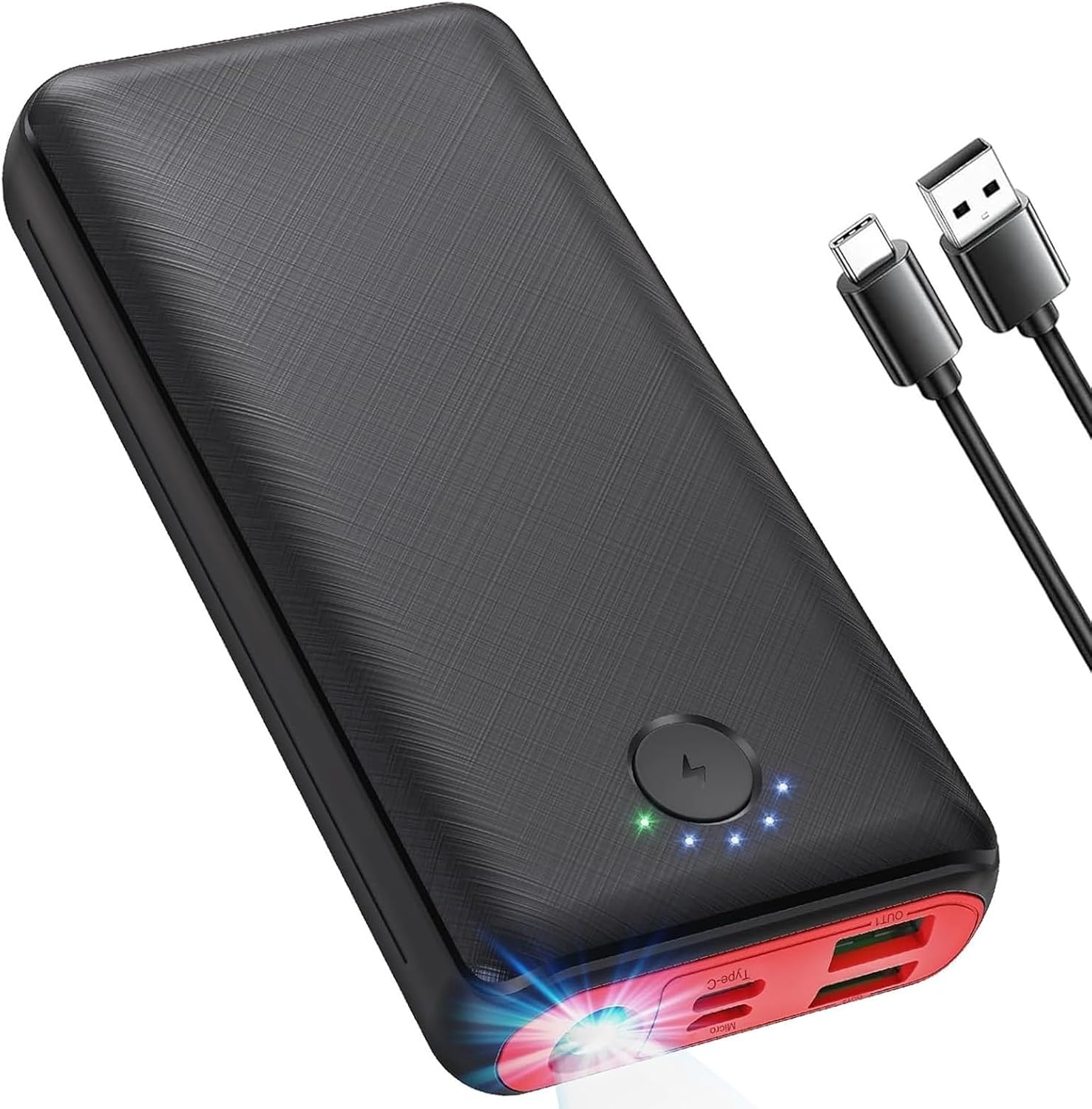
The second most reviewed power bank here with 23,973 ratings, and unusually conservative: it claims 3 to 5 phone charges from 27,000mAh when the sum allows about 5.
Pros
- 23,973 ratings, the second largest sample in this guide
- Conservative charge claim of 3 to 5, below what the pack can do
- £24.99 for 27,000mAh, the most capacity per pound here
- Five-segment LED indicator and built-in torch
- Two inputs including USB-C
Cons
- 4.2 rating, the lowest in this guide from a very large sample
- 99.9 watt hours leaves no margin against the 100Wh airline threshold
- 22.5W output will not charge a laptop
- No warranty length stated
With 23,973 ratings this has the second deepest evidence pool in the search, and the claim in its first bullet is the most conservative of any listing here: three to five iPhone top-ups, three to four for Samsung. Run the numbers and 27,000mAh delivering around 65 percent gives roughly 17,500mAh, which against a 3,349mAh iPhone battery is 5.2 charges. JIGA has quoted a range that starts well below what the pack can actually do, which in this category is remarkable restraint.
The practical package is sensible for the money: two inputs including USB-C, three outputs, a four-plus-one segment LED indicator that tells you the state of charge properly rather than with four vague dots, a built-in torch, and 22.5W Quick Charge 4.0 output. At £24.99 that is a lot of capacity per pound.
Two things hold it at seven. The 4.2 rating is the lowest in this guide, and from nearly 24,000 ratings that is a real signal about consistency rather than statistical noise. And at 27,000mAh it holds 99.9 watt hours, which is fractionally under the 100 watt hour threshold most airlines apply, so it is technically fine to fly with but leaves you no margin at all if a carrier measures it differently. If you fly often, the 20,000mAh units at 74 watt hours are the safer choice.
Belkin BoostCharge 20000mAh Power Bank, 3-Port

A recognised brand at £21.99 with a two-year warranty, expressing its capacity as 78 hours of extra battery life. Its 15W maximum output is the lowest in this guide.
Pros
- Recognised brand with a two-year warranty
- £21.99 for 20,000mAh, competitively priced
- Three ports and a cable included, pre-charged
- Capacity quoted as hours rather than an inflated charge count
- 5,513 ratings at 4.4
Cons
- 15W maximum output, the lowest in this guide
- Less than half the output of the Anker Zolo for £7 less
- 78 hours of battery life is a vague, uncheckable unit
- No built-in cable
Belkin is a genuine accessory brand with retail presence and proper support, and at £21.99 with a two-year warranty this is the cheapest way to get that reassurance in a 20,000mAh pack. Three ports, one USB-C and two USB-A, cover a phone, a tablet and a pair of earbuds, a short cable is included, and it arrives pre-charged so it works out of the box.
It also describes its capacity differently from everything else here, quoting 78 hours of additional smartphone battery life rather than a number of charges. That is a softer unit and harder to check, since it depends entirely on what the phone is doing, but it is at least not an inflated charge count.
The problem is output. Fifteen watts maximum is the lowest figure in this guide by 7.5W, and less than half the Anker Zolo at number two which costs £7 more. In practice that means a modern phone charges at roughly conventional speed rather than fast, so a top-up that takes half an hour on the Anker will take appreciably longer here. For overnight use or a slow trickle in a bag it is irrelevant; for a quick boost before going out it is the whole difference. Buy this for the brand and the warranty, not the speed.
Power Bank 27000mAh with 4 Built-in Cables, 22.5W

Four built-in cables and 27,000mAh in a passport-sized body. It calls itself a genuine 27000mAh and claims 6 to 7 iPhone charges, which the arithmetic puts at about 5.2.
Pros
- Four built-in cables plus three ports, six devices at once
- Passport-sized at 2.3cm thick despite 27,000mAh
- 22.5W PD3.0 and QC4.0 charging
- Three-year warranty and silicone lanyard included
- 5,624 ratings at 4.5
Cons
- Claims 6 to 7 iPhone charges when the arithmetic gives about 5.2
- Uses the word genuine, a tell rather than a specification
- 99.9 watt hours leaves no margin against airline limits
- Built-in cables cannot be replaced individually
On format this is appealing. Four integrated cables covering iPhone, Micro USB, USB-C and USB-A, plus two USB-A ports and a USB-C port for six devices at once, in a body 2.3cm thick and 11.6cm long that the listing compares to a passport. Add a silicone lanyard, 22.5W PD3.0 and QC4.0 charging, a stated six-layer safety system and a three-year warranty, and at £27.99 with 5,624 ratings at 4.5 it looks like strong value.
Then you check the claim. The second bullet promises six to seven full charges for an iPhone 15, 16 or 17. Those phones carry batteries of roughly 3,350 to 3,600mAh. A 27,000mAh pack delivers around 17,500mAh once the 3.7 volt cells have been stepped up to 5 volts and conversion losses taken, so the honest figure is a little over five charges. Six to seven overstates it by roughly a quarter, and the JIGA at number seven, with the same capacity and a much larger review sample, quotes three to five.
The other tell is a single word. The bullet describes it as a genuine 27000mAh power bank. Manufacturers reach for words like genuine and real when a category has a credibility problem, and inserting one here does not make the charge count add up. The hardware looks good; the number does not.
VEGER Power Bank 30000mAh, 20W PD Fast Charging

The largest capacity here at 30,000mAh, claiming up to 8 full phone charges. Its own listing gives the numbers that make that impossible, and 111 watt hours is over the usual airline limit.
Pros
- 30,000mAh, the largest capacity in this guide
- Four outputs and two inputs for charging four devices at once
- LED digital display showing exact remaining percentage
- £26.99, cheap for the capacity
- Good choice for a car, camping or off-grid use
Cons
- Claims 8 full charges when its own figures allow about 5
- 111 watt hours, above the 100Wh threshold most airlines apply
- Nothing on the listing mentions the air travel limit
- 2,601 ratings, the thinnest sample in this guide
This listing supplies everything needed to check its own headline claim, which is unusual and not to its advantage. The first bullet promises up to eight full charges for most smartphones. The third bullet describes charging a 3,500mAh phone. Eight charges of a 3,500mAh battery is 28,000mAh delivered, from a pack rated at 30,000mAh, which would require 93 percent efficiency from a 3.7 volt cell feeding a 5 volt output. The real figure, once the voltage step-up and conversion losses are accounted for, is closer to five, maybe five and a half.
The second issue matters more if you travel. Thirty thousand milliamp hours at 3.7 volts is 111 watt hours, which sits above the 100 watt hour threshold most airlines apply to power banks in cabin baggage. Nothing on this listing mentions that, and a device bought specifically for long journeys is exactly the one you might not be allowed to take on the plane. Check with your carrier before flying with any pack this size.
None of which makes the hardware bad. Four outputs and two inputs, 20W PD and QC 3.0, a proper LED percentage display, 617g for the capacity, and 4.4 from 2,601 ratings. As a bank that lives in a car or a rucksack for camping it is decent value at £26.99. It is the claims wrapped around it, and the watt hours nobody mentions, that put it last.
Final Verdict
The best power bank for most people is a 20,000mAh unit from a brand with a large review sample, because that size delivers around 13,000mAh to your devices, which is three to four phone charges, and it stays comfortably under the watt hour limits that matter for air travel. Before you buy, do two quick checks. Multiply the mAh by 0.65 to get the capacity you will actually receive, then divide by your phone battery to see how many charges that really is. And if you fly, multiply the mAh by 3.7 and divide by 1,000 to get watt hours: 20,000mAh is 74Wh, 27,000mAh is 99.9Wh, and 30,000mAh is 111Wh, which sits above the 100Wh threshold most airlines apply to cabin baggage, so check with your carrier before packing one. After capacity, output wattage is the specification that separates these: 15W to 22.5W charges phones, 30W to 45W charges them quickly, and you need 100W or more if you want to charge a laptop. Treat any listing promising a round, generous number of full charges with suspicion, and trust the ones quoting awkward decimals.
Written by
Felipe Iglesias
Founder & Lead Reviewer
Felipe is the founder of ranked10 and the person behind every buying guide on the site. He spends his time digging through specs, customer reviews and real-world feedback so you do not have to, turning hours of research into clear, honest top 10 lists for UK shoppers. When he is not comparing air fryers or cordless mowers, he is tinkering with the technology that keeps ranked10 running.
Related buying guides
All Tech guidesBest Dash Cam 2026: 10 Ranked, and Which 4K Is Actually 4K
There is one question worth asking about any dash cam, and the listings are built to stop you asking it: which image sensor is inside? We went through 21 front and rear car cameras on Amazon in August 2026 and the pattern was immediate. Every camera that names its sensor costs £74.98 or more. Every camera that simply prints 4K in the title and names nothing costs £54.99 or less. Meanwhile Nextbase, the established British brand, charges £119.99 for a dash cam it openly describes as 1080p — on the same results page as a £34.99 unit selling itself as 4K. One of those two is not describing the hardware it ships. Below we rank the best dash cam options on real specification rather than headline numbers, covering what 4K plus 1080P actually means, why supercapacitor versus lithium battery matters more than resolution on a British windscreen, and the three listings whose own specification tables contradict their own titles.
TechBest Gaming Mouse 2026: 10 Ranked on Weight, Not DPI
The headline number on every gaming mouse is the one number you should ignore. In this guide the sensors range from 12,000 DPI to 44,000 DPI, and here is what 44,000 means in practice: moving the mouse one inch would move the cursor 44,000 pixels, while a 4K monitor is only 3,840 pixels wide. One inch of hand movement would cross the whole screen more than eleven times. Competitive players actually play between 400 and 1,600 DPI, and the most convincing proof sits inside this very search. The Redragon at number four advertises 12,400 DPI in its title, then lists the five presets it genuinely ships with, and the highest of them is 6,200. So we ranked the best gaming mouse options on the specifications that change how a mouse feels: weight, which varies almost four times across this list, switch type and rated lifespan, button count, battery life where it applies, and the depth of real customer evidence behind each one.
TechBest 2TB SSD for PS5 in 2026: 10 Ranked Against Sony’s Own Rules
Every single drive on this page is fast enough for a PlayStation 5. Sony asks for PCIe Gen4 x4 with a sequential read speed of at least 5,500MB/s, and the slowest here manages 7,000MB/s — so the speed numbers plastered across these listings tell you almost nothing about which to buy. What actually decides it is the heatsink. Sony requires a cooling structure, and the console's M.2 bay allows a total thickness of just 11.25mm, so a drive that is too tall will not fit and a drive with no heatsink at all should not go in. Of the ten drives here, two ship with no heatsink whatsoever, three have only a thin thermal pad, and exactly one is officially licensed by Sony. There is also one with the biggest speed figure on the page that has no business being in a console at all. We ranked the best 2TB SSD for PS5 options on Amazon by whether they actually fit the console first, and by speed and price second.
Highest rated in our other guides
Weighted by how many people rated each product, not just the score.

BoYata Aluminium Adjustable Laptop Stand, 0-90 Degree, Foldable
£32.99

Ninja Foodi Blender and Soup Maker HB150UK, 1.7L Glass Jug, 1000W
£180.00

Acer Predator GM7 2TB SSD, Gen4 NVMe 2.0, 7200MB/s, Graphene Thermal Pad
£228.99

SanDisk 128GB Extreme microSDXC + Adapter, 190MB/s, A2, V30, U3
£27.99