Best Smart Plug 2026: 10 Ranked, and Why 13 Amps Means Three Different Wattages
By Felipe Iglesias · Updated
Every smart plug sold in Britain is rated at 13 amps, because that is the fuse in a UK plug. Watts are volts times amps, so the maximum load follows directly from the mains voltage — and these listings cannot agree on what the mains voltage is. TP-Link's Tapo P110, the most-reviewed smart plug in the country with 38,347 ratings, states "Operating Voltage 220 Volts". TP-Link's own Tapo TP11, on the same storefront, states 240. Meross publishes 230 volts on two products and 240 on a third, where it helpfully does the multiplication in a bullet: "up to 13A, 3120W". British mains has been 230 volts nominal since the European harmonisation of 1995. So the same 13 amp relay is advertised as handling 2,860 watts on one page and 3,120 on another, a spread of 260 watts, and two manufacturers disagree with themselves. Meanwhile all ten of these are sold on energy monitoring and not one publishes the accuracy of its meter — no tolerance, no measurement class, nothing — while several invite you to type in your electricity tariff and estimate your bill from it. We ranked ten of the best smart plug options on Amazon in August 2026, and found that only one brand warns you about the load that actually destroys these things.
At a glance
| # | Product | Price | Rating | Link |
|---|---|---|---|---|
| 1 | Tapo P110 Smart Plug with Energy Monitoring, Max 13A, 2-Pack | £15.97 | 4.6 | View |
| 2 | Tapo TP11 Compact Smart Plug with Energy Monitoring, 4-Pack | £31.96 | 4.7 | View |
| 3 | Meross MSS305 Mini Smart Plug with Energy Monitoring, 13A 3120W, 2-Pack | £16.99 | 4.6 | View |
| 4 | EIGHTREE 5GHz Smart Plug with Energy Monitoring, Max 13A, 4-Pack | £39.99 | 4.6 | View |
| 5 | TCP Smart Plug UK WiFi Socket, Alexa, Google Home, Siri, 4-Pack | £37.50 | 4.6 | View |
| 6 | EIGHTREE Alexa Smart Plug with Energy Monitor, BS1363, 4-Pack | £24.99 | 4.6 | View |
| 7 | Meross MSS315 Matter Smart Plug Mini with Energy Monitoring, 4-Pack | £49.99 | 4.3 | View |
| 8 | ANTELA Smart Plug with Energy Monitoring, 13A, 2.4GHz WiFi, 4-Pack | £29.99 | 4.4 | View |
| 9 | Meross MSS425 Smart Extension Lead, 4 UK Sockets, 4 USB, Apple Home | £29.74 | 4.2 | View |
| 10 | Tapo P110M Matter Smart Plug with Energy Monitoring, 4-Pack | £38.99 | 4.7 | View |
Tapo P110 Smart Plug with Energy Monitoring, Max 13A, 2-Pack
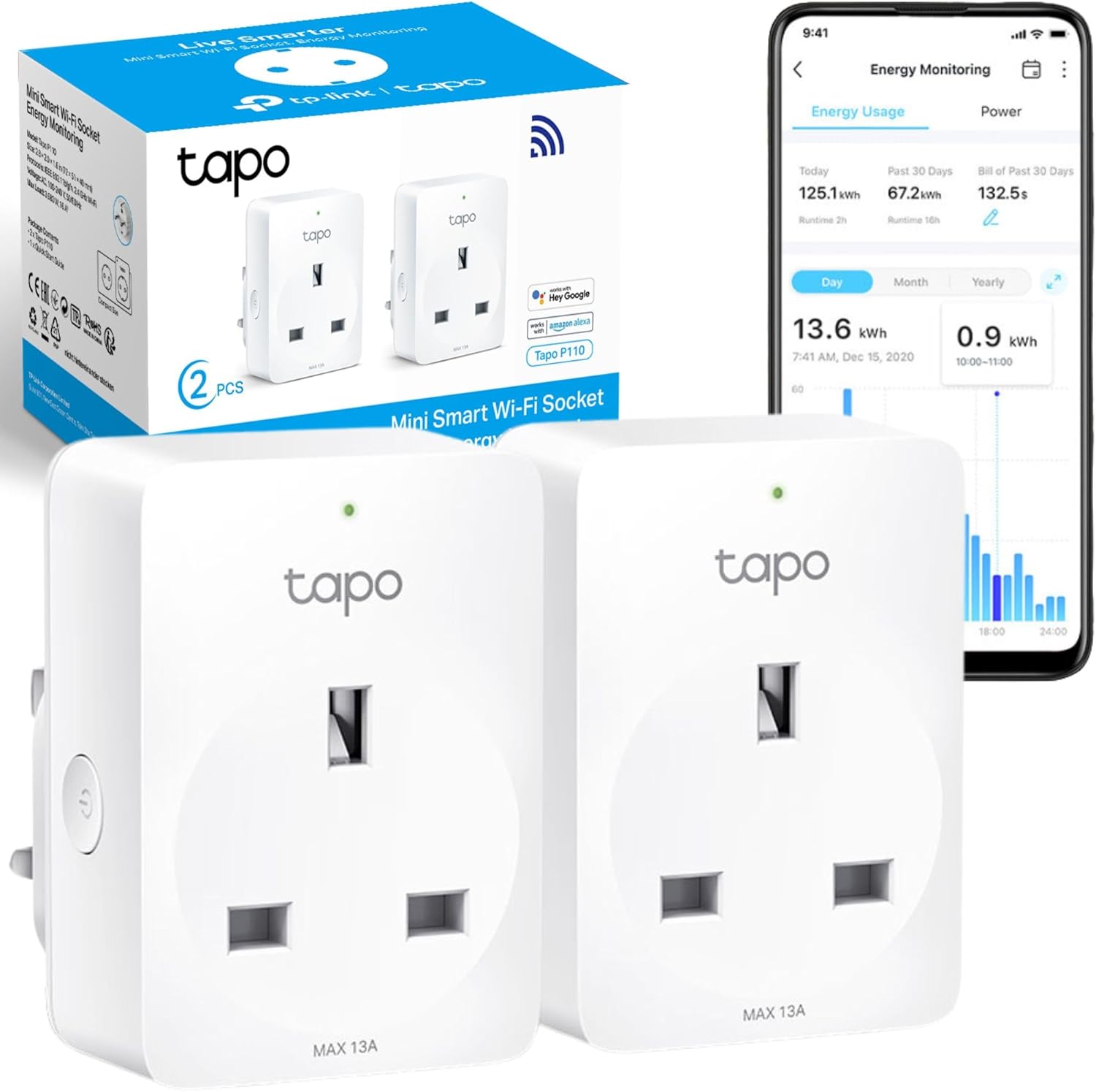
38,347 ratings, £8 a plug, and the only listing in the category that tells you which appliances will destroy the relay inside it.
Pros
- 38,347 ratings at 4.6, more than double the next deepest sample here
- The only listing that warns about motor and compressor loads
- £7.99 per plug, the joint cheapest in this comparison
- Best app in the category, with readable energy history
- No hub required, works with Alexa and Google Assistant
Cons
- Connector Type field says "Schuko", a plug that will not fit a UK socket
- Two spec fields contain raw template text with escape quotes intact
- States 220V where TP-Link's own TP11 states 240V
- Energy monitoring averages over one hour, hiding start-up peaks
Thirty-eight thousand three hundred and forty-seven ratings at 4.6 stars is the deepest evidence in this comparison by more than double, and at £15.97 for two this is also the cheapest way to a plug from a company with a real cloud service behind it. The Tapo app is the most polished here, energy history is genuinely readable, remote access and scheduling work without a hub, and device sharing lets a household control the same plugs from separate phones.
The reason it is the best smart plug on this page is a warning nobody else prints. The final bullet says: "Avoid plugging in appliances with a motor/compressor higher than 1/6HP, such as an air conditioner." That is the specification that matters most and it is the one the category ignores. A relay rated 13 amps is rated for resistive loads; motors and compressors draw six to eight times their running current at the instant they start, and that surge is what fuses relay contacts together so the plug never switches off again. One sixth of a horsepower is about 124 watts — so the real limit for anything with a motor is 4% of the headline wattage. Nine other listings say nothing, and several suggest heaters and appliances in their bullets.
The specification table is a different story. Connector Type reads "Schuko", which is the round two-pin continental European plug that physically will not fit a British socket. Switch Type reads "Wall Outlet" or "Receptacle" and Circuit Type reads "series" or "parallel" — raw template options with the escape quotes still in them. And Operating Voltage says 220 volts, where TP-Link's own TP11 says 240.
Tapo TP11 Compact Smart Plug with Energy Monitoring, 4-Pack

The highest rating in the category backed by 18,125 ratings, a three-year warranty, and the correct plug type in its specification table.
Pros
- 4.7 stars from 18,125, the best average-and-sample combination here
- Compact body does not block the adjacent socket on a double plate
- Plug Type field correctly reads Type G, unlike the P110
- Three-year warranty, the longest in this comparison
- Away Mode varies lamp timings to make a house look occupied
Cons
- States 240V where TP-Link's own P110 states 220V
- Number of Packs field reads 24 on a four-pack
- No stated accuracy for the energy meter, like every plug here
- No warning about motor loads, unlike the P110
Four point seven stars from 18,125 ratings is the best combination of average and sample size on this page, and the TP11 is the plug to buy if you want four of them. At £7.99 each it matches the P110's price per unit while being physically smaller, which is the practical difference: a compact body does not block the second socket on a double wall plate, and anyone who has fitted two fat smart plugs side by side knows that is the failure mode of the format.
The specification table is also cleaner than its stablemate's. Plug Type reads "Type G", which is correct for Britain, where the P110 says Schuko. The warranty is three years, the longest in this comparison, and the country of origin is stated. Away Mode is a real addition over the P110: it switches connected lamps on and off at varying times to make an empty house look occupied, which is a security feature rather than a convenience one.
Two notes. The voltage field says 240 volts against the P110's 220, from the same manufacturer — the 260 watt discrepancy in the headline of this article is TP-Link disagreeing with itself. And the pack fields do not add up: Number of Packs reads 24 while Unit Count reads 4.0, on a product sold as a four-pack. You receive four. It also inherits the category-wide silence on measurement accuracy: the energy monitor lets you enter your electricity rate to estimate bills, with no stated tolerance on the underlying reading.
Meross MSS305 Mini Smart Plug with Energy Monitoring, 13A 3120W, 2-Pack

The only listing that does the multiplication in front of you — 13A, 3120W — and the only one that keeps working when your internet goes down.
Pros
- Publishes 13A and 3120W together, and the multiplication is correct
- Every specification field is filled in accurately, unique on this page
- Local LAN control keeps working when the internet drops
- Bluetooth pairing makes setup faster than Wi-Fi-only rivals
- £8.50 per plug with 1,206 ratings at 4.6
Cons
- Uses 240V, the pre-1995 nominal, so the real ceiling is 2,990W
- 1,206 ratings is a thirtieth of the Tapo P110's sample
- 2.4GHz Wi-Fi only, so combined-band routers need splitting
- No accuracy figure for the energy meter
Two things make this the most technically honest listing in the category. The first is that it shows its working: "This WiFi plug can handle a load of up to 13A, 3120W". Thirteen amps at 240 volts is exactly 3,120 watts, so the arithmetic is right, and stating both numbers together lets a reader check it rather than trust it. Every table field matches too — 240 volts, 13 amps, Type G, three wires, three poles — which sounds like a low bar until you read the nine listings around it.
The second is local control. If your router loses its internet connection, devices on the same network can still be controlled from the Meross app over the LAN. Almost every rival here becomes a dumb plug the moment the broadband drops, which for anything on a schedule — heating, lights, an aquarium — is exactly when you notice. Bluetooth pairing also makes setup faster than the Wi-Fi-only dance most of these require.
The caveats are proportionate. One thousand two hundred and six ratings is respectable but a thirtieth of the Tapo's sample, so long-term reliability is less well proven. It runs on 2.4GHz Wi-Fi only, which means splitting your network bands if your router combines them. And the 240 volt figure, while it makes the arithmetic consistent, uses the pre-1995 nominal voltage — at Britain's actual 230 volts the true ceiling is 2,990 watts. It is the least wrong voltage claim on this page, which is not quite the same as being right.
EIGHTREE 5GHz Smart Plug with Energy Monitoring, Max 13A, 4-Pack

The only 5GHz smart plug here, which solves the single most common setup problem in the category.
Pros
- The only 5GHz plug here, removing the commonest setup problem
- Lower latency on voice commands than 2.4GHz rivals
- 1,593 ratings at 4.6 stars
- Four plugs for £39.99 with no hub required
- Works with Alexa and Google Home
Cons
- 5GHz penetrates walls far worse than 2.4GHz, and the listing never says so
- Publishes no voltage, so 13A cannot be converted to a wattage
- Actuator Type field contains raw template text with escape quotes
- Mounting Type says "Wall Mount" for a plug-in device
Nine of the ten plugs in this comparison require 2.4GHz Wi-Fi, and the most common complaint across all of their review sections is setup failing because the buyer's router broadcasts a single combined network name and the plug cannot find the right band. The usual workaround is to log into the router, split the bands, pair the plug, then put it back — which is a genuine obstacle for a £10 device. This one connects over 5GHz instead, and for anyone with a modern mesh system that hides band selection entirely, that removes the problem rather than working around it.
One thousand five hundred and ninety-three ratings at 4.6 stars is solid evidence, and four plugs for £39.99 is £10 each, which is mid-priced here. Response times over 5GHz are genuinely lower, which you notice on voice commands, and the plug supports Alexa and Google Home without a hub.
The trade-off is range, and the listing does not mention it. Five gigahertz carries more data but penetrates walls far worse than 2.4, which is why almost every smart home device in the world uses the lower band — a plug behind a sofa two floors from the router may connect worse than a 2.4GHz rival would. The specification table also carries the same raw template text found on the Tapo: Actuator Type reads "Hinge Lever" or "Push Button", quotes and all, and Mounting Type reads "Wall Mount" for something that plugs in. No voltage is published anywhere, so the 13 amp rating cannot be converted to watts at all.
TCP Smart Plug UK WiFi Socket, Alexa, Google Home, Siri, 4-Pack
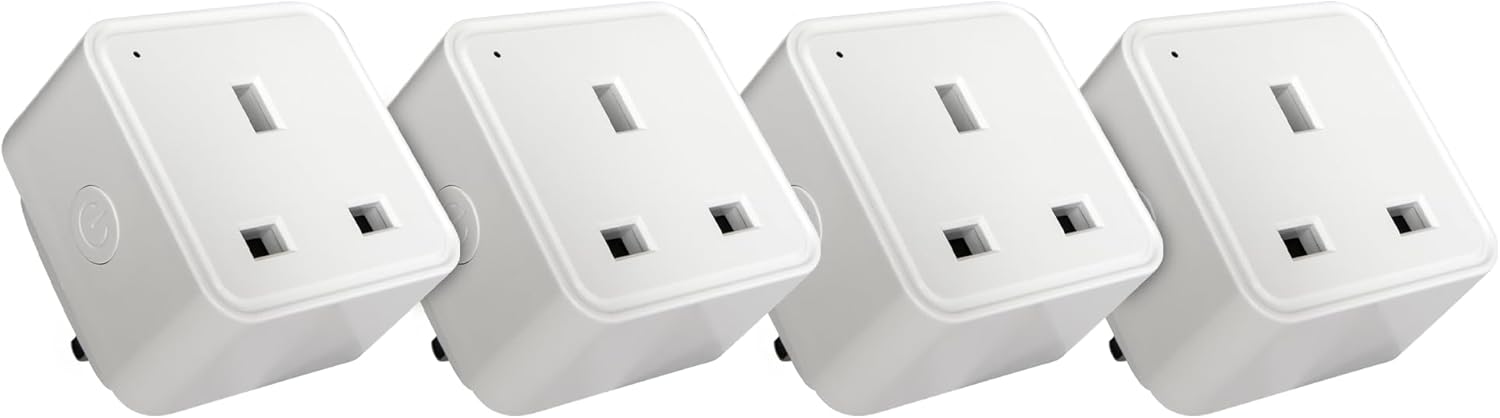
A manual switch on the body and Siri Shortcuts support — two things the more popular plugs here leave out.
Pros
- Manual switch on the body, so it works without a phone or Wi-Fi
- Siri Shortcuts support with no Matter hub required
- Alexa and Google Home too, the widest compatibility here without a hub
- British lighting brand rather than an anonymous seller
- 1,485 ratings at 4.6 stars
Cons
- Operation Mode field says "Manual" for a Wi-Fi plug
- Terminal field says "Screw" on a moulded plug
- Number of Positions field contains the pack size
- £9.38 per plug, more than the Tapo and Meross options above
The physical button is the reason to buy this one. Most smart plugs assume you will always have a phone, and when the app is slow, the Wi-Fi is down or a guest wants the lamp on, a plug you cannot operate by hand is an obstacle rather than a convenience. TCP puts a manual switch on the body, so the plug behaves like a socket when you want it to and like a smart device when you do not. It is a small design decision that changes how a household actually lives with these.
The other differentiator is Siri Shortcuts, which brings Apple voice control without requiring the Matter hub that the Meross and Tapo Matter models further down this page need. Combined with Alexa and Google Home support and no hub requirement of any kind, this is the most broadly compatible plug here for the money. One thousand four hundred and eighty-five ratings at 4.6 stars is strong, and TCP is a British lighting brand rather than an anonymous seller, which matters for the app still existing in three years.
At £9.38 per plug it sits mid-table, and the specification table continues the category's habits. Operation Mode reads "Manual" for a Wi-Fi controlled device, Terminal reads "Screw" on a moulded plug with no screws in it, Mounting Type reads "No Mount", and Number of Positions reads 4 — which is the pack quantity in a field describing switch positions. It does at least publish a voltage, 240 volts AC, though like every 240 volt claim here that is the pre-harmonisation figure.
EIGHTREE Alexa Smart Plug with Energy Monitor, BS1363, 4-Pack

The cheapest four-pack here at £6.25 a plug, and the only listing in the category that names the British safety standard it is built to.
Pros
- £6.25 per plug, the cheapest in this comparison
- The only listing that names its safety standard: BS1363 and UKCA
- 1,567 ratings at 4.6 stars
- Compact body that leaves the adjacent socket usable
- Smart Life app also controls thousands of other devices
Cons
- Spec table says four wires, where a UK plug has three
- Plug Type field reads "ELECTRICAL" and Connector Type "Quick Connect"
- No voltage published, so 13A cannot be converted to watts
- 2.4GHz Wi-Fi only, unlike EIGHTREE's own 5GHz model
Six pounds twenty-five per plug is the lowest price in this comparison, and 1,567 ratings at 4.6 stars means it is not cheap for the usual reason. The compact body is designed specifically not to block the second socket on a UK double plate, it runs on the Smart Life app which also controls thousands of other own-brand devices, and it does energy monitoring with cost estimation, timers, countdowns and cycle modes.
More interesting is a single line in the specification table: "Specification Met: BS1363, UKCA". BS 1363 is the British Standard for 13 amp plugs and sockets, and UKCA is the post-Brexit conformity marking. Not one other listing on this page names the standard it is built to. Given that everything here carries mains voltage into a device left plugged in unattended for years, an anonymous brand citing the correct standard by number is worth more than a familiar logo that does not.
The same table then says Number Of Wires: 4. A British plug has three — live, neutral and earth — and a fourth would have nowhere to go. It also gives Plug Type as "ELECTRICAL" and Connector Type as "Quick Connect", neither of which describes anything. No voltage is published, so as with EIGHTREE's 5GHz model the 13 amp rating cannot be turned into watts. And like eight of the ten here, it needs 2.4GHz Wi-Fi, which is the thing its own 5GHz sibling at number four exists to avoid.
Meross MSS315 Matter Smart Plug Mini with Energy Monitoring, 4-Pack

The most complete compatibility disclosure in the category — it lists the exact OS versions and hubs you need before you buy.
Pros
- Names the exact OS versions and hub models required, uniquely here
- Matter keeps working independently of the manufacturer's cloud
- Publishes 230V, the only correct UK nominal voltage on this page
- Local and offline control, and works across all four platforms
- 1,042 ratings behind it
Cons
- £12.50 per plug, the most expensive in this comparison
- 4.3 stars, the second-lowest average here
- Needs a hub, which the cheaper Wi-Fi plugs do not
- Plug Type field reads "wall plug", which is not a plug type
Two of the five bullets on this listing are spent telling you what you need before it will work, and that is a compliment. For Apple: iOS or iPadOS 16.1 or later, a 2.4GHz connection, and a hub such as an Apple TV 4K second or third generation, or a HomePod Mini. For Android: 8.1 or later, 2.4GHz, and a hub such as a SmartThings v3, an Echo fourth generation or a Nest Hub second generation. Matter devices need a hub and most listings mention it in passing if at all. This one names the models.
Matter itself is the reason to pay the premium. A Matter plug talks to Apple Home, Google Home, Alexa and SmartThings through one standard rather than through a manufacturer's cloud, which means it keeps working if Meross changes its app or its business, and it works locally rather than routing commands through a server in another country. For a device you will leave in a wall for a decade, that is a real form of insurance. Offline control works too.
The cost is the price: £12.50 per plug is the most expensive in this comparison, double the EIGHTREE, and 4.3 stars is the second-lowest average here — Matter setups are fiddlier and the reviews reflect it. It publishes 230 volts, which is the correct British nominal figure and the only accurate voltage on this page, though Plug Type reads "wall plug", which is not a plug type.
ANTELA Smart Plug with Energy Monitoring, 13A, 2.4GHz WiFi, 4-Pack
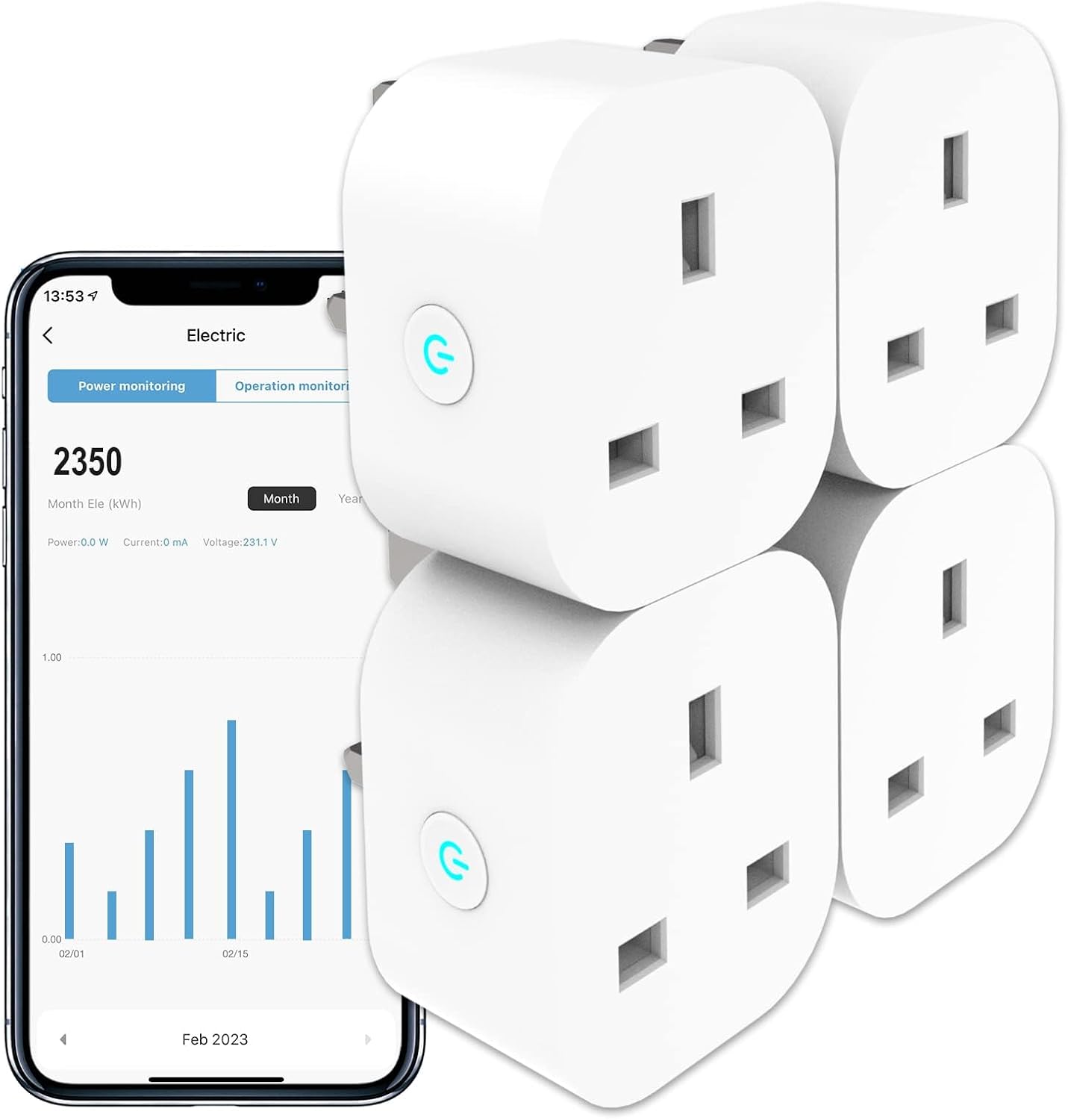
Group control across multiple plugs and 2,173 ratings, on a spec sheet that describes a wall socket using circuit-board soldering terms.
Pros
- Group control switches a whole room of plugs with one command
- Energy use shown as a graph over time, not just a running total
- 2,173 ratings at 4.4, the third deepest sample here
- £7.50 per plug with no hub or subscription needed
Cons
- Mounting Type and Terminal fields use circuit-board soldering terms
- Operation Mode reads "ON-OFF-ON", a three-position switch
- States 220V, giving a ceiling of 2,860W rather than 2,990W
- 2.4GHz Wi-Fi only, and no accuracy figure for the meter
Group control is the feature that justifies buying four of these rather than four of something else. Rather than switching plugs one at a time, you assign them to a room and turn the lot off with one command — every lamp in the living room, or every device on standby before bed. On a four-pack that is the difference between a novelty and an actual system, and it works through the Smart Life app with no hub or subscription. Two thousand one hundred and seventy-three ratings at 4.4 stars is the third deepest sample in this comparison.
The energy monitoring is presented better than most: consumption over time as a graph rather than a running total, which is what actually reveals that the dehumidifier is costing more than the fridge. At £7.50 per plug it is competitively priced, and it supports Alexa and Google Home.
The specification table is where it slips furthest of any listing here. Mounting Type reads "Through Hole Mount" and Terminal reads "Through Hole" — both are circuit-board soldering terms describing components with legs pushed through a printed board, applied to a device that pushes into a wall socket. Operation Mode reads "ON-OFF-ON", which describes a three-position toggle switch; a smart plug has two states. And Operating Voltage reads 220 volts, ten below the British nominal, which puts its true ceiling at 2,860 watts rather than the 2,990 the grid actually supports.
Meross MSS425 Smart Extension Lead, 4 UK Sockets, 4 USB, Apple Home

Four individually switched sockets in one lead, on a listing whose table gives two different plug types and a total load above its own fuse.
Pros
- Four individually switched sockets in one lead, unique here
- Four USB-A ports sharing 20W, switched as a group
- Apple HomeKit as well as Alexa and Google Home
- Wall-mountable, and 1,212 ratings at 4.2 stars
- Publishes 230V, the correct UK nominal voltage
Cons
- Claims 3250W total, which needs 14.1A through a 13A fuse at 230V
- Table gives Power Plug Type as G and Plug Type as C on the same page
- 4.2 stars, the lowest average in this comparison
- USB ports switch only as a group, not individually
Four individually controlled sockets in a single extension lead is a genuinely different product from four separate plugs, and for one specific job it is much better: a television stack, a desk, or a Christmas tree where several things live behind the same piece of furniture. Each socket switches independently by app or voice, the four USB-A ports share a 20 watt output and switch as a group, and it wall-mounts. Apple HomeKit support is included alongside Alexa and Google, and 1,212 ratings at 4.2 stars is reasonable.
Two problems keep it near the bottom. The first is arithmetic with a safety edge: the listing claims "Total output 3250W MAX". At Britain's nominal 230 volts, 3,250 watts requires 14.1 amps — and the extension lead's own plug is fused at 13. The figure only works if you assume 250 volts, the absolute top of the permitted supply range rather than the nominal. In practice the fuse in the plug opens before you reach the advertised maximum, so the number describes a condition the product cannot sustain.
The second is the plug type, given twice and differently. Power Plug Type reads "Type G", the British three-pin. Two rows below, Plug Type reads "Type C", the European two-pin. One of those rows describes what you plug into the wall and the other describes nothing that ships in the box. Meross gets the voltage right at 230, which makes the 3,250 watt claim harder to explain rather than easier.
Tapo P110M Matter Smart Plug with Energy Monitoring, 4-Pack
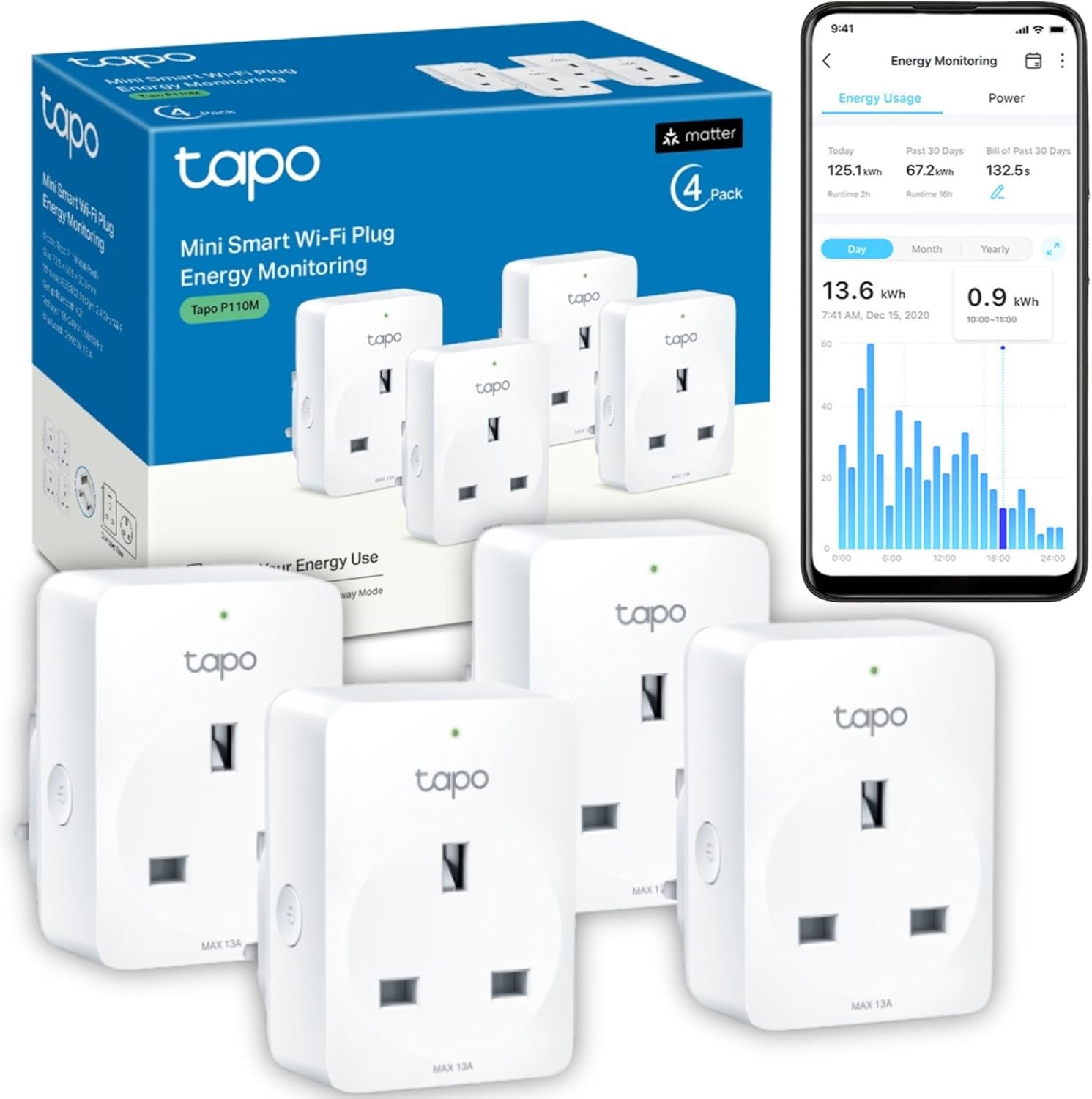
A Matter plug whose Matter energy monitoring works with SmartThings and Home Assistant only — not with Apple Home or Google, who help run Matter.
Pros
- 4.7 stars, joint-highest average in this comparison
- Automatic shut-off when consumption passes a threshold you set
- Flame-retardant polycarbonate housing
- The right choice if you run Home Assistant or SmartThings
- States its Matter limitations openly on the listing
Cons
- Matter energy monitoring works only with SmartThings and Home Assistant
- No Matter energy data in Apple Home or Google Home
- 163 ratings, the thinnest sample here by a factor of six
- £9.75 per plug against £7.99 for the far better proven P110
The first bullet is unusually candid and it is the reason this finishes last. "For Matter 1.3 Energy Monitoring Supportive, update both your Tapo P110M and Matter Hub to the latest firmware — currently works with SmartThings and Home Assistant only." Read that carefully: the energy monitoring, which is the entire premise of the product and the thing its price premium buys, does not function over Matter with Apple Home or Google Home. Those are two of the four platforms that jointly created and govern the Matter standard. Buy this expecting to see consumption data in Apple Home and you will not, and TP-Link deserves credit for saying so on the page rather than in a support article.
Everything else about it is good. Four point seven stars is the joint-highest average in this comparison, though from only 163 ratings — the thinnest sample here by a factor of six. The flame-retardant polycarbonate housing and the automatic shut-off when consumption exceeds a threshold you set are real safety features that no other plug on this page offers, and the threshold cut-off in particular is a sensible protection for a heater left unattended.
At £9.75 per plug it costs more than the standard P110 and delivers less in the platforms most people use, which is an unusual place for a newer model to land. If you run Home Assistant or SmartThings, this is the best plug on this page and the ranking should be reversed for you. If you run Apple Home or Google Home, buy the P110 at number one for £8 a plug and use TP-Link's own app.
Final Verdict
The best smart plug for most people is the cheapest one from a brand that will still be running its servers in five years, because a smart plug is a relay and a radio and the hardware barely differs between them. What does differ is worth knowing. First, the load: a relay rated 13 amps is rated 13 amps resistive, and motors and compressors draw six to eight times their running current at start-up, which is what welds relay contacts shut — Tapo is alone here in warning you, and its limit for motor loads is a sixth of a horsepower, about 124 watts, or 4% of the headline figure. So use these for lamps, heaters, chargers and Christmas lights; do not use them for fridges, dehumidifiers or air conditioners. Second, the energy monitoring is uncalibrated: it is genuinely useful for spotting that the tumble dryer costs more than you thought, and it is not a billing-grade meter, so treat the pounds-and-pence estimate as a comparison rather than a number. Third, almost all of these need 2.4GHz Wi-Fi, which matters if your router hides that band behind a combined network name. Crucially, buy in multipacks — the price per plug roughly halves — and check the voltage the listing claims, because a brand that cannot state the national grid voltage correctly has told you something about how carefully the rest of the page was written.
Written by
Felipe Iglesias
Founder & Lead Reviewer
Felipe is the founder of ranked10 and the person behind every buying guide on the site. He spends his time digging through specs, customer reviews and real-world feedback so you do not have to, turning hours of research into clear, honest top 10 lists for UK shoppers. When he is not comparing air fryers or cordless mowers, he is tinkering with the technology that keeps ranked10 running.
Related buying guides
All Tech guidesBest Multi Port USB C Charger 2026: 10 Ranked, and Why 165W Is 40+40+40+15+15+15
The wattage on the box is the sum of what every port can do on its own, not what the charger delivers at once — and three of these listings print the addition for you. A £25.99 charger advertised as 165W explains in its own second bullet that it has "3 USB-C ports (40W each)" and "3 USB-A ports (15W each)": three forties and three fifteens is 165. A £22.99 charger badged 200W describes "a 100W USB-C port for laptops and five additional 20W/18W USB-C ports", which is 100 plus five twenties. A £35.99 charger badged 240W says its top port reaches 140W "when used alone". None of the three claims the total is simultaneous, and the £22.99 listing gives the game away in the very next bullet, where its chip "intelligently distributes power across all ports based on device needs". Distributing is the opposite of adding. Meanwhile Anker and UGREEN, at £54.99, describe exactly the same architecture accurately — Anker states that two USB-C ports can each give 100W simultaneously, which is precisely its advertised 200W, and UGREEN says 100W "when used individually". We ranked ten of the best multi port USB C charger options on Amazon in August 2026 on the power they will admit to delivering together, and found one listing declaring an output current of 73 amps.
TechBest Portable SSD 2026: 10 Ranked on Speeds That Fit the Cable
An external drive can never be faster than the cable it plugs into, and the ceilings are fixed. USB 3.2 Gen 1 carries 5 gigabits a second, which after protocol overhead is about 450 megabytes a second in practice. Gen 2 carries 10 gigabits, or roughly 1,050 MB/s. Gen 2x2 carries 20 gigabits, or roughly 2,000. All three are called USB 3.2, which is where the trouble starts — and two listings in this comparison advertise a speed their own named interface cannot carry. The Crucial X10 says up to 2,100 MB/s over USB-C 3.2 Gen2, and Gen 2 tops out at 1,212 MB/s even in theory, so the claim is 173% of a ceiling that physics sets. That is Micron, one of the three largest memory manufacturers on earth, and a no-name rival makes the identical error two rows down. Meanwhile the specification field labelled Hard disk interface, which is exactly where a buyer looks to settle this, says NVMe on one drive, USB 3.0 on three, and USB-C — a plug shape, not a protocol — on two more. Below we rank the best portable SSD options on Amazon in August 2026, all 1TB, by whether the number on the box fits the wire.
TechBest Indoor Security Camera 2026: 10 Ranked on Real Resolution
Six of the ten cameras in this comparison are sold as 2K, and they do not mean the same thing by it. Proper 2K, the QHD standard, is 2560 by 1440 pixels — 3.69 megapixels. A 3 megapixel sensor in the same 16:9 shape gives 2304 by 1296, which is 19% fewer pixels while wearing the same label. Tapo demonstrates the whole problem inside its own range: the C211 at £21.99 says a 3 megapixel lens provides 2K resolution, and the C220 at £23.99 says 2K QHD resolution, 2560 by 1440, 4MP. Two pounds apart, both badged 2K, a full megapixel between them, and only one of them tells you the pixel dimensions. Elsewhere it gets stranger. Imou adds two 3 megapixel lenses pointing in different directions and calls the result 2K+2K. Eufy promises up to 2K and notes in brackets that it drops to 1080p on HomeKit, which is one of the three integrations it advertises. Two more say 2K and publish no number at all. Below we rank the best indoor security camera options on Amazon in August 2026 by converting every claim back into pixels.
Highest rated in our other guides
Weighted by how many people rated each product, not just the score.

BoYata Aluminium Adjustable Laptop Stand, 0-90 Degree, Foldable
£32.99

cocopar 15.6 Inch Portable Monitor, 1080p, 85% sRGB, 670g, VESA
£89.99

Ninja Foodi Blender and Soup Maker HB150UK, 1.7L Glass Jug, 1000W
£180.00

cocopar 18.5 Inch Portable Monitor, 100Hz, 350 nits, 1080p, 1kg
£142.49