Best 3D Printers for Beginners 2026: 10 Ranked, and the Numbers That Don't Add Up
By Felipe Iglesias · Updated
Shopping for the best 3D printers for beginners means wading through numbers that sound confident. The loudest figure is usually the one the same listing quietly qualifies. QIDI advertises 16 colours; its own bullet says that needs the QIDI BOX. The Kobra X photographs show four spools of filament, and the note underneath says those rolls are display-only and not included. Meanwhile the star badges across these ten machines read 4.1 to 4.4 — until you count the one-star votes, which run from 7 to 14 in every 100 ratings.
We ranked ten of the best 3D printers for beginners on Amazon on four things that can actually be checked: what the listing promises against what the box contains, how much of the calibration is genuinely automatic, the price of the machine rather than the machine plus the extras, and what the one-star share says about the headline rating. Where a listing leaves out a basic number, we say so.
At a glance
| # | Product | Price | Rating | Link |
|---|---|---|---|---|
| 1 | Bambu Lab P1S Combo with AMS, Enclosed | £499.00 | 4.4 | View |
| 2 | Bambu Lab A1 Combo with AMS lite + LED Lamp Kit | £345.00 | 4.1 | View |
| 3 | FlashForge AD5X, Four-Colour CoreXY | £299.00 | 4.2 | View |
| 4 | Anycubic Kobra X, 4-Colour with App Control | £279.99 | 4.2 | View |
| 5 | ELEGOO Centauri Carbon, Enclosed CoreXY | £209.00 | 4.2 | View |
| 6 | FlashForge Adventurer 5M, 220 mm Cube | £209.00 | 4.1 | View |
| 7 | Weefun TINA2C, Assembled for Kids and Beginners | £179.99 | 4.2 | View |
| 8 | Bambu Lab A1 mini + LED Lamp Kit | £169.00 | 4.4 | View |
| 9 | FlashForge Creator 5 Pro, Four Toolheads | £748.99 | 4.2 | View |
| 10 | QIDI Q2 with 65°C Heated Chamber | £429.00 | 4.4 | View |
Free WhatsApp group
Amazon deals, around the clock
Price drops and lightning deals posted the moment they go live. No spam, leave whenever you like.
Join the groupFree to join · Leave any time
Bambu Lab P1S Combo with AMS, Enclosed

The strongest all-round case here — 4.4 stars from 725 ratings, with the AMS multi-colour unit already in the box at £499, so its 16-colour claim is one of the few on this page you don't buy twice.
Pros
- 4.4 rating from 725 ratings, with 79 in every 100 giving five stars
- AMS multi-colour unit included at £499 — the 16-colour figure needs no extra purchase
- Fully enclosed body, listed as ideal for ABS and ASA and capable with PA and PC
- 500 mm/s and 20,000 mm/s² acceleration, with automatic bed levelling
- Setup quoted at 15 minutes
Cons
- Carbon and glass fibre reinforced filaments are explicitly not recommended
- £499, almost three times the £169 A1 mini
- 21.55 kg and 38.9 x 45.8 x 38.9 cm — it needs a dedicated surface
- 10 in every 100 ratings are one star
What buyers actually say
Quoted from customer reviews on Amazon
Verified purchase“Absolutely brilliant. This is an upgrade from my Ender 3 and there no comparison. It was straightforward to set up and the prints off it are fantastic I've added a pic of one of my first prints. One aspect I was disappointed with though. I thought it would have been nice to have 4 spools of filament with it, as there are 4 slots. I've ordered more because I'm still not sure if I can use what I have from my Ender 3 yet other than that can't fault it”
Verified purchase“Went back and forth on wether the p1s was good enough vs the p2s, and went with the p1s.1. You can add a HEPA filter to the p1s after purchase (apparently, the p2s isn't air tight, so the filter it has, even though bigger, still isn't for a fully enclosed system. Ps1 comes with a charcoal filter (for smell), but you can find HEPA 13 filters made for the p1s2. For basic prints, p1s is pretty much the same as the p2s3. Decided to save money and use the difference to buy filamentsFirst Impressions of p1s1. The foam that ships under the plate gets removed during the calibration phase (don't try to pull it out with starting calibration, the shipping foam under the plate goes the entire length of the plate)2. The defauls prints on the SD card don't work with the AMS (spool system). Thought the SD card files (the default ones) would be an easy print. Nope, wouldn't print, kept saying to load the filiment. Must print via the app not SD card for those as they're not programed to use the AMS apparently).3. Get ready to get more filament. It doesn't come with full spools.If you look on the App, you'll see designs people have posted, they'll also list the colors you need for it. Pretty cool. Watch pricing from where you buy. Bambu labs official filament has an RFID tag that helps the machine to identify it.4. Refillable spools can be bought and are independent of the filament. Empty, refillabe spools can be purchased. The sides twist off, and you can load a new spool that way.5. PLA is made from corn apparently and is the least problematic as far as chemicals go for printing.6. Read the comments by people in the app on different print builds posted there.7. The firmware update process seemed to hang. Initiated from the app, and hung on 99% forever. Immediately after, it notified that there was another firmware upgrade. Did that one via the LCD screen and it worked great.8. I keep wanting to call it the PS1.9. Prints are great. Having a lot of fun with it. The app is top notch. Connectivity isn't a problem (not after the firmware update).”
Price aside, this is the only machine on the list with both a 4.4 badge and more than 700 ratings behind it. The listing claims 500 mm/s and 20,000 mm/s² acceleration, and for once the 16-colour headline is backed by hardware: the AMS is part of the Combo, not an add-on. Which means the number on the box and the number on the invoice agree — rare among the best 3D printers for beginners.
In practice the enclosure is the differentiator. The listing names PLA, PETG, TPU, PVA and PET as ideal, with ABS and ASA supported and PA and PC capable — filaments that hold up better in a closed, warm chamber. Setup is quoted at 15 minutes and bed levelling is automatic. At 38.9 x 45.8 x 38.9 cm and 21.55 kg it needs a proper table, not a shelf.
That said, carbon and glass fibre reinforced polymers are explicitly not recommended, so this is not the machine for anyone chasing stiff engineering parts. And £499 is almost three times the £169 A1 mini two places below. If you print PLA models and nothing else, you are paying for a door and a lid: among the best 3D printers for beginners, this is the one where most of the money goes on the enclosure.
Bambu Lab A1 Combo with AMS lite + LED Lamp Kit

A £345 open-frame machine whose 10,000 mm/s² acceleration is half the figure quoted by the Bambu and FlashForge models around it, and whose 4.1 badge is the joint-lowest here.
Pros
- AMS lite for multi-colour printing, plus automatic calibration and a 1-clip nozzle swap
- Active flow rate compensation quoted for consistent extrusion
- LED Lamp Kit included, for printing functional light models
- 4.1 rating from 228 ratings, with 72 in every 100 giving five stars
- Simplified touchscreen and a tool-free nozzle change
Cons
- 10,000 mm/s² acceleration, half the 20,000 mm/s² quoted by the P1S, AD5X and AD5M
- 14 in every 100 ratings are one star — the highest share of the ten
- No enclosure, and the listing names no supported filaments
- 12.93 kg, with a listed 58.45 x 53.49 x 42.6 cm footprint
What buyers actually say
Quoted from customer reviews on Amazon
Verified purchase“I had an old 3D printer, but leveling the bed was a nightmare. So, I decided to take the plunge and buy one of these. Assembly is fairly easy, apart from the plugs underneath. It may just be me, but I fought for hours with them. Eventually it all clicked into place. The bed leveling is an absolute joy, and the filament feed is a doddle. I printed a benchy, to try it out, and that was perfect. I still have a lot to learn, but the printer is straightforward to use and an absolute joy. I will add to this as I become more experienced...UPDATE: I have now printed: a balloon dog, a vase, a newfypoo (dog), and they all turned out perfectly.”
Verified purchase“Exactly as described”
This is the joint-lowest rating on the list at 4.1, matched only by the £209 Adventurer 5M, and 14 in every 100 ratings are one star — the highest one-star share of the ten. The speed claim is careful: 10,000 mm/s² acceleration, where the P1S above and both FlashForge machines below quote 20,000 mm/s².
The AMS lite handles multi-colour, full-auto calibration covers Z-offset and bed levelling, and the listing adds active flow rate compensation plus a 1-clip quick-swap nozzle. The included LED Lamp Kit is an extra rather than a spec: you print lamp models and fit the supplied light. Note that the dimensions field reads 58.45 x 53.49 x 42.6 cm at 12.93 kg, a substantial footprint for an open-frame printer.
However, there is no enclosure, and the listing names no supported filaments at all, so advanced materials are undocumented rather than ruled out. With a 4.1 rating and a higher one-star share than most of the machines below it, this is an easy to use 3D printer that has not yet convinced everyone.
FlashForge AD5X, Four-Colour CoreXY

The fastest machine per pound near the top — 600 mm/s and 20,000 mm/s² for £299, with four colours from hardware that ships in the box.
Pros
- 600 mm/s and 20,000 mm/s² — the same acceleration figures as the £499 P1S
- Four-colour filament system included, with auto loading and up to 4 kg auto-refill
- 300°C hotend and 32 mm³/s flow, listed for PLA, PETG, TPU and carbon fibre
- 220 x 220 x 220 mm build volume at £299
- 4.2 rating from 536 ratings
Cons
- Real-time monitoring requires a camera kit bought separately
- 13 in every 100 ratings are one star
- 11 kg and a 36.3 x 37.6 x 41.3 cm body — not a shelf unit
- Aimed at batch production; the feature list is heavier than a first machine needs
What buyers actually say
Quoted from customer reviews on Amazon
Verified purchase“What a printer I have had this nearly a year got 2000 hours on it. still going strong just have to remember maintenance and updates and it just keeps going. Made some upgrades to enclose it but so easy to use and now you can print straight from the app on your phone.”
Verified purchase“Print quality is excellent even with all four colours and also possible to print in one color if necessary”
Here the multi-colour claim survives scrutiny: the four colours come from an intelligent filament system included in the build, with auto loading, auto unloading and up to 4 kg auto-refill, not from optional add-ons. That is why it sits third — 4.2 from 536 ratings, 600 mm/s and 20,000 mm/s² at £299. It earns its place among the best 3D printers for beginners on capability per pound rather than on simplicity.
The CoreXY frame, a 300°C hotend and 32 mm³/s flow are listed for PLA, PETG, TPU and carbon fibre, with a 220 x 220 x 220 mm build volume inside a 36.3 x 37.6 x 41.3 cm body weighing 11 kg. One-click levelling, vibration compensation, runout detection and power-loss resume are all quoted. By contrast with the two Bambu machines, this one is aimed at batch work: the listing talks about print farms and hundreds of printers under one account.
Worth noting, real-time monitoring needs a camera kit bought separately, so the full-control-from-your-phone line only holds once you add hardware. And 13 in every 100 ratings are one star. If you want a beginner 3D printer for a spare-room desk, £299 here buys a lot of machine you may never use.
Anycubic Kobra X, 4-Colour with App Control

The most-reviewed machine of the ten at 789 ratings and 4.2 stars, but its multi-colour ladder is the clearest example of a number you don't own yet.
Pros
- Largest review sample of the ten: 4.2 from 789 ratings
- Native four-colour printing, expandable to 19 colours with four ACE units
- 45 dB quoted printing noise — the quietest figure on this list
- AI failure detection pauses the print and sends a phone alert
- Pre-assembled, with setup quoted at 15 minutes
Cons
- The four filament rolls in the product photos are display-only and not included
- 19 colours needs four ACE units, sold separately
- Build volume given as 260mm3 — a volume figure rather than three dimensions
- 10 in every 100 ratings are one star
What buyers actually say
Quoted from customer reviews on Amazon
Verified purchase“had many 3d printers but this is the best so far, great auto levelling and good adhesion to bed, but best to install and load your filament from the top to save desk space”
Verified purchase“I'm struggling with this one. Have one purchased last year and it is great. Purchased another and it's terrible. Every time I fix an error a new one comes up. Had to replace so many parts and still not working. Problems since 2 months in. Now on month four and cannot get it working properly..UPDATE. I cannot fault the exceptional customer service received by any cubic. They reached out to me and gave some amazing options to sort out any issues. I am amazed at the level of service and options provided, I cannot fault them and will be taking them up on their offer to sort out the problem. I will recommend Anycubic based on the level of service received. I am a loyal customer now.”
Two numbers in this listing need reading together. The machine prints in four colours natively, and the same bullet says it expands to 19 colours with 4 ACE units — hardware that is not in this price. Then there is the photograph: the note below the pictures states that the four rolls of filament shown are display-only and not included. Meanwhile the rating is solid, 4.2 from 789 ratings, the largest sample here.
In practice the appeal is software and noise. Setup is quoted at 15 minutes from a pre-assembled machine, printing runs at 45 dB, AI detection pauses the job if it spots a foreign object or a spaghetti failure and notifies your phone, and LeviQ 3.0 handles levelling. Speed is quoted at 600 mm/s. The build figure in the bullet is written as 260mm3 — a volume, not three dimensions.
Even so, 10 in every 100 ratings are one star, and the filament in the photos is not in the box. As an entry level 3D printer for a family room it is one of the quieter options here; if you want a machine that arrives with everything in the picture, this isn't it.
ELEGOO Centauri Carbon, Enclosed CoreXY

An enclosed CoreXY with a 256 x 256 x 256 mm build volume for £209, held back only by how little rating evidence exists behind it.
Pros
- Enclosed chamber and a 256 x 256 x 256 mm build volume for £209
- 500 mm/s and 20,000 mm/s², with automatic vibration compensation
- Built-in chamber camera and dual LED lighting — no add-on kit needed
- 320°C hardened steel nozzle on a die-cast aluminium frame
- 8 in every 100 ratings are one star, the second-lowest share here
Cons
- Only 42 ratings behind the 4.2 badge
- No four-star ratings at all in the 100 shown: 8 one, 6 two, 12 three, 74 five
- Little long-term evidence for a machine this new
- 17.5 kg — not something you move between rooms
What buyers actually say
Quoted from customer reviews on Amazon
Verified purchase“So I actually ended up sending this back and buying directly from elegoo as that saved me about £70. But as far as the printer goes it's absolutely superb!”
Verified purchase“I have just bought my Elegoo 3 D printer, I looked at setting up on you tube, Followed the instructions in the box, and was printing in less than ten minuets, I love this printer. It connects to my laptop, so I can see it printing. How cool is that.. 10 out 10, the delivery was great. although early evening, not too good there, But the driver was a good man and very helpful, so I will forgive him. I'm over the moon with the whole purchase, Thanks Amazon,”
The specification-to-price ratio here is the sharpest on the list: a full enclosure, a 256 x 256 x 256 mm build volume, 500 mm/s, 20,000 mm/s² and a 320°C brass-hardened steel nozzle, for £209. The 4.2 badge comes from just 42 ratings, though. That is the second-smallest sample among these ten, which is why it sits fifth rather than higher among the best 3D printers for beginners.
The frame is a single die-cast aluminium piece, which the listing credits for stability at speed, alongside automatic vibration compensation and a heated bed. A chamber camera and dual LED lighting are built in — a real difference from the £299 FlashForge, which asks you to add a camera kit. The dual-sided plate has a PLA-specific surface. The whole machine is 39.8 x 40.4 x 49 cm at 17.5 kg.
That said, look at the rating spread: of the 100 ratings shown, 8 are one star, 6 are two, 12 are three and 74 are five — there are no four-star ratings at all. With 42 reviews, one unhappy buyer moves the average. If you want a long track record before spending, this is not it.
FlashForge Adventurer 5M, 220 mm Cube

The same 600 mm/s and 20,000 mm/s² as the AD5X for £209, with one colour, no enclosure and the joint-lowest rating here at 4.1.
Pros
- 600 mm/s and 20,000 mm/s² for £209
- Full-auto one-click levelling with vibration compensation on a CoreXY frame
- 32 mm³/s flow, 50W hotend and 200°C reached in 35 seconds
- Four nozzle sizes supported: 0.25, 0.4, 0.6 and 0.8 mm
- 4.1 rating from 489 ratings
Cons
- No enclosure — the listing suggests customising one yourself
- 14 in every 100 ratings are one star, joint-highest here
- Single colour, where the four-colour AD5X costs £90 more
- The same 220 mm cube as the AD5X, so no gain in build volume
What buyers actually say
Quoted from customer reviews on Amazon
Verified purchase“The media could not be loaded. I bought this despite not knowing a lot about 3D printers as a birthday present for my Fiance. He absolutely loves it and has been printing stuff non stop.He says its very intuitive and user friendly.He made a 'Benchy' which is a test file stored on the device and it works very well.I have since discovered from other people in the 3D printer groups that this is considered to be amazing for the price point. Brownie points for me then!The quality of the print is excellent and its not overly noisy and not too big but does need space behind it for ventilation”
Verified purchase“I bought one of these as I really wanted an enclosed model that was capable of ABS and ASA as well as the usual suspects for prototyping work. Two months later... I ordered another one as I was so pleased with the reliability, finish and general usefulness.The only real modifications I've felt the need to make (other than somewhere to keep the essentials at hand) are some flexible PLA feet to absorb some of the vibrations, and replacing the feed PTFE tube on both printers so that they can easily reach the heated dry box.They've both been proper little workhorses and have been used to create things from the very small to completely filling the 220x220 bed. I also like the ease with which I can swap the nozzles, especially as I now have the full range from 0.25 to 0.8mm.Issues? Few, I've had one filament clog and rarely have poor bed adhesion, warping or any of the other gotchas.”
The AD5M shares its speed figures with the £299 AD5X above — 600 mm/s and 20,000 mm/s² — along with 32 mm³/s flow, a 50W hotend and a 200°C heat-up in 35 seconds. What it does not share is the four-colour system or the enclosure. The build volume is 220 x 220 x 220 mm inside a 40 x 36.3 x 44.8 cm frame weighing 10.6 kg.
Full-auto one-click levelling runs with vibration compensation on a CoreXY structure, and the quick-release nozzle and flexible PEI steel plate make maintenance straightforward. Nozzles swap between 0.25, 0.4, 0.6 and 0.8 mm. Crucially, the listing tells you to customise the enclosure yourself — there isn't one in the box, so draughts and dust are your problem.
The catch is the record: 4.1 is the joint-lowest badge here, and 14 in every 100 ratings are one star. At the same price, the enclosed Centauri Carbon offers a 320°C nozzle and a camera, with far fewer reviews. It is a budget 3D printer for beginners on price; it just isn't the most forgiving one on this list.
Weefun TINA2C, Assembled for Kids and Beginners

The cheapest fully assembled machine here at £179.99, pitched at children and absolute starters — and the one listing that never states a build volume.
Pros
- Arrives fully assembled with factory-preset auto levelling
- Starter kit includes PLA filament, tools, magnetic build plate and TF card
- 2.45 kg and 17 x 21 x 25 cm — small enough for a desk
- 3,000+ models in the app, one-tap printing and AIGC photo-to-model
- 4.2 rating from 498 ratings
Cons
- No build volume, print speed or nozzle temperature stated anywhere in the listing
- 13 in every 100 ratings are one star
- Small format, so small models only
- The model library and AIGC features depend on the app
What buyers actually say
Quoted from customer reviews on Amazon
Verified purchase“This is a easy setup and easy use printer, my son loves using it and he can do it alone. The app has great design ideas for you to just download and print. Great gift and the price was good as I didnt want to go overboard incase he wasnt that interested. The prints he has done are really cute. You do need an up to date phone for the app to be download my sons phone wasnt the correct software level.”
Verified purchase“It is incredible piece of machinery doing exactly as described (I bought it as a Christmas present for someone), but do be careful about the yellow adhesive paper, as it's extremely tedious, yet essential, and delicate material, to put over the "black board" (unsure of the official name for it). Obviously when it comes to products, it's all about how you take care of them as well, so eventually, you will have to clean the nozzle using the pin provided in the packet. My only advice is to clean both the nozzle, and the "little platform" after each use. If you do print without the adhesive paper, then it will work for a bit, but gradually, the filament from the nozzle will immediately end up doing curls because it's struggling to find anything to stick onto. Also, do not create any files on the mircoSD card as the machine will not read it. If you are going to print a 3D hollow model, then use UltiMaker Cura (be warned, though, that it will ask to change the file type, otherwise you're good to go).With all that being said, it's worth the price! And very useful for wanting to understand 3D printing for a beginner.”
There is no build volume anywhere in this listing, no speed figure and no nozzle temperature. What it does give you is 498 ratings at 4.2, a 2.45 kg machine measuring 17 x 21 x 25 cm, and a starter kit in the box: a spool of PLA, tools, a magnetic build plate and a TF card holding test models. For a 3D printer for kids, arriving assembled and preset matters more than a specification sheet.
In practice the app does the work. The listing quotes 3,000+ ready-to-print models updated weekly, one-tap printing from a phone or tablet, 20+ design modules for STEM projects, and an AIGC function that turns a photo into a model. Wiibuilder and Cura are both supported if you would rather slice on a PC, and prints can go over wifi, TF card or USB-C. Silent printing, bed detection and resume-after-pause cover the safety basics.
That said, 13 in every 100 ratings are one star, and the small footprint that makes it a sensible first 3D printer also means small prints — you will not be making helmets on it. Pick it for a child's desk or a kitchen table; skip it if you already know you want a 256 mm build plate. It is the only machine among the best 3D printers for beginners here that never commits to a build volume at all.
Bambu Lab A1 mini + LED Lamp Kit

The lowest price here at £169 and the lowest one-star share at 7 in every 100, from a listing that also names no build volume and no print speed.
Pros
- 4.4 rating from 167 ratings — the joint-highest badge on the list
- 7 in every 100 ratings are one star, the lowest share here
- £169, the cheapest machine in the ranking
- Automatic calibration, MakerWorld library and Bambu Handy app support
- 5.5 kg, the second-lightest of the ten
Cons
- No build volume, print speed or acceleration stated in the listing
- 167 ratings is a smaller sample than the £209 to £299 machines
- No enclosure in this configuration
- Multi-colour printing is not part of this bundle
What buyers actually say
Quoted from customer reviews on Amazon
Verified purchase“The media could not be loaded. Amazing for beginners and pros. Sorry easy to use and I was printing within 20 minutes.”
Verified purchase“Very impressive quality and value - the app store is also very handy and easy to find prints etc.”
Two of the strongest numbers on this page belong to the cheapest machine: 4.4 stars, level with the £499 P1S, and just 7 one-star ratings in every 100 — the cleanest record of the ten. The badge rests on 167 ratings, so it is a smaller sample than the machines around it.
What you actually buy is the Bambu ecosystem. Automatic calibration, the MakerWorld model library and the Bambu Handy app are the pitch, and the included LED Lamp Kit lets you print lamp models and fit the supplied light. The listing is notably quiet on hardware — no build volume, no print speed, no acceleration figure. At 5.5 kg and a listed 38.63 x 42.6 x 45.57 cm, it is the lightest machine here apart from the 2.45 kg Weefun.
However, quiet specifications cut both ways: you cannot compare it on numbers because it publishes none. As a best beginner 3D printer for someone who wants to print downloaded models rather than tune a machine, the rating record argues for it. If you need to know the build volume before you buy, this listing will not tell you.
FlashForge Creator 5 Pro, Four Toolheads

The most capable and most expensive machine here at £748.99 — four toolheads, a 65°C heated chamber and no published build volume.
Pros
- Four preloaded, preheated toolheads with a 7-second toolchange
- 65°C actively heated chamber and a 320°C hardened nozzle
- Enclosed CoreXY build aimed at engineering materials
- 4.2 rating from 652 ratings
- Flow Dynamics Calibration compensates as the nozzle wears
Cons
- No build volume published in the listing
- 13 in every 100 ratings are one star
- 14 kg and 44.09 x 41.1 x 46 cm — a workshop footprint
- £748.99 buys capability most first-time buyers will not use
What buyers actually say
Quoted from customer reviews on Amazon
Verified purchase“Excellent 3D printer that works very well in minutes from unboxing it.I operate professional 3D printers at work that cost around 30-40K and I didn't think that this £300 printer would be anywhere near as good as the ones at work and I was proved totally wrong. I love my Flashforge Adventure 5M so much, it is excellent. I treated it to the DIY housing that I printed myself and I use it regularly. You won't regret buying one of these 😁”
Verified purchase“The printer works well, prints fast. It has issues now and then but for the price I would expect some.”
This is a different class of machine, and the ranking reflects it: £748.99 buys four preloaded, preheated toolheads with a 7-second swap, so material changes happen without purging. The 65°C actively heated chamber and 320°C hardened nozzle are aimed at engineering filaments. The 4.2 badge comes from 652 ratings, a bigger sample than either Bambu A1 manages.
The mechanism is the point. Instead of loading and unloading one filament, four independent toolheads switch automatically, with support listed for PLA, PETG, TPU, ABS and PVA among others. An adaptive airflow system refreshes the chamber with cool air so low-temperature filaments like PLA set at the right moment, while the heated chamber holds uniform heat for engineering materials. Flow Dynamics Calibration models extrusion as a non-linear system to compensate for wear.
That said, the listing publishes no build volume, and 13 in every 100 ratings are one star. At 14 kg and 44.09 x 41.1 x 46 cm it is a workshop machine, not a desk one. For most beginners this is more than four times the money for capability they will not use — which is exactly why it sits ninth on a list of the best 3D printers for beginners.
QIDI Q2 with 65°C Heated Chamber
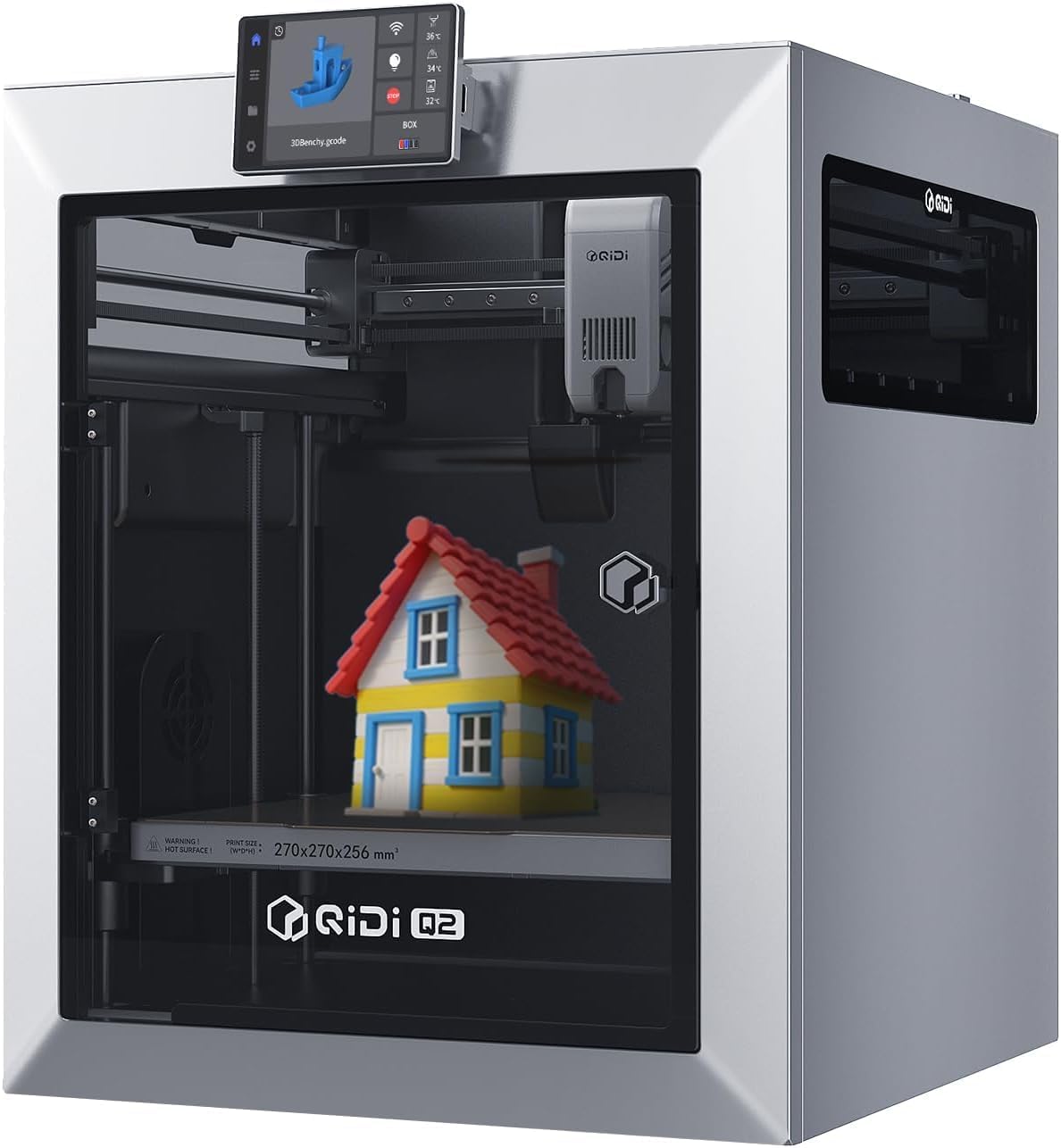
A 4.4 badge on the smallest sample here — 24 ratings — attached to the hottest specification of the ten: 370°C nozzle, 65°C chamber and 600 mm/s.
Pros
- 4.4 rating, joint-highest on this list
- 370°C high-temp nozzle and a 65°C actively heated chamber
- Full-metal CoreXY frame with precision linear rails and 600 mm/s
- Triple filtration: G3 pre-filter, H12 HEPA and activated carbon
- Nozzle acts as the levelling sensor for first-layer accuracy
Cons
- Only 24 ratings behind the 4.4 badge — the smallest sample of the ten
- 16 colours require the QIDI BOX, sold separately
- 23.5 kg and a 52 x 48 x 58 cm footprint
- No two-star or four-star ratings at all in the 100 shown
What buyers actually say
Quoted from customer reviews on Amazon
Verified purchase“The printer is one of the best. Easy to use and to fix any issues you may have along the way. Customer service (Charlie) is brilliant. I have never had such great service before. They responded back to me within 2hrs and solved my issues.”
Verified purchase“Wow.This is an amazing printer and couldn't be easier or more fun to use. Was running for 2 weeks constantly when the hot end blocked, causing a need to replace a few parts and Charlie at Qidi has been amazing in solving my problem, replacing parts under warranty at breathtaking speed to get me back printing. I had my issue on Christmas eve folks, and the responses were still immediate.Cannot say highly enough how impressed I am with this printer, and even more so the customer service. This is a must buy for both reasons. The blockage is not a problem, especially when the flawless service that follows is like this.Love my many gadgets I have made with this printer, and so do my sons and grandsons (star wars blasters) wife and daughters (scrub daddy holders, very funny) friends (x wing big block build) and my gaming set up (controller and headset holders, star wars models, many other useful bits and pieces, oh, and cable management systems for my Christmas lights).Absolutely brilliant.”
The rating is level with the P1S at 4.4, but it rests on 24 ratings rather than 725, which is why a machine with a 370°C nozzle and a 65°C heated chamber finishes tenth. The three buckets shown are telling: 8 one-star, 13 three-star and 79 five-star — no two-star and no four-star ratings at all.
On paper it out-specs almost everything above it. A full-metal CoreXY frame with precision linear rails, 600 mm/s, a 370°C high-temp nozzle for materials like PPS-CF, and a second-generation PTC heated chamber holding 65°C to limit warping. The nozzle doubles as the levelling sensor, so first-layer accuracy does not depend on the bed surface. A triple filtration system — G3 pre-filter, H12 HEPA and activated carbon — addresses fumes, and the chamber is flame-retardant.
The catch is the colour claim. Sixteen colours require the QIDI BOX, which is not in this £429 price; the machine on its own prints one material at a time. Add 23.5 kg, a 52 x 48 x 58 cm footprint and the smallest review base here, and this is a machine for someone who has already decided they need a 65°C chamber — not a first purchase.
Final Verdict
For most homes, the £499 Bambu Lab P1S Combo is the safest buy here: 4.4 stars from 725 ratings, an enclosed body, and the AMS multi-colour unit included rather than sold on top. If you want the cheapest route into the best 3D printers for beginners, the £169 A1 mini carries the lowest one-star share on the list at 7 in every 100, though you give up the enclosure and any published build volume. Families should look at the £179.99 Weefun Tina2C, which arrives assembled at 2.45 kg, and anyone who needs a 65°C chamber or a 370°C nozzle should read the QIDI Q2 and Creator 5 Pro entries before spending four figures. Either way, treat a 16-colour headline as a shopping list rather than a feature: the best 3D printers for beginners are the machines whose numbers survive the second paragraph of their own listing.

Written by
Felipe Iglesias
Founder & Lead Reviewer
Felipe is a computational engineering student who has been working in SEO since he was sixteen. He founded ranked10 and researches every guide on the site.
Related buying guides
All Tech guidesBest Wifi 7 Router 2026: 10 Ranked, and the Numbers Behind the Badges
On a best wifi 7 router, the headline number on the box is normally every band added together, not the speed any single device will see. The TP-Link Archer BE700 is sold as BE15000 with 15 Gbps, yet its own listing states a maximum upstream rate of 7,500 Mbps from a 10,000 Mbps LAN port. The Cudy WR11000 claims 1,500 m² of coverage — roughly 16,000 sq ft — while the other nine routers here claim 2,000 to 2,500 sq ft. Meanwhile, the Mercusys MR47BE is named BE9300 but lists a maximum upstream rate of 3,000 Mbps. At the same time, the two biggest numbers on this page — 15 Gbps and 12.5 Gbps — are a band sum and a port sum respectively. We ranked ten of the best wifi 7 routers sold on Amazon, using four checks we could make in the listings themselves: how far the headline speed sits above the highest figure in the spec table, how many 2.5G ports the box really carries, the rating with a review count behind it, and the price against usable ports. Where a best wifi 7 router's own spec sheet contradicts its headline, we name both numbers.
TechBest Ultrawide Curved Gaming Monitor 2026: 10 Ranked by Spec Sheets
Shopping for an ultrawide curved gaming monitor means reading two descriptions of the same screen: the headline the seller writes, and the specification table underneath it. In the listings below, those two disagree more often than you would expect. The AOC CU34G2XP/BK advertises 1ms GtG in its title while its own Response Time field reads "5 Milliseconds". The AOC CU34G2XPD/BK has a 180Hz title and a first bullet that says "144 Hz refresh rate". The Gawfolk 34-inch lists dimensions of "2.33D x 8.07W x 4.43H metres" — eight metres of desk where you expect about 80cm. The spec table is the part a buyer copies into a comparison, so that is the part we ranked on. Every ultrawide curved gaming monitor below was ranked on two things we could verify: the specification table — refresh rate, response time, resolution, price — and the owner ratings behind each listing. Where a headline and a spec field disagreed, we ranked the spec and said so, with both numbers named.
TechBest OLED TV 2026: 10 Ranked, and Why the Price Ladder Is Upside-Down
If you are shopping for the best OLED TV, the listings are the first thing worth reading closely. The same 65-inch Samsung OLED appears twice on this page. Both entries give 144.4 x 83.2 x 4 cm and 21.2 kg, and both repeat the same five selling points. One costs £1,199, the other £1,499.99 — a £300.99 gap for what the listings describe as the same panel. The size ladder is upside-down elsewhere. Samsung's 55-inch S95F at £1,369 costs £170 more than Samsung's own 65-inch S90F at £1,199. Meanwhile LG's 42-inch C6 at £1,099 is £300 more than LG's own 48-inch C4 at £799. The spec tables also disagree with themselves: Sony's 65-inch BRAVIA 8 page gives 31 kg with its stand but 40.6 kg without, and Philips' 55OLED760 gives 10 kg with the stand against 17.28 kg without. We ranked ten of the best OLED TV models on Amazon on four checks: price against screen size, whether the refresh rate in the bullets matches the spec table, the number of ratings behind each star score, and whether the listed weight with the stand is heavier than without it.
Comments
Reader comments are not checked against the manufacturer's claims above.
No comments yet
Be the first to add something we missed — a price change, a spec that turned out wrong, or how one of these held up.
Leave a comment
No account needed. Own one of these? Tell other readers how it actually performed.