Best Audio Interface 2026: 10 Ranked, and Where the Spec Sheets Disagree
By Felipe Iglesias · Updated
On these ten audio interface listings, the fields buyers lean on hardest are the ones filled in with the least care. The Focusrite Scarlett Solo 4th Gen (£119) prints 'Frequency Response: 96 KHz' in the same block where it declares 'Maximum Sample Rate: 192 KHz', and the highlight block on that same page says 24-Bit/192kHz. The Behringer UMC404HD (£89) repeats the split exactly: 96 KHz in one field, 192 KHz in the next. Meanwhile 'Number of Channels' tells you very little. The Scarlett Solo's own highlight reads '1 XLR Mic Preamp, 1 Hi-Z Instrument Input' underneath a spec sheet claiming 2 channels. The Arturia MiniFuse 2, with a 2 in its own name, lists 'Number of Channels: 1' and a 48 kHz maximum. In short, every figure below is quoted from the listing it belongs to — contradictions included.
We ranked ten of the best audio interface options on Amazon on three checkable criteria: whether the published specs agree with each other, how many ratings stand behind the star score, and price per input. Where two numbers on the same listing disagree, we name both.
At a glance
| # | Product | Price | Rating | Link |
|---|---|---|---|---|
| 1 | Focusrite Scarlett Solo 3rd Gen USB-C Audio Interface | £77.00 | 4.7 | View |
| 2 | PreSonus Studio 24c USB-C Audio Interface | £125.75 | 4.6 | View |
| 3 | Focusrite Scarlett 2i2 4th Gen USB-C Audio Interface | £164.00 | 4.7 | View |
| 4 | Behringer UMC202HD 2x2 USB Audio Interface | £54.70 | 4.5 | View |
| 5 | Behringer UMC204HD 2x4 USB Audio/MIDI Interface | £65.00 | 4.6 | View |
| 6 | Focusrite Scarlett Solo 4th Gen USB-C Audio Interface | £119.00 | 4.5 | View |
| 7 | Audient EVO 4 USB-C Audio Interface | £89.00 | 4.3 | View |
| 8 | Arturia MiniFuse 2 USB-C Audio & MIDI Interface | £104.00 | 4.6 | View |
| 9 | Behringer UMC404HD 4x4 USB Audio/MIDI Interface | £89.00 | 4.6 | View |
| 10 | Universal Audio Volt 1 USB Audio Interface | £107.00 | 4.5 | View |
Free WhatsApp group
Amazon deals, around the clock
Price drops and lightning deals posted the moment they go live. No spam, leave whenever you like.
Join the groupFree to join · Leave any time
Focusrite Scarlett Solo 3rd Gen USB-C Audio Interface
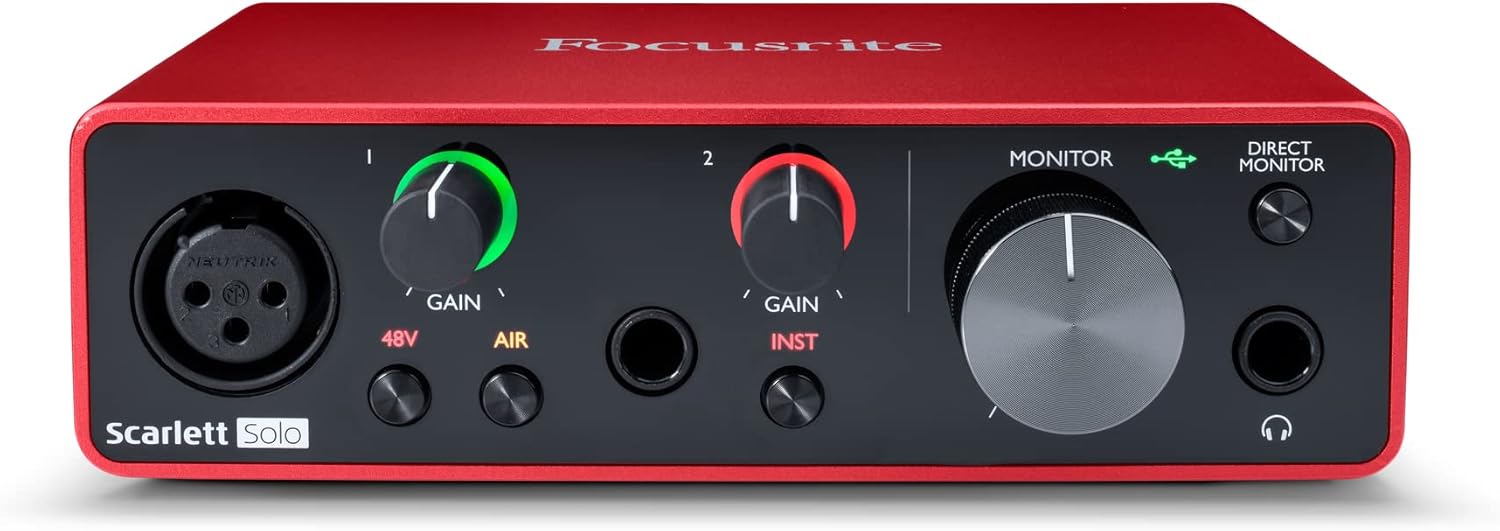
The best-supported audio interface here: 29,034 ratings at 4.7, and two sample-rate fields that agree with each other.
Pros
- 29,034 ratings at 4.7 — by far the largest review base of the ten
- 192 KHz appears in both the frequency response and maximum sample rate fields, so nothing contradicts itself
- 56dB gain range plus a switchable Air mode on the mic preamp
- 24-bit/192kHz converters, two balanced outputs and a high-powered headphone output
- £77 — £42 cheaper than the 4th Gen Solo at £119
Cons
- 1 XLR mic preamp and 1 instrument input, despite a channel field reading 2
- No MIDI I/O listed; inputs are XLR and instrument only
- Operating system field lists Linux and macOS but omits Windows, which the highlight claims
- One mic preamp rules out recording two microphones at once
What buyers actually say
Quoted from customer reviews on Amazon
Verified purchase“This is an excellent piece of equipment. Great build quality and audio quality is way beyond what is humanly discernible. Much more robust with respect to dock undock than another audio interface I have. But really wish I had bought the Scarlett 2i2 or 4i4.”
Verified purchase“Best budget audio interface hands down performance amazing definitely worth the price (I run vst on windows my laptop is high end my old audio interface was I'm assuming bottle necking the computer I run kontakt pianos usually at 128 buffer size little to no latency great purchase oh and it has its own audio driver no need for asio4all lol”
This tops the list on volume of evidence. 29,034 ratings at 4.7 is roughly six times the review base of anything else here, and it is one of the few audio interface listings in this group whose sample-rate fields match: 192 KHz under Frequency Response, 192 KHz under Maximum Sample Rate. The highlight block — 24-Bit/192kHz, 56dB gain range, Air mode — lines up with that.
In practice, the single XLR input carries a 56dB gain range and a switchable Air mode for added presence on vocals. The second input is Hi-Z for guitar and bass, with a high-headroom design the listing says avoids clipping. Two balanced outputs and a high-powered headphone output handle playback, and the box weighs 349 g and runs off USB-C.
That said, do not buy it for a two-person podcast. The highlight reads '1 XLR Mic Preamp, 1 Hi-Z Instrument Input' while the channel field says 2 — those two figures are describing different things. No MIDI I/O appears in the listed inputs, and the operating system field names Linux and macOS while the highlight also claims Windows, so check your platform before ordering.
PreSonus Studio 24c USB-C Audio Interface

Two XMAX-L mic preamps and a full software bundle for £125.75, with 192 KHz printed in both sample-rate fields.
Pros
- Two XMAX-L mic preamps for £125.75
- 192 KHz in both the frequency response and maximum sample rate fields
- XLR, 1/4 inch and RCA inputs accepted
- Ships with Studio One Artist and Ableton Live Lite as a bundle
- 2-year manufacturer warranty stated in the listing
Cons
- No MIDI I/O anywhere in the listed connections
- 2 in / 2 out, so a four-mic session is out
- Country-of-origin field reads Germany, which does not match the brand's usual listings
- Software bundle adds setup time if you already own a DAW
What buyers actually say
Quoted from customer reviews on Amazon
Verified purchase“After nearly two months with the PreSonus Studio 24c replacing my broken Zoom U-24, I can confidently say this interface delivers where it matters most whilst revealing some frustrating design choices that hold it back from perfection.The Good StuffThe sound quality genuinely impressed me. Those XMAX-L preamps aren't marketing fluff - they're noticeably cleaner than what I had before, with enough headroom to handle my dynamic microphone without needing a cloudlifter. For content creation work like voiceovers and streaming, the clarity is spot-on. The 24-bit/192kHz capability means my recordings have that professional sheen that makes editing a pleasure rather than a chore.USB-C connectivity feels properly modern, and the bus-powered design means one less wall wart cluttering my desk. The metal construction feels reassuringly solid - this isn't going to fall apart if you're lugging it between locations.Where it gets frustratingThe control layout is genuinely maddening. Five knobs crammed together on the front panel with the phantom power button squeezed in between - it's like they designed it for people with fairy fingers. I've accidentally knocked settings whilst reaching for the mix control more times than I care to admit. The headphone jack being round the back is another head-scratcher for anyone who actually uses headphones regularly.Against the competitionHaving researched extensively, the Focusrite Scarlett 2i2 consistently gets more expert recommendations, and I can see why - its layout is far more sensible. However, the Studio 24c has proper MIDI I/O, which the Scarlett lacks. For the same money, you're getting more connectivity options, even if they're packaged less elegantly.The Behringer alternatives cost less but reviews consistently mention more electronic noise. At this price point (around £70 used), the PreSonus hits a sweet spot between the budget options and the premium interfaces.The software bundleStudio One Artist is genuinely useful - far better than the basic DAWs usually bundled with interfaces. I didn't bother with most of the other included software, but having a proper DAW included adds real value.Bottom lineThis interface does exactly what I bought it for without fuss. The sound quality justifies the price, the build feels professional, and it's been completely reliable. Yes, the control layout is annoying, and yes, there are more user-friendly options available. But if you can live with reaching round the back for headphones and being careful with those cramped controls, you're getting excellent audio performance that'll serve you well for years.It's not the most elegant solution, but it's a proper tool that gets the job done without breaking the bank.After using various budget interfaces over the years, this strikes the right balance between price and performance for someone who needs clean audio without the premium price tag. Just wish they'd sort out that control layout in the next revision.”
Verified purchase“I've hooked mine up via a USB switch so I can use it with a Pi5 running Raspberry Pi OS Bookworm or a tower PC running Kubuntu LTS, and it runs flawlessly with both. No jumping through hoops to get it working as the Linux kernel immediately recognised it on both computers.Sound quality is as amazing as the specs imply, and noise is virtually non-existent when driving the inputs with line level signals. It's capable of driving my 64 Ohm Sennheiser HD280 Pro headphones nicely up to an unbearably loud volume level with no audible distortion, so no complaints there either.I got mine when it was on sale recently for just £74 and consider this to be outstanding value for money for the level of performance it delivers. Overall performance matches that of some other manufacturer's offerings costing over twice as much, so definitely give PreSonus a look if you haven't already.”
Two mic preamps is the headline, and the spec sheet backs it: 2 channels, XLR, 1/4 inch and RCA inputs, and 192 KHz in both the frequency response and maximum sample rate fields. 4,514 ratings at 4.6 is the third-deepest base on this page.
In practice, the two XMAX-L preamps cover vocals and instruments, with high-headroom instrument inputs for guitar and bass. Per-input metering shows your levels, and a Mix control blends the analogue inputs against computer playback while you track. It is bus-powered over USB-C, weighs 454 g, and ships with Studio One Artist and Ableton Live Lite, which is worth noting if you own no DAW yet.
However, no MIDI I/O is listed, and 2 in / 2 out is the ceiling. If you are shopping for an audio interface for podcasting with two hosts, this meets the minimum. If you need four microphones for a drum kit, it does not, and the £89 Behringer UMC404HD has four combination XLR/TRS inputs. The country-of-origin field reads Germany, which is an oddity in a PreSonus listing rather than a specification.
Focusrite Scarlett 2i2 4th Gen USB-C Audio Interface

The priciest pick at £164, and the only listing here that names Auto Gain and Clip Safe.
Pros
- Auto Gain and Clip Safe — features no other listing in this group names
- 120dB dynamic range, the highest figure quoted here
- 2 mic preamps and 2 Hi-Z instrument inputs
- Pro Tools Intro+, Ableton Live Lite, Cubase LE and Hitmaker Expansion included
- 192 KHz maximum sample rate
Cons
- £164 is the highest price of the ten
- Frequency response field reads 20,000 Hz, which is bandwidth rather than a conversion rate
- Operating system field lists Windows only, despite the software list naming GarageBand and Logic Pro
- Costs £75 more than a four-input Behringer while offering half the inputs
What buyers actually say
Quoted from customer reviews on Amazon
Verified purchase“I've been using this with my Presonus Eris 3.5 monitors, Eris Sub 8BT, and an SM7B through a Cloudlifter, and it's been flawless. Everything worked straight away with no driver headaches, and it's been fully compatible with all my gear. The preamps are clean, latency is extremely low, and the recording quality is excellent. It has more than enough gain for my setup, and the inputs and outputs cover everything I need. For the price, the value for money is outstanding—you get professional-quality performance without spending a fortune. I can definitely see why the Scarlett range is so popular. Highly recommended :)”
Verified purchase“Seems fine, preamps are clean and gives a little more gain over my previous Behringer UMC22.XLR inputs are on the back which is a huge bonus considering they never get unplugged, and always seem to be in the way on under desk mounted units.Having all the controls on the front, and controllable from software is good. No more reaching around the back to toggle phantom power... (*cough* behringer *cough*)Meets my needs well, which also aren't too much from an audio interface :)”
At £164 this is the most expensive item on the list, backed by 2,626 ratings at 4.7. It is also the only listing here that names Auto Gain and Clip Safe, which set your level for you and stop a take clipping. Its two sample-rate figures do not contradict each other, although the frequency response field reads 20,000 Hz — that is audio bandwidth, the top of human hearing, not the 192 KHz conversion rate quoted beside it.
Crucially, you get 2 mic preamps and 2 Hi-Z instrument inputs, a 120dB dynamic range, and Air mode on both channels. The converters are described as the same ones used in Focusrite's flagship interfaces. The software covers Pro Tools Intro+, Ableton Live Lite, Cubase LE and the Hitmaker Expansion, which is a lot of included tooling for the money.
The catch is price per input. £164 buys 2 in / 2 out; the £89 Behringer UMC404HD buys 4 combination XLR/TRS inputs for £75 less. Meanwhile the operating system field lists Windows only, while the supported software list names GarageBand and Logic Pro, so macOS support is implied rather than stated. If you record alone, one source at a time, you are paying for headroom you may never use.
Behringer UMC202HD 2x2 USB Audio Interface

The budget audio interface of the group at £54.70, with 3,378 ratings behind it.
Pros
- £54.70 — the lowest price of the ten
- 3,378 ratings at 4.5, the second-deepest review base here
- 192 KHz in both the frequency response and maximum sample rate fields
- Two combination XLR/TRS inputs with +48V phantom power
- Switchable zero-latency direct monitoring for tracking
Cons
- No MIDI I/O, no RCA playback and no analogue inserts
- Only 2 in / 2 out, so multi-mic sessions are out
- No included DAW is listed in the bundle
- £10 more buys the UMC204HD with four outputs instead of two
What buyers actually say
Quoted from customer reviews on Amazon
Verified purchase“I had my doubts about this as the technical information doesn't state any noise figures. I'm using it mainly for headphone output and have done some very unscientific tests. With nothing playing, I can't tell if my headphones are plugged in or not, theres no noise I can detect at all. Though my ears are probably not the best.”
Verified purchase“Great audio interface! Easy to set up, sounds great with guitar rig 7 virtual amps. Supports Linux and windows. Not tried Mac. Some people say it feels low quality but I personally like the feel”
This is the budget audio interface here: £54.70, with 3,378 ratings at 4.5, the second-largest review base on the page. Frequency response and maximum sample rate both read 192 KHz, so those two fields agree.
On the desk, two combination XLR/TRS inputs take microphones or instruments, a +48V switch feeds condenser mics, and 1/4 inch TRS outputs feed monitors. Direct monitoring is switchable and described as zero-latency, which matters when you track a vocal against a backing track. Connection is USB 2.0 and the unit weighs 540 g.
Even so, 2 in / 2 out is all you get. There is no MIDI and no RCA playback, and no analogue inserts for outboard gear. The UMC204HD at £65 adds RCA playback and two inserts for £10 more. Buy this one only if two channels is genuinely enough for how you record.
Behringer UMC204HD 2x4 USB Audio/MIDI Interface

£65 for 2 ins and 4 outs, including two analogue inserts the cheaper Behringer lacks.
Pros
- £65 for 2 inputs and 4 outputs
- Two analogue inserts for outboard compressors, gates or EQ
- Playback via both 1/4 inch TRS and RCA
- 192000 Hz frequency response and 192 KHz maximum sample rate agree
- 2,312 ratings at 4.6
Cons
- Product name says Audio/MIDI, but no MIDI I/O is listed in the connections
- Only 2 mic preamps
- No included software bundle is stated
- £24 less than the UMC404HD, which doubles the input count
What buyers actually say
Quoted from customer reviews on Amazon
Verified purchase“This i/f worked out-of-the-box with Linux Mint. With Rosegarden the midi worked straight off. The audio input had to be selected using QJackCtl, but then it was all up and running. It seems very well built and I would recomend it.”
Verified purchase“This is a highly rated interface. So far it's living up to my expectations. Crucially it's class compliant which means that it worked with Apple workstations and iPads and iPhones right out the box. Only Windows needs drivers.”
For £10 more than the UMC202HD you get double the outputs: 2 in / 4 out at £65, with 2,312 ratings at 4.6. Both sample-rate fields read 192000 Hz and 192 KHz, so this listing is internally consistent where the UMC404HD is not.
The two combination XLR/TRS inputs run through Midas-designed preamps. Playback covers both 1/4 inch TRS and RCA, and there are 2 analogue inserts for compressors, gates or EQ. This USB audio interface weighs 620 g and is bus-powered over USB 2.0.
Worth noting: the product name says Audio/MIDI, but no MIDI I/O appears anywhere in the listed inputs or connections, only XLR and line. Check that before buying if MIDI is the reason you clicked. And if you need four mic preamps rather than two, this is not the box — that is the UMC404HD.
Focusrite Scarlett Solo 4th Gen USB-C Audio Interface

The listing that shows the problem: 96 KHz in one spec field and 192 KHz in the next, on the same page.
Pros
- 120dB dynamic range and Air mode on the mic preamp
- USB-C connection with the Easy Start setup tool
- Same software bundle as the more expensive 2i2: Pro Tools Intro+, Ableton Live Lite, Cubase LE, Hitmaker Expansion
- 2,725 ratings at 4.5
- Weighs 408 g, the lightest Focusrite here
Cons
- Frequency response field reads 96 KHz against a 192 KHz maximum sample rate — the listing contradicts itself
- One mic preamp and one instrument input, despite a channel field reading 2
- No product warranty field listed, while the 3rd Gen states 3 years
- £42 more than the 3rd Gen Solo for the same input count
What buyers actually say
Quoted from customer reviews on Amazon
Verified purchase“Easy to set up, comprehensive list instructions online, including loads of videos. The sound quality is good. Keeps the tone with no unwanted distortion or clipping. Well worth £109. Only gripe is the connecting cable supplied isn't only USBC on one end so you'll need an adapter for your MacBook.If you go to my website at simoneyre.uk then go to Bonus Content and play song 9 (Renegade) or 10 (Hold my Beer) which were recorded using this kit.Would buy again.”
Verified purchase“A really great soundcard, lots of inputs, excellent latency, does everything you need with lots of routing options in the mixer too. Really impressed with the sound quality recording, perfect home studio sound card.”
£119, with 2,725 ratings at 4.5. This is where the spec sheet stops agreeing with itself: 'Frequency Response: 96 KHz' sits directly above 'Maximum Sample Rate: 192 KHz', and the highlight block on the same page states 24-Bit/192kHz. Two of those three numbers cannot both be right.
In use, you get one XLR mic preamp and one Hi-Z instrument input, a 120dB dynamic range, Air mode and USB-C. The Easy Start tool walks you through setup. Weight is 408 g, and the software bundle matches the 2i2's: Pro Tools Intro+, Ableton Live Lite, Cubase LE and the Hitmaker Expansion.
By contrast with the 3rd Gen Solo at £77, you are paying £42 more for the newer generation, and this listing carries no product warranty field at all while the 3rd Gen states a 3-year warranty. The channel field says 2; the highlight says 1 mic preamp and 1 instrument input. If you need two microphones, neither Solo will do it.
Audient EVO 4 USB-C Audio Interface

A 2 in 2 out audio interface with Smartgain, but the lowest rating in this group at 4.3.
Pros
- Smartgain sets input levels automatically
- Two mic preamps with 58dB of gain
- Discrete JFET instrument input
- Loopback function for streaming and screen recording
- 96 KHz in both sample-rate fields, so no internal contradiction there
Cons
- 4.3 from 1,639 ratings — the lowest score in this ranking
- 96 kHz maximum sample rate, not 192 kHz
- Bullet points say 360 g and 140 x 55 x 60 mm while the spec table says 600 g and 6.7 x 14 x 6.7 cm
- Only 2 in / 2 out
What buyers actually say
Quoted from customer reviews on Amazon
Verified purchase“I know this is aimed mostly at musicians, but I bought this first and foremost for gaming / streaming / podcasting and I am generally over the moon with the sound reproduction.Using it with a Shure MV7, the SM7B's little brother, but much like the SM7B, the MV7 is a gain hungry mic that requires a minimum of 55dB of gain from your interface for usable sound. This is just shy of the Evo 4's 60dB of supplied gain and to get a usable sound for Discord and good recording levels for my podcast, the Evo 4 needs the gain to be to be cranked up to the max. This is also how the Evo 4 sets the gain if I use the auto gain function with this specific microphone. Not ideal, but not a deal breaker as adding an in-line mic booster (I went for the Klark Technik CT1 - +25dB of gain for £40) has given me enough headroom to turn my mic up during my streams and gaming sessions as necessary.As for output sound, pairing this with a pair of DT770s (80ohm) has suddenly given me the ability to hear colours. I'm unstoppable in Halo Infinite, I can hear enemy Spartans breathing from across the map. But in all seriousness, I don't know if this will make footsteps easier to hear for you, but as for general improvement and offering a more rich, immersive and higher quality of sound, I really can't complain for the price. It's actually quite impressive.I will say, however, that if you are looking for live sound processing such as adding a noise gate or limiter to your voice or general EQing to make yourself sound better on stream or in your gaming session, it is not possible with this device / supplied Evo 4 software. Bear in mind, that the primary function of the Evo 4 is for recording and as such, Audient have assumed that you will add those effects in post production.”
Verified purchase“Amazing interface! The Smart Gain feature is an absolute win. This interface lets you get to recording/playing with very little messing around. The audio quality is superb and the bundled software/plugins that you can redeem with purchase are cool.2 xlr inputs and 1 instrument lineMax 4096 buffer size and 96KHz sample rate.In/out latency is around 6.7/8.3msOnly downside for me is the plastic shell, it doesn't feel premium, but for the price this is a very solid choice given the features.Would recommend if your after a user friendly interface that doesn't get in the way of creating something.”
This is the only 2 in 2 out audio interface in the group rated 4.3 — the lowest of the ten — from 1,639 reviews. Its specs are consistent, though: 96 KHz in both the frequency response and maximum sample rate fields.
Smartgain sets input levels for you, which is the feature most home studio audio interface buyers notice first. The two mic preamps offer 58dB of gain, there is a discrete JFET instrument input, and a loopback function routes computer audio back into a stream, which is handy for podcasting and screen recording. Power and data both run over USB-C, and it weighs 360 g according to the bullet points.
At the same time, 96 kHz is the ceiling here, not 192. And the listing contradicts itself on physical size: the bullet points say 360 g and 140 x 55 x 60 mm, while the spec table says 600 g and 6.7 x 14 x 6.7 cm. Check the footprint before you buy a stand or a desk shelf for it.
Arturia MiniFuse 2 USB-C Audio & MIDI Interface

Named 2, listed as 1 channel, and capped at 48 kHz in the spec table.
Pros
- 5-year warranty, the longest stated in this ranking
- MIDI I/O for synths, controllers and drum machines
- Software bundle built around Ableton Live Lite with tutorials
- 1,180 ratings at 4.6
- Compact desktop housing
Cons
- Spec table says 1 channel for a product named MiniFuse 2
- 48 KHz maximum sample rate, the lowest here
- No frequency response field listed at all
- Supported software field names Mac OS only, while the operating system field lists Windows and macOS
What buyers actually say
Quoted from customer reviews on Amazon
Verified purchase“I was looking for a good quality interface for my laptop so I could record away from the studio, and for playing live gigs with software instruments. It had to be small (hence easily portable), with USB and MIDI connections, and have a loopback facility so I could record what I'm hearing back into my DAW. and all this at a reasonable price. The MiniFuse 2 ticked every box - in fact it was the only one I could find that did. Oh, and it's very cute too. Registering the unit with Arturia also gives access to additional software plugins, if you should want them. Highly recommended.”
Verified purchase“Great audio interface that works well with a MacBook Pro 2020.Hooks up decent monitors and sounds good. Great to have an accessible headphone port that is easily controlled.Connects an Arturia MiniLab3 midi keyboard and doesn't seem to have any lag. Input from external audio is also very good and clear”
The name says MiniFuse 2. The spec table says 'Number of Channels: 1' and 'Maximum Sample Rate: 48 KHz', and there is no frequency response field at all. The listing carries 1,180 ratings at 4.6 and the price is £104.
What the listing does describe is flexible: microphone and instrument inputs, MIDI I/O for synths and controllers, and a software bundle built around Ableton Live Lite with beginner tutorials and ready-made song projects. It comes with a 5-year warranty, the longest stated anywhere in this group.
However, that 48 kHz figure is the reason to pause. If you track at 96 kHz or 192 kHz, this is not the box for you. If you need more than one input running at once, the channel field's 1 is a warning. Either way, do not buy on the spec table alone here, because the name and the numbers disagree.
Behringer UMC404HD 4x4 USB Audio/MIDI Interface

Four Midas preamps for £89 — the cheapest route to four XLR inputs, but the thinnest review base at 552.
Pros
- Four combination XLR/TRS inputs for £89
- Four Midas-designed mic preamps
- MIDI I/O included, unlike the UMC202HD and UMC204HD
- 192 kHz resolution claimed in the product bullets
- 4.6 average from 552 ratings
Cons
- Frequency response field reads 96 KHz against a 192 KHz maximum sample rate
- Only 552 ratings — the smallest review base in this ranking
- 1.2 kg and 41.4 cm deep, so it needs desk space
- No included software bundle is stated
What buyers actually say
Quoted from customer reviews on Amazon
Verified purchase“Had a need to upgrade from a M-Audio air 192 6 usb interface 2-in/2-out to the Behringer UMC404HD which is a 4-in/4-out usb midi interface. Snapped this up from Amazon Warehouse who were offering it with around 30% discount as it was allegedly badly scratched. But it wasn't; just the packaging was in very poor condition. It worked straight out of the box being recognised immediately by a MacBook Pro. Featuring the usual 24 bit/192 kHz resolution, it comes with 4 Midas mic preamps and has 48V phantom power.”
Verified purchase“Four XLR or 6.3mm Jack inputs with a variety of Jack or XLR outputs too. Work perfectly with Ableton Live 11. Easy to manage volume control. Has a nice weight to the device. 100% recommend this for anyone who produces music/video and uses a variety of inputs and outputs.”
Four Midas-designed mic preamps for £89. That is the pitch, and the spec sheet repeats the same contradiction as the Solo 4th Gen: 'Frequency Response: 96 KHz' alongside 'Maximum Sample Rate: 192 KHz', with 192 kHz resolution claimed in the bullets.
In practice, four combination XLR/TRS inputs plus MIDI I/O make this the pick for tracking a drum kit or a four-piece band on a tight budget. The chassis is the biggest here — 41.4 cm deep and 1.2 kg — so it wants real desk space rather than a laptop bag.
That said, 552 ratings at 4.6 is the thinnest review base of the ten, less than a fifth of the UMC202HD's. And if you only ever record one source at a time, four inputs is £34 more than you need; the UMC202HD covers that for £54.70.
Universal Audio Volt 1 USB Audio Interface

One preamp, a Vintage Mic Preamp mode and a deep plug-in bundle at £107.
Pros
- Vintage Mic Preamp mode for colour on vocals and instruments
- Deep software bundle: Ableton, Melodyne, UJAM Virtual Drummer, Marshall, Ampeg, plus a 30-day UAD Spark trial
- 192000 Hz and 192 KHz in both sample-rate fields
- Works with Mac, PC, iPad and iPhone
- 713 ratings at 4.5
Cons
- Channel field reads 2, but the model name and the preamp count say one input
- Audio Input field reads USB, which is a connection type rather than an input
- Fourth bullet is a cross-border shipping disclaimer, not a spec
- £107 for a single input, when £125.75 buys two preamps
What buyers actually say
Quoted from customer reviews on Amazon
Verified purchase“Excellent quality. The care taken to make it is shown in the finish and even the quality of the packaging- A company that pays attention to detail. Works straight out of the box with my Apple Studio M2 Max - no fuss and immediately recognized unlike others that are cheaper. Type C connector is good and latest model.”
Verified purchase“Great Interface works right outside of the box quick setup with UA Connect software very little latency and my CPU isn't even that good it's very compatible and very worth for the money.”
The Volt 1 is a single-preamp audio interface for recording at £107, with 713 ratings at 4.5. Its channel field says 2, the same loose use of that field you see on the Arturia. Both sample-rate fields read 192000 Hz and 192 KHz, so those agree.
The drawing card is Vintage Mic Preamp mode, which colours vocals and instruments. The bundle is unusually deep: Ableton, Melodyne, UJAM's Virtual Drummer, Marshall and Ampeg among others, plus a 30-day UAD Spark trial. It runs on Mac, PC, iPad and iPhone, weighs 544 g, and connects over USB.
Either way, one input means one source at a time. The 'Audio Input' field reads 'USB', which is a connection type rather than an input, so read the bullets for the real picture. The fourth bullet is not a specification at all: it is a cross-border shipping disclaimer warning that international products may differ from local ones. If you want two mic preamps, the PreSonus Studio 24c is the better fit.
Final Verdict
Two picks cover most people. For one mic and one guitar, the £77 Focusrite Scarlett Solo 3rd Gen has the deepest rating base here — 29,034 reviews at 4.7 — and its two sample-rate fields agree with each other. If you need a home studio audio interface with two mic preamps, the PreSonus Studio 24c at £125.75 gives you two XMAX-L preamps and 192 KHz in both sample-rate fields. For four microphones at once, the £89 Behringer UMC404HD is the cheapest route, though its review base is the thinnest at 552; either way, treat its 96 KHz frequency-response field as a typing error, not a ceiling. And if you are starting from nothing, the £54.70 Behringer UMC202HD is the best audio interface for beginners on price, with 3,378 ratings behind it.

Written by
Felipe Iglesias
Founder & Lead Reviewer
Felipe is a computational engineering student who has been working in SEO since he was sixteen. He founded ranked10 and researches every guide on the site.
Related buying guides
All Tech guidesBest DAB Radios 2026: 9 Ranked, and the 30W Claim That Doesn't Add Up
A radio that claims 30 W of output and a battery that lasts over 10 hours is claiming something the arithmetic will not support. The AZATOM Spitalfields 2 lists 30 W maximum speaker output; the same listing says its 2,000 mAh battery runs for over 10 hours. A 2,000 mAh cell at the 3.7 V that appears in these spec sheets holds about 7.4 Wh, so ten hours averages 0.74 W. At a genuine 30 W, that pack would be empty in about 15 minutes. That is the problem with shopping for the best DAB radios on wattage alone: the Mycket, at £29.99, declares 5 W against a 2,200 mAh battery and 12 hours — around 0.68 W average, the same order of magnitude as the AZATOM. The '30 W' and the '5 W' are not the same measurement, which is why a £29.99 radio looks six times more powerful than a £44.95 one. We ranked nine of the best DAB radios on Amazon on preset count, power source, battery type, display and how well each listing's own numbers agree with each other. Every one of the dab radios reviewed here was checked against its spec table, not against its marketing headline. Price runs from £21.59 to £99.00, and the most expensive model is not the one with the biggest wattage claim.
TechBest CPU Air Cooler 2026: 10 Ranked, One Sold Twice at Two Prices
The same cooler appears twice in this best cpu air cooler shortlist, at two different prices. The Thermalright Peerless Assassin 120 SE is listed at £29.99 with 3,133 ratings and again at £35.90 with 307 ratings — £5.91 more for a name that is identical. The two listings cannot both be right about the hardware: one records 12 Volts and 265 watts, the other 5 Volts and 3 watts. Those watts are not power draw. The cooler's own fan is a 4-pin, 12-volt part moving 66.17 CFM, and the 265 W sitting in the Wattage field is the thermal capacity quoted in the bullet text, not the current the product consumes. The pattern repeats. be quiet! sells two Pure Rock Pro 3 coolers at the same £41.98, yet one lists 3.6 watts and the other 250 watts. Cooler Master's MasterLiquid describes a 394 mm radiator in its copy while its own dimensions field says 15.7 cm long. We ranked ten of the best cpu air cooler options on Amazon on three criteria: the published price and rating counts, the socket support each listing actually states, and whether a product's own specifications agree with each other.
TechBest Case Fans 2026: 9 Ranked by What a Fan Actually Costs
Almost nothing in this list of the best case fans is sold as a single fan, so the price on the page is not the price of a fan. The £21.49 ARCTIC five-pack works out at £4.30 a fan. The £18.66 ARCTIC pack works out at £3.73. Meanwhile the £18.99 be quiet! Light Wings buys you one fan. The same be quiet! Light Wings 120mm PWM high-speed fan is listed twice — £18.99 on its own and £44.99 as a three-pack with an ARGB hub. That is £15.00 a fan, and £11.98 less than three singles. The noise numbers cannot be lined up either: ARCTIC quotes 0.3 sones on both its five-packs, Noctua quotes 25.1 dB(A), be quiet! 31 dB and Corsair 36 dB. As a result the spec tables are not all in the same unit, and Noctua is the only brand here quoting airflow in cubic metres rather than CFM. We ranked nine of the best case fans on Amazon on three measures a buyer can check: the price divided by the number of fans in the box, the specification each manufacturer actually publishes, and the review count behind the star rating. There is no test bench here. Where a listing contradicts itself — and several do — we say so, with both numbers.
Comments
Reader comments are not checked against the manufacturer's claims above.
No comments yet
Be the first to add something we missed — a price change, a spec that turned out wrong, or how one of these held up.
Leave a comment
No account needed. Own one of these? Tell other readers how it actually performed.