Best Wireless Charger 2026: What 15W Actually Means
By Felipe Iglesias · Updated
A wireless charger does not have a speed. It has a speed for your phone, fed by your adaptor, and the number on the box is the one that happens in the best of those combinations. The listings that understand this are worth reading closely and there are two of them here, both from Amazon's own brand. The 15W pad at number five states three outcomes in a single bullet — 15 watts on LG phones, 10 on Samsung, 7.5 on iPhones — and then explains that the 15 requires a 30-watt PD adaptor of at least 9 volts and 2 amps, which is not included. The 10W stand at number six goes one further and adds a fourth figure: with a standard 5V/2A adaptor, it produces 5 watts. One product, four speeds, and the adaptor you already own decides which you get.
Against that, the rest of the ranking is a set of contradictory fields. The Anker 313 at number two is titled 10W Max and records its wattage as 7.5 watts, its input voltage as 7.5 volts — the wattage copied into the row below — and its plug type as a North American two-pin, on a listing sold in Britain for a charger that has no plug at all. The Amazon Basics stand at number six repeats that last error in its own fields. The £6.99 pad at number nine states 230 volts of mains AC as its input and then multiplies its own output fields to two and a half watts, against a 15-watt claim: a factor of six, on the page. The pad at number ten multiplies correctly to fifteen, at 5 volts, which is the wrong voltage for it to happen. And the two magnetic chargers at numbers seven and eight promise iPhones 15 watts without the certification that Apple requires to deliver it.
The thing that decides whether any of this matters is the cable, and the ranking reveals how little attention it gets. The Anker PowerWave Pad at number one is the most-reviewed product on this entire site, with 138,064 ratings, and it connects over Micro USB — a connector most drawers stopped accumulating years ago. The Anker 313 at number two, with 106,173 ratings, uses USB and asks for a 9V/2A adaptor that is not in the box. The INIU at number three is the only listing in the ranking whose power-source field says induction, which is what wireless charging actually is, where every other listing says corded electric, which describes the cable running to the pad. And the INIU also credits the technology to AirFuel, a standard that competes with Qi, which is the same species of error as the misspelled chip and the barcode in the model field found elsewhere on this site: text written by somebody who had heard of the thing and reviewed by nobody who knew what it was.
So choose by format first, because it changes how the product is used, not how fast it is. A stand holds the phone upright so the screen stays readable and doubles as a bedside clock; a flat pad lets the phone lie down and asks you to place it on the coil, which is the most common complaint in the negative reviews here; a magnetic puck is the only one that positions itself, and it is worth having for a car or a bedside table. Then check the voltage: a charger quoting 5 volts in and 5 volts out cannot deliver fast charging to a phone, whatever the headline says, because that negotiation happens at 9 volts. Then read the adaptor requirement, since the top speed on every product here depends on one you may not own — and prefer the listing that tells you so in its title. Then weigh the sample, because the failure mode of a cheap charger is not dramatic; it is a coil that stops working, and distribution is what shows it. And ignore the plug-type field entirely: two of these ten listings name a North American plug for a device with no plug at all.
At a glance
| # | Product | Price | Rating | Link |
|---|---|---|---|---|
| 1 | Anker PowerWave Pad Wireless Charger 10W, Qi-Certified | £10.99 | 4.3 | View |
| 2 | Anker 313 Wireless Charger Stand 10W Max, Qi-Certified | £12.98 | 4.4 | View |
| 3 | INIU Wireless Charger Stand 15W with Self-Adaptive LED | £13.89 | 4.3 | View |
| 4 | NANAMI Wireless Charging Pad 10W Max with Non-Slip Rubber | £12.99 | 4.2 | View |
| 5 | Amazon Basics 15W Qi Wireless Charging Pad, USB-C, No Adapter | £10.99 | 4.1 | View |
| 6 | Amazon Basics 10W Qi Wireless Charging Stand, USB-C, No Adapter | £14.69 | 4.1 | View |
| 7 | Magnetic Wireless Charger for iPhone, 15W Mag-Safe Style, Dual Ports | £11.98 | 4.1 | View |
| 8 | Magnetic Wireless Charger 15W for iPhone, White, No Adapter | £8.98 | 4.2 | View |
| 9 | Wireless Charging Pad 15W Claim with 4 Charging Modes | £6.99 | 4.1 | View |
| 10 | Wireless Charging Pad 15W for iPhone and Samsung, Model W8 | £5.94 | 4.0 | View |
Free WhatsApp group
Amazon deals, around the clock
Price drops and lightning deals posted the moment they go live. No spam, leave whenever you like.
Join the groupFree to join · Leave any time
Anker PowerWave Pad Wireless Charger 10W, Qi-Certified

The deepest sample of any product on this site — 138,064 ratings at 4.3 stars — for £10.99, on a pad that charges over Micro USB.
Pros
- 138,064 ratings at 4.3 stars, the deepest sample on this site
- £10.99 with a Qi certificate and an honest 10W ceiling
- Charges earbuds as well as phones
- Over 50 million users for the range, per the listing
- Flat pad: nothing to snap or hinge
Cons
- Micro USB, not USB-C, in 2026
- A pad, so the phone must be centred to charge
- 10W maximum is now the middle of the market
- 5 per cent of its 138,064 ratings are one-star
Why it is number 1
- Ratings
- 4.3 from 138,064 The deepest sample of any product on this site
- Wattage as listed
- 10 watts The title says 10W Max and the field agrees
- Connector
- Micro USB Type B A legacy cable in a USB-C market
- Power source
- Corded electric A cable to the pad, then induction
- Format
- Flat pad Charges a phone lying down
- Price
- £10.99 The cheapest Anker charger here
What buyers actually say
Quoted from customer reviews on Amazon
Verified purchase“It does exactly what it says, though even with silicone case the phone can easily slip off.”
Verified purchase“Perfect charger for phone, so easy to dock phone and looks good too. Great quality as you would expect from Anker.”
The most-reviewed wireless charger anywhere, and the most-reviewed product on this site by a factor of one and a third: 138,064 ratings at 4.3 stars, 65 per cent five-star and 5 per cent one-star, for £10.99, in a flat pad format with a Qi certificate and a stated maximum of 10 watts. Nothing in its specification is inflated — the wattage field and the title agree, which is more than can be said for half the listings in this ranking.
What its specification does reveal is age. The connector type is Micro USB Type B, not USB-C, which places this pad in the older generation of accessories: it works, it charges, and if you own the right cable you will never notice, but it is the one product here that asks for a cable you may not have. For a pad bought in 2026 that is a small tax, and its own bullet answers the objection in the language of scale rather than specification: enjoyed by over 50 million users worldwide, it says, which is the kind of claim a product makes when it has been around long enough to have a legacy connector.
The functional part is a flat charging surface rather than a stand, so the phone lies down while it charges, and the listing is explicit that centring the phone is what makes it work: place it in the centre of PowerWave Pad. One reviewer makes the corresponding complaint, which is the universal one for pads rather than stands — the phone can be knocked off the sweet spot even through a silicone case — and another reports it as the perfect charger for docking a phone, easy and good-looking. At £10.99 it is the cheapest of the three Anker chargers here and the one with the most evidence behind it.
Anker 313 Wireless Charger Stand 10W Max, Qi-Certified
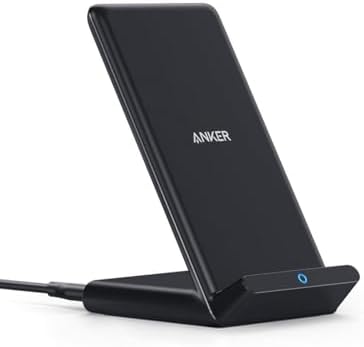
106,173 ratings at 4.4 stars for £12.98 — and three specification fields that disagree with its own title.
Pros
- 106,173 ratings at 4.4 stars, 72 per cent five-star
- Stand format keeps the screen visible while charging
- States 10W for Samsung and 7.5W for iPhone accurately, in the bullets
- Saves a phone whose charging port has failed
- £12.98 for the best-reviewed stand here
Cons
- Wattage field says 7.5W against a 10W title
- Input voltage field says 7.5 volts, copying the wattage
- Plug type field says North American, on a UK listing
- Adaptor not included, so a 9V/2A charger is needed separately
Why it is number 2
- Wattage as listed
- 7.5 watts The iPhone figure, in a field a title contradicts at 10W
- Input voltage as listed
- 7.5 Volts The wattage copied into the voltage field
- Power plug type
- Type A - 2 pin (North American) On a UK listing with no plug at all
- Charging in the bullets
- 10W Samsung, 7.5W iPhone The accurate figures, in prose
- Adaptor
- Not included, 9V/2A required Another £8 or a drawer full of them
- Ratings
- 4.4 from 106,173 The best record of the large samples
What buyers actually say
Quoted from customer reviews on Amazon
Verified purchase“Works wellcharges quicklyIf anything changes will be back to tell you all”
Verified purchase“Bought this as charging port on IPhone wasn’t working, problem solved.Very convenient to use.”
The best-rated of the very large samples here and, in its specification, the clearest demonstration that these tables are filled in by copying. The title says 10W Max. The wattage field says 7.5 watts, which is the figure for an iPhone rather than the maximum for a Samsung. The input voltage field says 7.5 volts, which is not a voltage: it is the wattage from the field above, entered one row down. And the power plug type field says Type A - 2 pin (North American), on a listing sold in Britain, for a charger that does not have a plug at all because it runs from a USB adaptor you already own.
Only the last of those three errors is genuinely misleading, and it is worth saying why. A buyer who reads that the charger has a North American two-pin plug may conclude it will not work in a UK socket — and the answer is that it does work, because there is no plug to be wrong. The other two are noise: the input voltage of 7.5 volts looks odd until you see that it cannot be right, and the wattage of 7.5 is one of the honest figures for this product. The correct numbers are in the bullets, where the listing says up to 10W for Samsung Galaxy and 7.5W for iPhone models, and states that a 9V/2A adaptor is required and not included.
What you get for £12.98 is the stand format, which is the one most people prefer: the phone sits upright at an angle so its screen stays visible, it is easier to place on the charging coil than a flat pad, and it doubles as a bedside clock. Its record is 106,173 ratings at 4.4 stars with 72 per cent five-star and 5 per cent one-star, and the reviews describe exactly the use case it was bought for — one buyer whose phone's charging port had stopped working and who considers the problem solved, and another confirming it charges quickly.
INIU Wireless Charger Stand 15W with Self-Adaptive LED

28,138 ratings at 4.3 stars for £13.89, with a self-dimming LED and the only honest power-source field in the ranking.
Pros
- 28,138 ratings at 4.3 stars, 68 per cent five-star
- Power source correctly given as induction
- The only listing here to express speed as time saved
- Self-adaptive LED that dims at night
- USB-C input on the stand itself
Cons
- Credits AirFuel, a rival standard to Qi
- £13.89, the dearest of the three large-sample chargers
- 7 per cent of its 28,138 ratings are one-star
- 15W still depends on the phone and the adaptor
Why it is number 3
- Power source
- Induction The only correct entry in this field across the ranking
- Wattage as listed
- 15 watts True for a compatible phone and adaptor
- Speed claim
- Up to 45 minutes saved The only time-based claim here
- Technology credited
- AirFuel A standard competing with Qi
- Connector
- USB Type C A modern input on the stand
- Ratings
- 4.3 from 28,138 68 per cent five-star, 7 per cent one-star
What buyers actually say
Quoted from customer reviews on Amazon
Verified purchase“It's a very good product. Charge my phone very well. It's just has described.”
Verified purchase“Good little charger . Works well and good value . Cable length is good and seems to be well built to last the time .”
The charger that describes how it works rather than what it claims, in the one field where it matters. Its power source is given as induction, which is precisely correct and unique in this ranking — every other listing here says corded electric, which is true of the cable and wrong about the charging, or USB, which is where the cable plugs in. Wireless charging is induction, and this is the only page that says so.
It spoils the effect slightly by crediting the technology to AirFuel, which is a competing standard to Qi rather than the one this charger almost certainly uses. It is the same class of error as the misspelled chip name and the barcode in the model field elsewhere in these rankings: the marketing text was written by someone who had heard of a technology, and the reference survived review because nobody was checking the parts of the page that are not the price.
What it does tell you, and no other listing here does, is what the speed means in time: save up to 45 minutes, it says, on a morning charge. That is the only attempt in this ranking to convert a wattage into something a person can feel, and it is the right instinct, because 15 watts is meaningless without the phone it is charging and the adaptor feeding it. The rest of the specification is conventional — a stand with a USB-C port, 9 volts at 3 amps in, an LED — and the LED is the feature its buyers mention: it dims itself in the dark and brightens by day, which is what you want from a bedside charger. Its record is 28,138 ratings at 4.3 stars, 68 per cent five-star and 7 per cent one-star, and at £13.89 it is the dearest of the three big-sample chargers here.
NANAMI Wireless Charging Pad 10W Max with Non-Slip Rubber

23,625 ratings at 4.2 stars for £12.99, on a pad whose own voltage fields cannot support its 10W claim.
Pros
- 23,625 ratings at 4.2 stars
- Non-slip rubber base holds the phone
- Compact, with a 3-foot cable included
- £12.99 for a large-sample pad
- Buyers report it charging quickly and easily
Cons
- Input and output both 5 volts, which limits real speed
- 10W claim not achievable at 5 volts on a fast-charging phone
- Flat pad, so the phone must be placed carefully
- 7 per cent of its 23,625 ratings are one-star
Why it is number 4
- Wattage as listed
- 10 watts 5 volts times 2 amps, which cannot reach it on a phone
- Input voltage
- 5 Volts Fast wireless charging needs 9 volts
- Output voltage
- 5 Volts The same figure, one row below
- Speed claim
- Up to 1.4x faster True of 10W against a 5W pad
- Box contents
- Pad, 3ft cable, manual Listed in a field, unlike most here
- Ratings
- 4.2 from 23,625 63 per cent five-star, 7 per cent one-star
What buyers actually say
Quoted from customer reviews on Amazon
Verified purchase“Does what it says on the package! Pleased it works great.”
Verified purchase“A very sleek design, It charges quickly and easily. Overall very good and value for money.”
The listing whose arithmetic works and whose physics does not. Its title claims a 10W maximum. Its fields say the input voltage is 5 volts, the output voltage is 5 volts, and the output current is 2 amps — and five volts multiplied by two amps is exactly 10 watts, so the numbers agree with each other and with the headline. The problem is that no phone takes 10 watts over wireless charging at 5 volts. Fast wireless charging works by raising the voltage to 9 volts, which is why every other listing here quotes 9 volts somewhere; at 5 volts, the current needed to reach 10 watts would exceed what the coil and the phone will accept, and the realistic outcome is 5 watts.
It is the most subtle version of the problem this article describes, and the most common. A charging pad is not one specification but a negotiation between three things: what the pad can output, what the phone will accept, and what the adaptor supplies. The Amazon Basics at number five states all three of its outcomes in a single bullet — 15 watts on LG, 10 on Samsung, 7.5 on iPhone — and the one at number six goes further, explaining that a standard 5V/2A adaptor produces 5 watts where a quick-charge adaptor produces its full figure. This listing states one number and a set of fields that cannot produce it.
What it is, at £12.99 with 23,625 ratings at 4.2 stars, is a competent conventional pad: 63 per cent five-star, 7 per cent one-star, a non-slip rubber base, a compact footprint, a 3-foot cable in the box, and a claimed 1.4 times faster charging than a standard wireless pad, which is true of 10 watts against 5. The reviews are the ones pads always attract — it does what it says, charges quickly and easily — and its weakness is shared with all the flat designs: the phone has to be placed, not thrown, on to the coil.
Amazon Basics 15W Qi Wireless Charging Pad, USB-C, No Adapter

£10.99 for the one listing here that spells out its three real wattages and the adaptor you need to reach the highest.
Pros
- States three real wattages: 15W LG, 10W Samsung, 7.5W iPhone
- Explains which adaptor is needed for each
- USB-C on the pad, unlike the Anker PowerWave
- Qi certified, and £10.99
- Buyers report it working well with Samsung phones
Cons
- Adaptor not included, so the 15W needs another purchase
- 9 per cent of its 6,621 ratings are one-star
- Flat pad rather than a stand
- 61 per cent five-star, the lowest of the big-brand pads here
Why it is number 5
- Wattage as listed
- 15 watts Explained as three figures by phone brand
- Charging by phone
- 15W LG, 10W Samsung, 7.5W iPhone The most useful bullet in this ranking
- Adaptor needed
- 9V/2A for 10W, 30W PD for 15W Stated, along with not being included
- Power plug type
- No Plug Correctly empty, unlike the stand at number six
- Connector
- USB Type A to USB-C A modern cable on the pad
- Ratings
- 4.1 from 6,621 61 per cent five-star, 9 per cent one-star
What buyers actually say
Quoted from customer reviews on Amazon
Verified purchase“A very good item, works very well, I was surprised. B!”
Verified purchase“Bought this for a Galaxy S23 Ultra.Charging well and happy with the wireless charger.Would buy again if needed.13/7/26”
The listing that explains the whole problem in a single bullet, and for £10.99. High-speed dynamic charging, it says, and then it gives three numbers instead of one: 15 watts on LG phones, 10 watts on Samsung, and 7.5 watts on iPhones. That is the honest version of a 15W claim. A wireless charger does not have a speed; it has a speed for each phone, because the phone decides what it will accept, and Apple's limit of 7.5 watts on ordinary Qi pads is the reason the same product is a fast charger for one person and a slow one for another.
The bullet continues, and this is the part most listings leave out: to get 10 or 7.5 watts you need a Quick Charge 3.0 or PD 3.0 adaptor of at least 9 volts and 2 amps, and a 30W PD 3.0 charger is required for the full 15 watts. The adapter is not included, and the specification confirms it in its own way by recording no plug type at all — properly, in this case, rather than the North American entry in the Amazon Basics stand further down this page. So the £10.99 buys a pad and a cable, and the wattage depends on the charger already in your drawer.
It is USB-C on the pad, which is the modern connector, and it carries a Qi certificate. Its record is 6,621 ratings at 4.1 stars with 61 per cent five-star and 9 per cent one-star, which is the weakest of the four Amazon listings here and the weakest of the four big-brand pads. The reviews are the usual ones for this format: a buyer surprised at how well it worked, and another charging a Galaxy S23 Ultra happily. At £10.99 it is the cheapest of the four mainstream pads and the one whose documentation tells you the truth about all three numbers, which is worth more than a watt of headline.
Amazon Basics 10W Qi Wireless Charging Stand, USB-C, No Adapter

£14.69 for a stand whose bullets explain that the same device charges at 10W, 7.5W or 5W depending on your adaptor.
Pros
- Explains its three outputs: 10W, 7.5W and 5W
- Stand format with the screen visible
- USB-C connector and no plug, correctly stated
- Plug type field left empty rather than filled wrongly
- Buyers charge it overnight and consider it sufficient
Cons
- Compatible plug type field says North American
- 60 per cent five-star, the lowest of the big brands
- Adaptor not included
- 11 per cent of its 5,605 ratings are one-star
Why it is number 6
- Wattage as listed
- 10 watts Matching the title, and explained as three outcomes
- Charging outcomes
- 10W Samsung, 7.5W iPhone, 5W standard adaptor The most useful bullet in this ranking
- Compatible plug type
- Type A - 2 pin (North American) The same false field as the Anker 313
- Power plug type
- No Plug Correct, and it contradicts the field above
- Connector
- USB Type C A modern input
- Ratings
- 4.1 from 5,605 60 per cent five-star, the lowest of the big brands here
What buyers actually say
Quoted from customer reviews on Amazon
Verified purchase“Does the job. Not the fastest, but used overnight so perfect for my use.”
Verified purchase“Arrived on time. Plugged into an iPad charger and it charged. Some comments mention it’s slow to charge but I reckon it’s fairly quick. Works with iPhone SE 2022. The metal ring on my wife’s case prevented that from being charged. Happy with charger”
The clearest explanation in this ranking of why a wireless charger has no single speed. Its bullet states two outcomes for the phones — 10 watts on LG and Samsung, 7.5 watts on iPhones — and then a third for the adaptor: a Quick Charge or PD adaptor of at least 9 volts and 2 amps gives the full figures, while a standard 5V/2A charger allows 5 watts of output. One product, three speeds, and the one you get is decided by the adaptor in your drawer and the phone in your hand. No listing here is more useful about that, and none is more likely to disappoint a buyer who does not read it.
Its specification is mostly careful: the wattage is recorded as 10 watts, matching the title, USB-C is the connector on the stand, and the power plug type is correctly left as no plug, because there is no plug. Then the next field, compatible power plug type, says Type A - 2 pin (North American) — the same error that appears on the Anker 313 at number two, which means two of the ten listings here tell a British buyer that the product takes an American plug. In this case it is contradicted on the same page, where the plug type field says there is no plug at all, so the reader has two conflicting entries and the correct one is the emptier.
What you get for £14.69 is the stand format in black, with the phone upright and visible while it charges, and a USB cable in the box. It carries 5,605 ratings at 4.1 stars with 60 per cent five-star and 11 per cent one-star, which is the lowest five-star share of the four big-brand listings, and its reviews are pragmatic rather than enthusiastic: it does the job, not the fastest, used overnight so perfect for my use; and another buyer who plugged it into an iPad charger and found it charged, which is exactly the adaptor question this article keeps returning to.
Magnetic Wireless Charger for iPhone, 15W Mag-Safe Style, Dual Ports

£11.98 for a magnetic charger claiming 15W to iPhones, with a plug that exists and does not exist in adjacent fields.
Pros
- Magnetic alignment, which buyers confirm is strong
- Dual charging ports on the body
- Compatible with iPhone 12 and later, plus AirPods
- £11.98: the cheapest magnetic charger here
- 4,979 ratings at 4.1 stars
Cons
- 15W claim without a MagSafe or Qi2 certificate
- Three fields disagree about whether it has a plug
- 12 per cent of its 4,979 ratings are one-star
- Adaptor not included
Why it is number 7
- Wattage as listed
- 15 watts Achievable on an iPhone only with a certified magnetic charger
- Main power connector
- Two- or Three-Prong Plug Contradicted by the field below
- Power plug type
- No Plug Contradicted by the field above
- Compatible plug type
- Type G The British plug, which is the only relevant answer
- Magnet
- Self-aligning, strong per reviews The reason to buy a magnetic charger
- Ratings
- 4.1 from 4,979 61 per cent five-star, 12 per cent one-star
What buyers actually say
Quoted from customer reviews on Amazon
Verified purchase“Good size, looks good, sticks well to my iPhone 16 max magnet & charges fast. I like this.”
Verified purchase“Very happy with this charger. The magnetic connection is strong and holds the phone securely in place, while charging is quick and reliable. It’s also compact and easy to use. Great value for the price! ⭐⭐⭐⭐⭐”
The magnetic charger that claims Apple's own speed without Apple's certification. Its title says 15W and calls itself a Mag-Safe charger, and the wattage field agrees. The qualification that matters is absent: an iPhone accepts 15 watts over the magnetic connection only from a genuine MagSafe puck or a Qi2-certified one, and this is a clone at £11.98 that does not claim either certificate in a specification field. What it does claim is a magnet strong enough to align itself, dual charging ports on the back so a cable can serve the pad or a second device, and compatibility with every iPhone from the 12 series onward.
Its own specification is confused about whether it has a plug. One field, main power connector type, says two- or three-prong plug. The next, power plug type, says no plug. A third records the compatible power plug type as Type G, which is the British three-pin. Three fields, three answers, and the one that is certainly true is the last: whatever plug you have, this pad wants a USB adaptor, which is not supplied.
The record is 4,979 ratings at 4.1 stars, 61 per cent five-star and 12 per cent one-star, which is the highest one-star share among the four-figure samples here — one in eight buyers dissatisfied, on a product whose central promise is a speed it cannot control. The reviews that are positive are about the magnet rather than the speed: it sticks well to an iPhone 16 and charges fast, and the magnetic connection is strong and holds the phone. At £11.98 it is the cheapest way here to get the magnetic alignment behaviour, which for a phone in a car or on a bedside table is the part that actually matters.
Magnetic Wireless Charger 15W for iPhone, White, No Adapter

£8.98 for a magnetic pad that states No Adapter in its own title — the only listing here to warn about that in the headline.
Pros
- £8.98: the cheapest magnetic charger here
- Says No Adapter in the title, unlike the others
- Box contents listed precisely, including the USB-A converter
- USB-A and USB-C ports on the pad itself
- Compatible with iPhone 12 and later, plus AirPods
Cons
- 15W is 7.5W on an iPhone without certification
- 11 per cent of its 1,601 ratings are one-star
- A reviewer reports it not working at all
- No adaptor, which the title at least discloses
Why it is number 8
- Price
- £8.98 The cheapest magnetic charger in this ranking
- Title disclosure
- White, No Adapter The only listing to warn in the headline
- Box contents
- Pad, 1m USB-C cable, USB-A converter, manual Itemised, which is rare here
- Wattage as listed
- 15 watts 7.5W on an iPhone without a certified puck
- Ports
- USB Type A and USB Type C Either cable will feed it
- Ratings
- 4.2 from 1,601 72 per cent five-star, 11 per cent one-star
What buyers actually say
Quoted from customer reviews on Amazon
Verified purchase“Light weight wireless charger. Works with iPhone. Just simply plug into USB port and then it works. Easy to use.”
Verified purchase“Did not work at all. I was really disappointed as I read reviews and so I bought .The company acted straight away and sent a replacement which is super. I recommend this product to everyone needing a charger.”
The cheapest magnetic charger here and the only one that warns you in its own title that there is no adaptor in the box. White, no adapter, it reads, which is a small act of honesty that the rest of this ranking does not bother with: the Anker stand and both Amazon Basics listings explain in their bullets that the adaptor is not included, and the listing at number seven does not say so anywhere. Whether you consider that worth £8.98 depends on how many USB adaptors are already in your house.
The pad has two ports on its body, USB-A and USB-C, so a single cable can feed either this pad or something else, and the box contents are listed properly, which is rarer here than it should be: a Mag-Safe wireless charger, a one-metre USB-C cable, a USB-A converter, and a manual. It offers 15W, which for an iPhone means 7.5W in practice unless the pad is certified, and it lists compatibility back to the iPhone 12 series with AirPods support.
Its record is 1,601 ratings at 4.2 stars, 72 per cent five-star and 11 per cent one-star, and that one-star share is the honest counterweight to a five-star share that looks strong. One of the featured reviews is a one-star, and it says the simplest possible thing: did not work at all, and the buyer was disappointed because they had read the reviews first. With magnetic chargers, the failure mode is usually alignment or adaptor rather than the coil, which is why the listing that says no adapter in its title is doing its buyers a favour.
Wireless Charging Pad 15W Claim with 4 Charging Modes

£6.99 for a pad that claims 15W and whose output fields multiply to 2.5W, with 230V of mains electricity as its input voltage.
Pros
- £6.99: the cheapest wireless charger in this ranking
- Four charging modes for different standards
- Wide compatibility from iPhone XS and Galaxy S9 onward
- 1,186 ratings at 4.1 stars
- Buyers report it working with a suitable adaptor
Cons
- Fields multiply to 2.5W against a 15W claim
- Input voltage listed as 230V mains AC
- 10 per cent of its 1,186 ratings are one-star
- No adaptor, and no statement of one being needed
Why it is number 9
- Wattage as listed
- 15 watts Six times the figure its own fields produce
- Input voltage
- 230 Volts (AC) The wall socket, not an input to the pad
- Output
- 5 Volts at 0.5 Amps Two and a half watts, one sixth of the claim
- Modes
- 4 wireless charging modes The pad negotiates with the device
- Compatibility
- iPhone XS onward, Galaxy S9 onward Broad, if the adapter is adequate
- Price
- £6.99 The cheapest charger here
What buyers actually say
Quoted from customer reviews on Amazon
Verified purchase“Great charging pad does what it says on the tin”
Verified purchase“Works well. Use a charging brick of at least 1A or 100ma at 5v”
The listing whose numbers can be multiplied, and the result is not the one on the box. The wattage field says 15 watts. The output voltage field says 5 volts. The output current field says 0.5 amps. Five volts times half an amp is two and a half watts, which is a quarter of what a slow charger delivers and one sixth of the claim. And the input voltage field says 230 volts AC, which is not an input to a charging pad by any route — it is the voltage at the wall socket in your house, and between that wall and the pad there is a USB adaptor, a cable and a coil, none of which appear in the specification.
This is the arithmetic version of the problem that runs through this ranking: a wattage is not a property of a box, it is the product of volts and amps at the point where the phone meets the coil, and these fields do not describe that point. The Amazon Basics listings handle it by explaining the three possible outcomes in prose; this one leaves the reader to multiply, and the multiplication contradicts the headline by a factor of six. It is the cheapest listing here at £6.99 and the one whose specification is least capable of being true.
What it does offer is four charging modes listed as a feature, meaning the pad will attempt different standards depending on the device, and compatibility spanning iPhones back to the XS and Galaxy phones back to the S9, with AirPods and Galaxy Buds. It carries 1,186 ratings at 4.1 stars, 61 per cent five-star and 10 per cent one-star, and the best of its reviews is also the most useful: works well, use a charging brick of at least 1A at 5 volts — which is the buyer explaining the missing adaptor problem themselves, and the closest this listing gets to a statement about its real speed.
Wireless Charging Pad 15W for iPhone and Samsung, Model W8

The cheapest charger here at £5.94, and the one with 14 per cent of buyers giving it one star.
Pros
- £5.94: the cheapest charger in this ranking
- Fields and headline agree at 15W by multiplication
- Box contents and a model number are listed
- Compatible from iPhone 11 and Galaxy S9 onward
- Some buyers report it still working months later
Cons
- 5 volts cannot deliver 15W to a phone
- 14 per cent one-star, the highest share here
- 433 ratings: the smallest sample in this ranking
- 4.0 stars, the lowest average of the ten
Why it is number 10
- Price
- £5.94 The cheapest charger here
- Wattage as listed
- 15 watts 5V x 3A by arithmetic, not by wireless physics
- Input voltage
- 5 Volts Fast charging needs 9 volts
- Output
- 5 Volts at 3 Amps Consistent internally, unusable at the phone
- Model
- W8 Identified, unlike the listing at number nine
- Ratings
- 4.0 from 433 60 per cent five-star, 14 per cent one-star
What buyers actually say
Quoted from customer reviews on Amazon
Verified purchase“Very easy to use no need for cables hanging out of your phone.”
Verified purchase“Works really well for an i phone. Still working well after months of use”
The cheapest wireless charger in this ranking and the one with the worst record. At £5.94 it claims 15 watts, and unlike the pad at number nine its arithmetic works: five volts multiplied by three amps is fifteen watts, so the fields and the headline agree. The problem is the same as at number four, only more so — fast charging above 5 watts on a phone happens at 9 volts, not 5, and a 5-volt coil pushing 3 amps is describing a USB-A quick-charge negotiation that a wireless pad does not get to make on its own. Whether any phone receives 15 watts from this pad is not established by anything on the page.
Its rating distribution is the real warning: 433 ratings at 4.0 stars, 60 per cent five-star and 14 per cent one-star, the highest one-star share of the ten chargers here and nearly one buyer in seven. Budget chargers fail in unremarkable ways — a coil that stops working, a pad that hums, a phone that gets warm and charges slowly — and a distribution like this one is the aggregate of that experience. Where the money goes at this price is a fair question, and the answer is usually the coil and the thermal protection.
What it does provide is a complete list of what arrives: the pad, a USB-C cable and a manual, plus a model number, W8, which is more identification than the listing at number nine gives. It is compatible with iPhones from the 11 series onward and Galaxy phones from the S9, and the reviews that are positive are the ordinary ones: very easy to use, no cables hanging out of the phone, and one buyer reporting it still working after months. At £5.94 it is a pound cheaper than the next cheapest here, which buys very little in a category where the cheapest reliable options cost £2 more.
Final Verdict
What we would buy. The Anker PowerWave Pad at £10.99 is the charger we would buy: 138,064 ratings at 4.3 stars is the deepest evidence on this site, the wattage it claims is the wattage it records, and a flat pad is the least fussy thing to use. If you prefer a stand, the Anker 313 at £12.98 has the best record of the large samples at 4.4 stars from 106,173 buyers, provided you have a 9V/2A adaptor and can ignore its own specification. The INIU at £13.89 is the best-documented charger here, with a self-dimming LED and the only honest power-source field in the ranking. The Amazon Basics 15W pad at £10.99 and its 10W stand at £14.69 are the two listings that explain what they can actually deliver, and they are worth choosing for that reason alone. If you want magnetic alignment, the white pad at number eight is £8.98 and its title admits there is no adaptor, which is more than the clone above it does. And if the budget is absolute, remember that the two cheapest pads here charge at 5 volts and multiply out to figures their own fields cannot support. What the listings will not tell you. Expect a wattage number to be the best case for one phone on one adaptor, and read the bullets for the rest of the range: 15, 10, 7.5 and 5 watts all describe the same product on two of these listings. Check the voltage, because a charger that quotes 5 volts in and out will not deliver fast charging, and 9 volts is where that negotiation happens. Budget for an adaptor, since none of the ten includes one and a 30W PD unit is what unlocks the top figure. Distrust any phone-speed claim that does not mention certification, because an iPhone limits ordinary Qi pads to 7.5 watts. Choose between a stand, a pad and a magnetic puck on how you will use it, not on what it promises. And check the connector before you buy: the most-reviewed charger on this site takes Micro USB. Everything on this page comes from the Amazon listings, collected on 11 September 2026.

Written by
Felipe Iglesias
Founder & Lead Reviewer
Felipe is a computational engineering student who has been working in SEO since he was sixteen. He founded ranked10 and researches every guide on the site.
Related buying guides
All Tech guidesBest Ryzen 7 Laptop UK 2026: Vega 8 Under a Gaming Badge
The one we would buy is the £820.09 HP Victus: a 15.6 inch machine with a Ryzen 7 7445H, 16 GB of memory, a 512 GB SSD and, crucially, a dedicated NVIDIA RTX 4050 with 6 GB of its own memory — rated 4.4 stars from 57 buyers, and the cheapest laptop in this article that can be described as gaming without an asterisk. The cheapest machine worth considering is the £449.99 15.6 inch laptop with a Ryzen 7 5700U, rated 4.3 stars from 14 ratings, with 16 GB of RAM and a 512 GB SSD, which is a great deal on a fast office laptop and not a games machine at all. Those two sentences are the whole market, because the badge on the lid does not tell you which one you are holding. Ten laptops carry a Ryzen 7 here and they span seven different chips from 2021 to 2025, two power classes from 15 to 45 watts, and £749 in price. Only two of the ten have a graphics card of their own. And the machine with the most buyers of any here — 183 ratings — is sold as a gaming laptop while running integrated graphics built into a 2022 processor.
TechBest i7 Laptop UK 2026: The Badge That Stopped Meaning Anything
The best i7 laptop here is the £599.99 HP 14": 130 ratings at 4.0 stars, the largest sample in the article, with 16 GB of RAM and a 512 GB SSD in a chassis that weighs 1.46 kg. The cheapest one worth buying is the £586.69 Acer Aspire 3, rated 4.7 stars with no one-star and no two-star reviews at all — the cleanest record in a market that has very few records to show. Five laptops survived the search out of fifty-four listings, and price is not the reason the rest did not. An 'i7 laptop' search on Amazon UK returns two Snapdragon machines, two Ryzens, an i5, an Apple MacBook and a laptop whose processor field says only 'Intel'. One of the five here does not say i7 anywhere on the page, because Intel has renamed it. And the fastest chip in the whole search, a 45-watt i7-13620H, was listed at £499.99, a hundred pounds below the slowest one, a 15-watt i7-1255U at £599.99.
TechBest WiFi Extender 2026: 1 Gram, 12,000 Sq Ft
A WiFi extender is sold by three numbers and a name, and the name is the honest part. Every product here carries its speed class in its own title — AC1200, AC1900, AC750, N300 — and every one of those classes is the sum of two radio bands, which means the model number is the only figure on the page that a buyer can check arithmetic against. The rest is a field called Range, and this market fills it in with metres, with feet, with square feet and in Spanish. One listing says 150 to 300 meters, another says 50 feet, another says up to 100 meters, one puts 12,000 square feet, and the fifth answers short to medium, in Spanish, followed by the letters NA. That last field is the most revealing because of what the same page does elsewhere. The cheapest extender here is a TP-Link that reports its own weight as one gram — a wall-mounted device, with a plug and an aerial, weighing a paperclip. Its sibling at £46.99 declares 359 grams, and between those two numbers are 200, 270 and 91, which are all plausible weights for a small router in a socket. One gram is not a rounding error, it is a field filled in by somebody who had the number in kilograms in front of them, and it is the same failure this site found on an air mattress whose own specification gave its weight as 320 grams. The colours are written in two languages. One listing describes itself as bianco perla and another as oro antic, which is pearl white and antique gold in Italian, on pages sold in pounds to British buyers and alongside three siblings from the same brand that simply say white. This site has met the same habit in a mattress whose depth was recorded in Spanish and a stove fan whose specification ran a sentence in French, and it is worth naming as a pattern rather than a slip: these tables are assembled by people copying from a parent listing in another language, and the translation stops before the fields. What is genuinely useful is small and verifiable. The speed class in the name is real, the wired ports are the difference between extending a network and throttling it, and one listing here is the only one that states its plug type — a type G three-pin, which is the difference between a device that fits a British socket without an adapter and one that does not say. Five extenders, all from the same manufacturer, with more than a hundred thousand ratings between them: this is what a British WiFi shelf looks like, and the second brand the search returns, Amazon's own eero, publishes no specification at all.
Comments
Reader comments are not checked against the manufacturer's claims above.
No comments yet
Be the first to add something we missed — a price change, a spec that turned out wrong, or how one of these held up.
Leave a comment
No account needed. Own one of these? Tell other readers how it actually performed.