Best Pure Sine Wave Inverter 2026: 10 Ranked, and Why the Peak Wattage Misleads
By Felipe Iglesias · Updated

On paper, a bigger number on the box looks like more power. In practice, the headline figure on a pure sine wave inverter listing is often the surge rating, not what the unit delivers hour after hour. Take the OLTEANP 2500W: its title advertises 5,000W peak, yet the Peak Output Power Watts field on the same page reads 2,500 — exactly its continuous rating. Meanwhile the Standby Power Shutoff field, which should record idle consumption, is filled with efficiency percentages instead: 90%, 'up to 91%', '>95%'.
We ranked ten of the best pure sine wave inverter models on Amazon on continuous wattage against stated peak, price per continuous watt, how well each spec table agrees with its own bullets, and the depth of buyer feedback behind the star rating.
Novopal 2000W Pure Sine Wave Inverter, 12V to 240V, LCD Remote
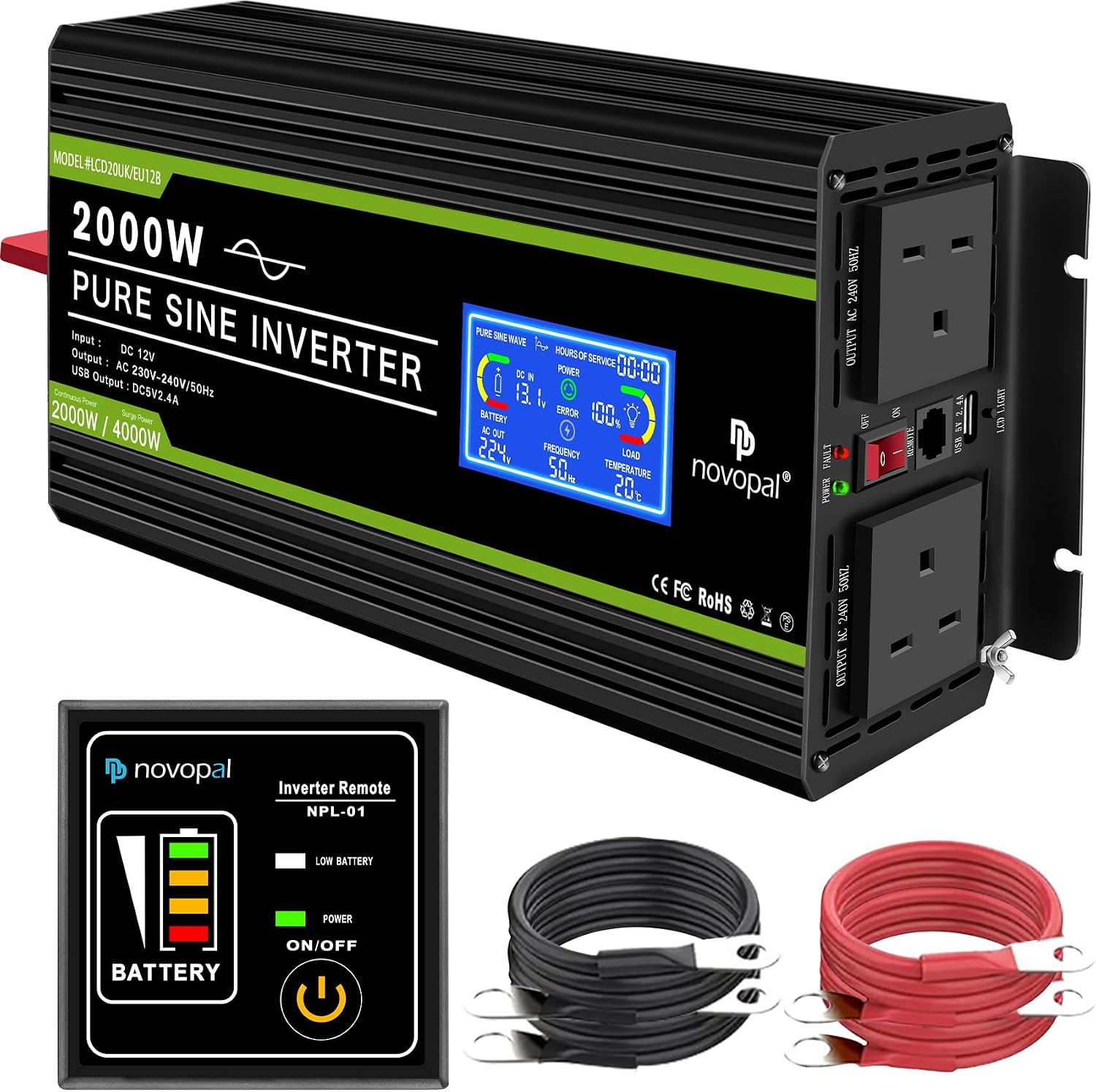
Top of the ranking because its listing is internally consistent — 2,000W continuous and 4,000W peak appear in both title and spec table — and it carries 385 ratings at 4.5 stars.
Advantages
- 2,000W continuous and 4,000W peak stated consistently in title and spec table
- 385 ratings at 4.5 stars, the largest review base in this ranking
- LCD shows battery supply, input voltage, output voltage, load and fault warnings
- Fans stay off until 45°C, so light loads run quietly
- 16.4ft wired remote, battery cables and a fuse listed in the box contents
Disadvantages
- £254.99 — roughly double the £132.99 MINGHAOXIN for the same 2,000W continuous claim
- Spec table counts the USB port as a third outlet; there are only two AC sockets
- Standby Power Shutoff is given as 90%, an efficiency figure, not an idle consumption number
- No weight published in the spec table, so check before ordering
This 2,000W pure sine wave inverter sits first because its numbers agree with each other. The title says 2,000W, the Output Power field says 2,000 Watts and Peak Output Power Watts says 4,000 — a 2:1 surge ratio, which is the normal shape for this class. No other listing here pairs that consistency with 385 customer ratings.
The 12V input is matched to a stated 240Ah battery capacity, output is 240V at 50Hz, and the two cooling fans only start above 45°C, so light loads run silently. A 16.4ft wired remote handles on/off, and the LCD reports battery supply, input voltage, output voltage, load and fault states rather than a single warning light.
However, at £254.99 it costs nearly twice the £132.99 MINGHAOXIN for the same stated continuous output. The spec table also lists 'Number of Outlets: 3' where the bullets describe two AC sockets plus one USB port — the USB is being counted as an outlet. If you only need to run a laptop and a fridge, you are paying for headroom you will not use.
Giandel 1500W Pure Sine Wave Power Inverter, 12V to 240V

Second because 1,500W continuous for £149.99 works out at about 10p per watt, the fan stays off until 104°F or 800W of load, and 4.6 stars come from 42 ratings.
Advantages
- 1,500W continuous / 3,000W peak for £149.99, about 10p per continuous watt
- Fans stay off below 104°F or 800W of load
- RJ10 4P4C remote connector — standard cable, easy to extend
- 24-month warranty and AIG product liability cover stated on the listing
- 2.82kg and 31cm long, so it fits tighter mounting spaces
Disadvantages
- 42 ratings only, with five one-star reviews in the histogram
- 'Standby Power Shutoff: up to 91%' is an efficiency figure, not idle draw
- No battery capacity guidance in the spec table
- 1,500W will not start a large microwave or a power tool
This pure sine wave power inverter is ranked second on value rather than raw output. Continuous power is 1,500W and peak is 3,000W, and the price is £149.99 — about 10p per continuous watt against the Novopal's 12.7p. A 4.6-star average from 42 ratings is a small but strong sample.
In practice the cooling fan does not run at start-up; it spins up only above 104°F (40°C) or 800W of load. That means a laptop, a TV and a phone charger can run without fan noise. The remote uses an RJ10 4P4C connector, so you can extend the 4.5m cable yourself rather than buying a proprietary lead, and the 2.82kg, 31cm-long case fits tighter installs.
That said, the spec table's 'Standby Power Shutoff: up to 91%' is an efficiency figure, not standby consumption. Worth noting too that 42 ratings is a much thinner record than the Novopal's 385, and five of them are one-star. A 1,500W rating will not start a large microwave or a power tool.
FLAMEZUM 4000W Pure Sine Wave Inverter 12V to 240V, LCD Remote

Third because it carries the highest continuous rating here, 4,000W, and unlike the OLTEANP its 8,000W surge claim matches its own Peak Output Power Watts field.
Advantages
- 4,000W continuous and 8,000W peak — consistent in both title and spec table
- About 9p per continuous watt
- 2 AC outlets plus 3.1A USB-A and 36W USB-C
- Soft Start claimed to limit inrush current on motor loads
- 4.6 stars from 65 ratings
Disadvantages
- £368.99, the highest price in this ranking
- 12-month warranty only, against two years on Renogy and Junbpaw
- 6kg and 43.5cm long — check the mounting space first
- No battery capacity guidance; the '>90%' standby entry is an efficiency figure
By contrast with the OLTEANP further down this list, FLAMEZUM's headline numbers hold up inside its own spec table: the title says 4,000W/8,000W, Output Power says 4,000 Watts and Peak Output Power Watts says 8,000. That is the highest continuous rating in this ranking. At £368.99 it works out at about 9p per continuous watt.
The case measures 43.5 × 22 × 11cm and weighs 6kg — the heaviest published weight in this group, so plan the mounting space. Efficiency is stated as >90% with a low no-load draw, and it offers 2 AC outlets, a 3.1A USB-A and a 36W USB-C. Soft Start is claimed to limit inrush current, which matters when a fridge compressor or a motor starts off a battery bank.
Even so, the warranty runs 12 months where the Renogy and Junbpaw both offer two years, and the table gives no battery capacity figure. If your loads are genuinely under 1,000W, this is £368.99 spent on headroom. The Standby Power Shutoff entry, '>90%', is again an efficiency number rather than a consumption figure.
Renogy 1000W Pure Sine Wave Inverter with UK Sockets and UPS

Fourth because it is the only unit here with a stated automatic transfer time, 50mS, plus genuine UK three-pin sockets, at £113.99 with 161 ratings.
Advantages
- UPS function with a stated 50mS transfer between battery and mains
- UK three-pin sockets — no plug adapters required
- 2.6kg and 34.2 × 17.3 × 7.6cm, the most compact unit in this ranking
- 2-year material and workmanship warranty, ETL certified
- 161 ratings at 4.4 stars
Disadvantages
- 1,000W continuous will not run kettles, heaters or large microwaves
- 8 one-star ratings in the histogram
- Standby Power Shutoff is listed as '90' with no unit given
- No USB port listed; charging is via the AC sockets only
This pure sine wave inverter earns its place on features rather than wattage. Continuous output is 1,000W and peak is 2,000W for £113.99, which comes to about 11p per continuous watt. The UPS function is the differentiator: the listing states a 50mS switch between battery and mains, and the grid priority function feeds utility power first when it is available.
In theory a 1,000W continuous rating sounds limiting, but the spec table pairs it with a 100Ah battery capacity and >90% conversion efficiency. It has UK three-pin sockets, so no adapters are needed, plus a remote controller, an internal backup DC fuse and silent high-speed fans. At 2.6kg and 34.2 × 17.3 × 7.6cm it is the most compact and lightest unit here.
At the same time, 1,000W will not run a kettle, a heater or a large microwave. The histogram is also the weakest among the top five: 8 one-star ratings out of 100, against 2 for the Novopal. No USB port is listed either, so phones charge from the AC sockets. If you need to run heavy appliances, this is the wrong rung of the ladder.
Junbpaw 2080W Pure Sine Wave Inverter 12V to 230V, Silent Fans

Fifth because 2,080W continuous and 6,000W surge are backed by 93% efficiency, 47dB fans and a 4.8-star average, though from only 20 ratings.
Advantages
- 2,080W continuous / 6,000W surge stated in title and spec table
- 93% efficiency and a claimed low no-load consumption
- Dual ball-bearing fans at 47dB, rated for 50,000 hours
- 230V/240V and 50Hz/60Hz switchable for imported equipment
- 2-year manufacturer warranty
Disadvantages
- Only 20 ratings — a much thinner record than the top-ranked units
- Frequency field says 60 Hz; the bullets say 50Hz/60Hz switchable
- No Standby Power Shutoff figure anywhere in the spec table
- £259 for 2,080W is more per watt than the £132.99 2,000W MINGHAOXIN
Its numbers are unusually precise for this market: 2,080W continuous, 6,000W surge and 93% efficiency, with a 2-year manufacturer warranty. Crucially, 4.8 stars from 20 ratings is a joint-highest average here, but it is a thin sample — 20 buyers against the Novopal's 385. At £259 you are paying about 12.5p per continuous watt.
The cooling design is the selling point. Two ball-bearing fans are rated at 47dB with a claimed 50,000-hour life, and the capacitors are solid-state rather than electrolytic, which matters in hot vans and off-grid cabinets. Voltage and frequency are switchable between 230V/240V and 50Hz/60Hz, so imported 60Hz equipment is covered.
The catch is in the spec table: the Frequency field reads 60 Hz on its own, while the bullets describe 50Hz/60Hz switching — two different answers on the same page. The table also omits Standby Power Shutoff entirely, so there is no idle-draw figure. As a result, if you want published standby consumption before buying, this listing will not give it to you.
OLTEANP 2500W Pure Sine Wave Inverter, 12V to 240V, UPS

Sixth because 2,500W continuous for £169.99 is strong on paper, but the listing contradicts itself on surge power, which is why it does not rank higher.
Advantages
- 2,500W continuous output for £169.99 — about 6.8p per watt
- 12ms automatic switchover and a 25A built-in battery charger
- Adjustable cut-off from 9.5V to 11V to protect the battery
- 2 AC outlets plus 36W USB-C and 5V/3.1A USB
- 4.8 stars from 47 ratings
Disadvantages
- Title claims 5,000W peak; the Peak Output Power Watts field says 2,500
- Box Contents lists only the inverter, though the bullets describe a 15ft remote
- 5.2kg and 30cm × 30.5cm — bulky for a 2.5kW unit
- No standby or idle-draw figure published
Here is the clearest example of a headline number that does not survive contact with its own spec table. The title advertises 2,500W with 5,000W peak. The Peak Output Power Watts field on the same listing says 2,500 — the same as continuous. Either the surge figure is wrong or that field is; the listing does not resolve it.
What it does describe well is switching. A 12ms transfer to battery is claimed, alongside a built-in 25A charger and an adjustable cut-off between 9.5V and 11V to protect the battery. Output is 240V AC through 2 AC outlets plus a 36W USB-C and a 5V/3.1A USB port, and a 15ft wired LCD remote reports voltage, power and battery level. At £169.99 that is about 6.8p per continuous watt.
That said, the unit is 5.2kg and 30 × 30.5 × 12cm, and the Box Contents field lists only 'Power Inverter' — no remote, no cables, even though the bullets describe a 15ft remote. No standby figure is published. If your loads are modest, a 12v to 240v pure sine wave inverter in the 2,000W range does the same job for less.
MINGHAOXIN 2000W Pure Sine Wave Inverter, UK Sockets, LCD

Seventh because £132.99 for a stated 2,000W continuous and 4,000W peak is the cheapest route to that rating here, with 59 ratings at 4.6 stars.
Advantages
- £132.99 for a stated 2,000W continuous / 4,000W peak
- Cheapest per continuous watt of the three 2,000W-class units here
- 30m wireless remote — no cable run needed
- Up to 95% conversion efficiency claimed
- 4.6 stars from 59 ratings
Disadvantages
- '>95%' Standby Power Shutoff is an efficiency figure, not idle draw
- Spec table lists 4 outlets, counting USB and Type-C alongside 2 AC sockets
- No wired remote option listed; a wireless remote needs managing
- 3.5kg in a 37cm-wide case — check the space first
On price per watt, nothing in the 2000w pure sine wave inverter class beats it: £132.99 against £179.99 for the SUDOKEJI and £254.99 for the Novopal, all three claiming 2,000W continuous. The Peak Output Power Watts field says 4,000, matching the 4,000W surge in the title, so that part of the listing is consistent.
The remote is a 30m wireless unit rather than a wired lead, which is unusual at this price — most units here ship 4.5m to 16ft of cable. Efficiency is quoted at up to 95%, and the spec table lists four outlets where the bullets name two AC sockets plus USB and Type-C ports. Dual cooling fans and an aluminium alloy shell handle heat.
However, a wireless remote means pairing and batteries to manage, and no wired alternative is listed. The '>95%' Standby Power Shutoff entry is once more an efficiency percentage, not a consumption figure. And at 3.5kg in a 37 × 16.5 × 10cm case, check the mounting position before ordering.
Victron Energy 500VA Pure Sine Wave Inverter 12V to 230V

Eighth because Victron's build and VE.Direct monitoring are well regarded, but 500VA continuous is the lowest output here and the spec table disagrees with its own bullets.
Advantages
- 1W draw in zero-load ECO mode — the only published idle figure here
- VE.Direct port for monitoring from computer, tablet or smartphone
- 500VA continuous / 900W peak, per the listing bullet
- 4.7 stars from 27 ratings
- Compact high-frequency build, 4.33kg
Disadvantages
- 500VA is the lowest continuous rating in this ranking
- Spec table shows 900 Watts for both Output Power and Peak Output Power Watts
- Only one 230V outlet
- VE.Direct cables and dongles sold separately
Victron's numbers need reading carefully. The bullet describes 500VA continuous and 900W peak, with a 1W draw in zero-load ECO mode. The spec table's Output Power field says 900 Watts, and the Peak Output Power Watts field says 900 as well — so the peak figure has been entered twice, and the 500VA continuous rating does not appear in the table at all.
In practice this is the smallest continuous rating in the ranking. It will run a laptop, a router, some lights and a small TV; it will not run a kettle or a power tool. The VE.Direct port allows monitoring from a computer, tablet or smartphone, but cables and dongles are sold separately, on top of the £97.99 asking price.
Even so, it is the only unit here with a published zero-load figure — 1W in ECO mode — and the high-frequency design keeps it to 4.33kg. There is one 230V outlet, and only one. If you need two mains sockets, or more than 500VA, look higher up this list.
SUDOKEJI 2000W Pure Sine Wave Inverter 12V to 240V, Hardwire

Ninth because the hardwire port is unique here, but 11 ratings with 13% of them two-star is the weakest feedback profile in the list.
Advantages
- 2,000W continuous / 4,000W surge for £179.99
- Hardwire port as well as 2 AC outlets — unique in this ranking
- 15ft wired remote with LED status screen
- 5V/3.1A USB and 30W USB-C charging
- Reverse connection protection listed alongside the usual safeguards
Disadvantages
- Only 11 ratings, with 13% of the histogram at two stars
- 12-month warranty against two years elsewhere
- 'Standby Power Shutoff: 91%' is an efficiency figure, not idle draw
- No battery capacity guidance in the spec table
Ranked ninth mainly on evidence. Only 11 buyer ratings back this listing, and 13 points of the histogram are two-star. Its continuous rating is 2,000W with 4,000W surge, and efficiency is quoted at >91%. At £179.99 it sits between the £132.99 MINGHAOXIN and the £254.99 Novopal for the same stated class, which is about 9p per continuous watt.
It does bring a hardwire port, which no other unit here offers — useful if you want to feed a fixed circuit rather than plug into sockets. There are also 2 AC outlets, a 5V/3.1A USB and a 30W USB-C, plus a 15ft wired remote with an LED screen showing battery level, output and errors.
That said, the 12-month warranty is half the cover Renogy and Junbpaw offer, and the 'Standby Power Shutoff: 91%' field is an efficiency number rather than a standby draw. With 11 ratings there simply is not enough buyer history to judge reliability. Either way, for a caravan pure sine wave inverter setup, most people will want a longer track record first.
Spark 1000W Pure Sine Wave Inverter, 2 UK Sockets, LCD Remote

Tenth because it is the cheapest unit here at £109.99, yet it lacks the Renogy's UPS transfer and carries 6 one-star ratings.
Advantages
- £109.99 — the lowest price in this ranking
- 1,000W continuous / 2,000W peak
- THD quoted at ≤3%, which most listings here omit
- Two UK three-pin sockets plus a 2.4A USB port
- Wired LCD remote included
Disadvantages
- 6 one-star ratings plus 11 three-star, out of 100
- No UPS or automatic transfer function
- Box Contents lists only the instruction manual, though bullets promise battery leads
- No battery capacity figure in the spec table
At £109.99 this is the cheapest unit in the ranking, and 1,000W continuous with 2,000W peak puts it in the same class as the £113.99 Renogy. The difference is features rather than price: no UPS transfer, no battery capacity figure, and a Box Contents field that lists only the instruction manual while the bullets promise battery connection leads too.
THD is quoted at ≤3%, a figure most listings here leave out entirely, and there are two UK three-pin sockets plus a 2.4A USB port — no adapters needed. The rugged aluminium housing and a silent smart cooling fan handle heat, and a wired LCD remote lets you switch the unit on and off from arm's reach.
However, 6 of the 100 histogram points are one-star and 11 more are three-star. Nearly a fifth of ratings sit at three stars or below, which is the pattern to watch on a pure sine wave inverter 12v to 230v class unit at this price. If you also want automatic switchover, the Renogy costs £4 more and states 50mS.
All 10 compared
The same ranking side by side, now that the numbers have names.
2
6
| # | Product | Price | Amazon rating |
|---|---|---|---|
| 1 | Novopal 2000W Pure Sine Wave Inverter, 12V to 240V, LCD Remote | £254.99 | 4.5 (385) |
| 2 | Giandel 1500W Pure Sine Wave Power Inverter, 12V to 240V | £149.99 | 4.6 (42) |
| 3 | FLAMEZUM 4000W Pure Sine Wave Inverter 12V to 240V, LCD Remote | £368.99 | 4.6 (65) |
| 4 | Renogy 1000W Pure Sine Wave Inverter with UK Sockets and UPS | £113.99 | 4.4 (161) |
| 5 | Junbpaw 2080W Pure Sine Wave Inverter 12V to 230V, Silent Fans | £259.00 | 4.8 (20) |
| 6 | OLTEANP 2500W Pure Sine Wave Inverter, 12V to 240V, UPS | £169.99 | 4.8 (47) |
| 7 | MINGHAOXIN 2000W Pure Sine Wave Inverter, UK Sockets, LCD | £132.99 | 4.6 (59) |
| 8 | Victron Energy 500VA Pure Sine Wave Inverter 12V to 230V | £97.99 | 4.7 (27) |
| 9 | SUDOKEJI 2000W Pure Sine Wave Inverter 12V to 240V, Hardwire | £179.99 | 4.6 (11) |
| 10 | Spark 1000W Pure Sine Wave Inverter, 2 UK Sockets, LCD Remote | £109.99 | 4.4 (24) |
Final Verdict
For most homes and campervans, 1,000W to 1,500W continuous covers a fridge, a laptop and a few lights, so the Renogy 1000W at £113.99 or the Giandel 1500W at £149.99 is enough — and the Renogy's stated 50mS transfer is the reason to pick it if you want a pure sine wave inverter to take over when mains drops. If you run a microwave, a circular saw or a coffee machine, move up to the 2,000W class: the Novopal costs £254.99 and the MINGHAOXIN £132.99 for the same stated continuous output, a gap worth understanding before you pay. And if you need a pure sine wave inverter for campervan trips with genuinely heavy loads, the FLAMEZUM's 4,000W continuous at £368.99 is the largest here, though its warranty runs 12 months against Renogy's two years.
Why trust this ranking?
We rank on price, customer ratings and the specifications that decide the job, and we read each specification table against the marketing bullets on the same listing. When a number does not survive that check, we say so in the entry rather than quietly dropping the product. We also say when a product is the wrong one for you.
How we rank, in full
Written by
Felipe Iglesias
Founder & Lead Reviewer
Felipe is a computational engineering student who has been working in SEO since he was sixteen. He founded ranked10 and researches every guide on the site.
Related buying guides
Every guide below ranks ten products the same way this one does.
 Tech
Best Mini Projector 2026: 10 Ranked
The best mini projector here is the XuanPad 40000L at £129.99: native 1080p and Netflix built in. We rank 10 and compare the real ANSI lumens.
 Tech
Best Gaming Motherboard 2026: 10 Ranked
Best gaming motherboard 2026: the £127.99 ASUS TUF Gaming B650-Plus WiFi wins with 14 power stages at £9.14 each, half the £16.22 a stage of a dearer board.
 Tech
Best Floorstanding Speakers 2026: 10 Ranked
Best floorstanding speakers 2026: the Q Acoustics 3050i wins with two 165 mm drivers per tower, and the Fenton SHF700B pair costs £159.90.
 Tech
Best Binoculars 2026: 10 Ranked
The best binoculars for 2026 ranked: the £25.99 Kylietech 12x42 gives a 3.5 mm exit pupil, nearly three times the light of the £34.99 occer 12x25.
 Tech
Best Camcorder 2026: 10 Ranked
The best camcorder for most buyers is the FIREFOTO 4K 64MP at £59.99, working out at £0.94 a megapixel against £2.49 on the 8K PITIKI.
 Tech
Best OLED Gaming Monitor 2026: 10 Ranked, Brightness Listed Four Ways
The best OLED gaming monitor picks ranked by panel, refresh rate and price — brightness is listed four different ways across these listings.
 Tech
Best 128GB SD Cards 2026: 10 Ranked, and Three Adverts That Contradict Themselves
Every 128GB SD card here leads with read speed. Three listings contradict their own specs — we show you both numbers before you buy.
 Tech
Best DAB Radios 2026: 9 Ranked, and the 30W Claim That Doesn't Add Up
The best DAB radios compared: one claims 30W yet a 2,000mAh battery lasting 10 hours — that averages 0.74W. Nine models ranked on their own figures.
 Tech
Best CPU Air Cooler 2026: 10 Ranked, One Sold Twice at Two Prices
We ranked the best CPU air cooler picks on Amazon, including the same Peerless Assassin 120 SE listed twice at £29.99 and £35.90.
 Tech
Best Case Fans 2026: 9 Ranked by What a Fan Actually Costs
The best case fans are rarely sold singly: a £21.49 five-pack is £4.30 a fan, while £18.99 buys one. Nine ranked by cost per fan and quoted noise.
Products you might like
The best rated products from our other Tech guides.
-
Noctua NF-P12 redux-1700 PWM 120mm Quiet Fan
£12.95
4.8
in Best Case Fans 2026: 9 Ranked by What a Fan Actually Costs
-
 WD_BLACK SN850X 4TB NVMe SSD
£499.99
4.8
in Best 4TB SSD for PS5: 10 Ranked, and the Speed Numbers That Don't Add Up
-
 Canon EF 50mm f/1.8 STM
£129.00
4.8
in Best 50mm Lens 2026: 10 Ranked, Spec Sheets Cross-Checked
-
Noctua NH-D15 Dual Tower CPU Cooler
£99.95
4.8
in Best CPU Air Cooler 2026: 10 Ranked, One Sold Twice at Two Prices
-
 Corsair MP600 PRO LPX 4TB PS5 SSD
£415.01
4.8
in Best 4TB SSD for PS5: 10 Ranked, and the Speed Numbers That Don't Add Up
-
 CTEK MXS 5.0 5A Battery Charger with Temperature Compensation
£74.49
4.8
in Best Car Battery Charger 2026: 10 Ranked, and Two Share a Model Number
-
 JBL Charge 6 Portable Bluetooth Speaker, 24H, Built-in Powerbank
£159.00
4.8
in Best Bluetooth Speaker 2026: 10 Portable Speakers Ranked
-
 Acer Predator GM7 1TB NVMe Gen4
£155.99
4.8
in Best 1TB SSD for PS5: 10 Ranked, From £135.99 to £199.99
-
Acer Predator GM7 2TB SSD, Gen4 NVMe 2.0, 7200MB/s, Graphene Thermal Pad
£228.99
4.8
in Best 2TB SSD for PS5 in 2026: 10 Ranked Against Sony’s Own Rules
-
 Wharfedale Diamond 9.1 Bookshelf Speakers (Pair, Walnut)
£129.00
4.8
in Best Bookshelf Speakers 2026: 10 Ranked, From £94.99
-
 WD Elements 1TB Portable Hard Drive
£93.00
4.7
in Best 1TB External Hard Drive 2026: 10 Ranked, and the 625 MB/s Myth
-
WD 2TB Elements Portable External Hard Drive
£99.99
4.7
in Best 2TB External Hard Drive: 8 Ranked, and the Speeds That Don't Add Up
-
 Crucial BX500 1TB 2.5" SATA SSD
£149.99
4.7
in Best 1TB SATA SSD: 10 Ranked, and Why £190 Buys 10MB/s
-
 soundcore Anker 2 Portable Bluetooth Speaker, 12W Stereo, IPX7, 24H
£28.49
4.7
in Best Bluetooth Speaker 2026: 10 Portable Speakers Ranked
-
 SanDisk 512GB Extreme microSD Card + Adapter
£109.00
4.7
in Best 512GB MicroSD Card 2026: 10 Ranked, and Why Read Speed Misleads
Comments
Reader comments are not checked against the manufacturer's claims above.
No comments yet
Be the first to add something we missed — a price change, a spec that turned out wrong, or how one of these held up.
Leave a comment
No account needed. Own one of these? Tell other readers how it actually performed.